
Red Tail Shark – Epalzeorhynchos bicolor
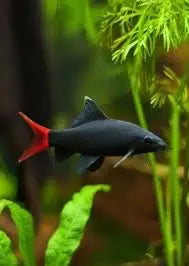
The Red Tail Shark (Epalzeorhynchos bicolor) is a bold freshwater fish known for its deep black body, bright red tail, and active personality. This eye-catching species is a favorite for aquarists who want a striking centerpiece fish with strong contrast and plenty of movement.
Native to Thailand, Red Tail Sharks are hardy and adaptable, but they can be territorial. They are best suited for larger freshwater aquariums with open swimming space, caves, driftwood, rocks, and defined territories.
Key Features
- Deep black body with bright red tail
- Bold centerpiece fish for larger aquariums
- Hardy and adaptable with proper care
- Active bottom to mid-level swimmer
- Long-lived freshwater fish when housed correctly
- Best kept singly in most aquariums
Care Guide
- Scientific Name: Epalzeorhynchos bicolor
- Common Name: Red Tail Shark
- Origin: Thailand
- Care Level: Easy to moderate
- Temperament: Semi-aggressive and territorial
- Adult Size: Up to approximately 6 inches
- Minimum Tank Size: 55 gallons or larger recommended
- Tank Level: Bottom to midwater
- Water Temperature: 72–79°F
- pH Range: 6.5–7.5
- Diet: Omnivore
- Lifespan: Approximately 5–8 years with proper care
Why Choose a Red Tail Shark?
Red Tail Sharks are a great choice for aquarists who want a dramatic freshwater fish with personality. Their jet-black body and vivid red tail create a strong visual contrast that stands out in planted tanks, rock layouts, and larger community aquariums.
They are active, curious fish that often patrol the lower areas of the aquarium. Because they can become territorial, they should be given enough space and should usually be kept one per tank unless the aquarium is very large and carefully planned.
Temperament Note
Red Tail Sharks are semi-aggressive and may claim caves, driftwood, or sections of the aquarium as their territory. They may chase similar-looking fish, other shark species, or bottom-dwelling tankmates if the aquarium is too small or lacks enough structure.
For best results, provide a 55 gallon or larger aquarium with hiding places, visual barriers, and compatible active tankmates.
Ideal Tank Setup
Red Tail Sharks do best in a stable, well-filtered freshwater aquarium with open swimming space and plenty of hiding areas. Driftwood, caves, rocks, plants, and decor help create territories and reduce stress.
A secure lid is recommended, and regular water changes help maintain good health and activity. Avoid overcrowding and avoid placing them in small aquariums where territorial behavior can become more intense.
Compatible Tankmates
- Larger barbs
- Rainbowfish
- Danios
- Peaceful cichlids with caution
- Active livebearers
- Loaches in larger aquariums with ample space
- Other active community fish that are not slow or delicate
Tankmates to Avoid
- Other Red Tail Sharks in most aquariums
- Other shark species
- Similar-looking bottom dwellers
- Very small nano fish
- Slow or long-finned fish
- Delicate or shy bottom-dwelling fish
- Aggressive predators
Diet & Feeding
Red Tail Sharks are omnivores and accept a variety of aquarium foods. Feed quality sinking pellets, algae wafers, flakes, frozen brine shrimp, bloodworms, daphnia, and vegetable-based foods.
They may graze on algae and biofilm, but they should not be relied on as a primary algae-control fish. A varied diet helps support healthy color, growth, and long-term condition.
Care Tips
- Keep one Red Tail Shark per aquarium in most setups
- Use a 55 gallon or larger aquarium
- Provide caves, driftwood, rocks, and hiding spots
- Avoid similar-looking fish and other shark species
- Choose active tankmates that can handle their personality
- Maintain clean, stable water with reliable filtration
Frequently Asked Questions
Can Red Tail Sharks be kept together?
Usually no. Red Tail Sharks are territorial and are typically best kept singly unless the aquarium is very large with multiple territories and careful planning.
Are Red Tail Sharks algae eaters?
They may graze on algae and biofilm, but they should not be relied on for algae control. They need a balanced omnivore diet.
Are Red Tail Sharks beginner-friendly?
They can be beginner-friendly for aquarists with a properly sized aquarium, stable water, hiding spots, and compatible tankmates.
How long do Red Tail Sharks live?
With proper care, Red Tail Sharks can live approximately 5–8 years.
Do Red Tail Sharks need hiding spots?
Yes. Caves, driftwood, rocks, and plants help reduce stress and give them defined territory.
How big do Red Tail Sharks get?
They can reach up to approximately 6 inches as adults.
Are these fish available for shipping?
No. Live fish are available for in-store purchase or local pickup only at Tropical Treasures Wyo in Cheyenne, Wyoming.
Available at Tropical Treasures Wyo
Red Tail Sharks are bold freshwater fish for larger community aquariums, planted tanks, and aquascapes with suitable tankmates. Visit Tropical Treasures Wyo in Cheyenne, Wyoming, to shop freshwater fish, centerpiece fish, algae grazers, live aquarium plants, fish food, filtration supplies, and aquarium care products. Live livestock is available for in-store purchase or local pickup only.
Explore More Aquarium Products:
Low stock: 4 left
Couldn't load pickup availability
Explore Related Aquarium Products: