
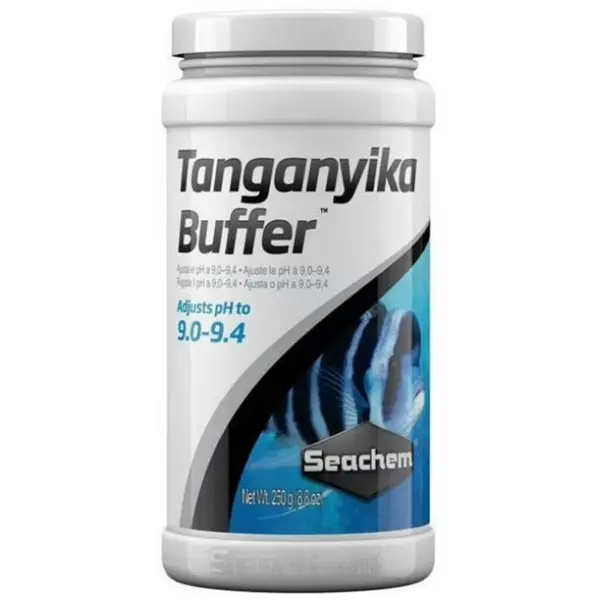
Seachem Tanganyika Buffer 250 g – Lake Tanganyika Cichlid pH & KH Buffer
Seachem Tanganyika Buffer 250 g is a concentrated carbonate buffer formulated to create and maintain the highly alkaline water conditions preferred by Lake Tanganyika cichlids. It raises pH, carbonate hardness, alkalinity, and buffering capacity, helping aquarium water resist sudden downward pH changes.
Tanganyika Buffer is designed to maintain aquarium pH between approximately 9.0 and 9.4, depending on the amount used and the chemistry of the source water. This specialized range makes it suitable for Tanganyikan cichlids and other freshwater species that naturally inhabit very alkaline environments.
Tanganyika Buffer does not increase general hardness. For a more complete replication of Lake Tanganyika mineral conditions, Seachem recommends using it with Cichlid Lake Salt, which supplies calcium, magnesium, potassium, and other mineral salts that contribute to GH.
Key Features
- Raises and Stabilizes pH: Formulated to maintain approximately 9.0–9.4
- Raises Carbonate Hardness: Increases KH and alkalinity to improve buffering capacity
- Helps Prevent pH Swings: Supports stable alkaline water conditions for sensitive Rift Lake species
- Lake Tanganyika Formula: Designed specifically for Tanganyikan cichlid aquariums
- Will Not Raise GH: Allows carbonate hardness and mineral hardness to be adjusted separately
- Concentrated Dry Powder: Economical for aquarium setup and recurring water changes
- Compatible with Cichlid Lake Salt: May be paired with a mineral supplement for more complete Tanganyika water preparation
- Flexible pH Control: May be combined with Malawi/Victoria Buffer when a lower alkaline pH is desired
Product Information
- Brand: Seachem
- Product: Tanganyika Buffer
- Size: 250 g
- Equivalent Weight: Approximately 8.8 oz
- Product Type: Freshwater carbonate alkalinity and pH buffer
- Form: Concentrated dry powder
- Target pH: Approximately 9.0–9.4
- Raises: pH, KH, alkalinity, and buffering capacity
- Effect on GH: Does not increase general hardness
- Standard Dose: 5 g per 10–20 US gallons
- Aquarium Type: Freshwater African cichlid aquariums
Best Used For
- Lake Tanganyika cichlid aquariums
- Frontosa aquariums
- Tropheus aquariums
- Shell-dwelling cichlid systems
- Julidochromis and Neolamprologus aquariums
- Altolamprologus aquariums
- Establishing high-pH Rift Lake conditions
- Increasing carbonate hardness and alkalinity
- Preparing RO or low-alkalinity water
- Maintaining stable chemistry during water changes
Directions for Use
Use 5 g, or one level teaspoon, for every 10–20 US gallons of water each day until the desired pH is reached and maintained.
After the target pH has been established, use Tanganyika Buffer as required to maintain it. Seachem states that maintenance dosing is usually needed no more than once every two to three weeks, although actual demand depends on aquarium conditions.
Dissolve the measured powder in freshwater before adding it to the aquarium. Add the prepared solution gradually to an area with strong water movement.
Test pH and KH before repeating a dose. Do not continue adding buffer merely because a fixed schedule has elapsed if the aquarium is already within the desired range.
Approximate Daily Dosage Guide
Seachem provides a dosage range of 5 g per 10–20 gallons. Use the lower concentration for gradual adjustments and the stronger concentration when source water has very little alkalinity and testing confirms that a larger increase is appropriate.
- 10-Gallon Aquarium: Approximately 2.5–5 g
- 20-Gallon Aquarium: Approximately 5–10 g
- 30-Gallon Aquarium: Approximately 7.5–15 g
- 40-Gallon Aquarium: Approximately 10–20 g
- 55-Gallon Aquarium: Approximately 13.75–27.5 g
- 75-Gallon Aquarium: Approximately 18.75–37.5 g
- 100-Gallon Aquarium: Approximately 25–50 g
- 125-Gallon Aquarium: Approximately 31.25–62.5 g
- 150-Gallon Aquarium: Approximately 37.5–75 g
These amounts are proportional calculations based on the official dosing range. Actual dosing should be determined through pH and KH testing rather than aquarium size alone.
How Much Water Does the 250 g Container Treat?
A 250 g container provides approximately 50 individual 5 g doses.
- At 5 g per 10 gallons: Treats approximately 500 gallons
- At 5 g per 20 gallons: Treats approximately 1,000 gallons
The package does not treat 2,000 gallons at Seachem’s official standard dosage. Long-term capacity varies because initial adjustment may require daily treatment, while maintenance dosing is usually less frequent.
How Tanganyika Buffer Works
Biological activity, fish respiration, decomposing organic matter, and acids produced during the nitrogen cycle can gradually lower aquarium pH. Water with insufficient carbonate hardness has little ability to resist these changes.
Tanganyika Buffer contains carbonate salts that increase alkalinity and KH. Higher alkalinity improves the water’s capacity to neutralize acids, helping maintain the strongly alkaline conditions associated with Lake Tanganyika.
The final pH depends on the starting KH, existing buffers, source-water chemistry, substrate, decorations, carbon dioxide, biological load, and amount of product used.
Target pH
Seachem formulates Tanganyika Buffer to maintain pH between approximately 9.0 and 9.4.
The product will not necessarily force every aquarium to exactly the same pH. Existing minerals, carbonate substrates, untreated hard tap water, and other buffers can affect the final result.
Adjust gradually and prioritize a stable pH appropriate for the fish rather than repeatedly adding product to chase one exact number.
Does Tanganyika Buffer Raise KH?
Yes. Tanganyika Buffer increases carbonate hardness, alkalinity, and buffer capacity.
KH describes the concentration of carbonate and bicarbonate compounds that help aquarium water resist pH changes. A suitable KH is essential for maintaining the high pH required by many Tanganyikan cichlids.
Test KH regularly because excessive dosing can produce a much higher alkalinity than intended.
Does Tanganyika Buffer Raise GH?
No. Seachem specifically states that Tanganyika Buffer will not affect general hardness.
GH represents dissolved calcium and magnesium hardness. Tanganyika Buffer supplies carbonate buffering but is not intended to supply the complete mineral profile required for Lake Tanganyika water.
Use Seachem Cichlid Lake Salt when calcium, magnesium, potassium, and other mineral salts need to be added.
Tanganyika Buffer and Cichlid Lake Salt
Seachem recommends using Tanganyika Buffer with Cichlid Lake Salt for more complete replication of Tanganyikan water conditions.
- Tanganyika Buffer: Adjusts pH, KH, alkalinity, and buffering capacity
- Cichlid Lake Salt: Increases GH and supplies important mineral salts
When using both products, Seachem recommends adding Cichlid Lake Salt before Tanganyika Buffer.
Dissolve each product separately in freshwater. Do not combine concentrated dry powders in a small amount of water before they are fully dissolved.
Recommended Tanganyika GH Range
When Cichlid Lake Salt is used to establish mineral hardness, Seachem recommends a Tanganyika GH range of approximately:
- 3–5.5 meq/L
- Approximately 8–14 dGH
Tanganyika Buffer alone will not establish this GH range. Test GH separately and adjust it with an appropriate mineral supplement.
Using Tanganyika Buffer with RO or DI Water
RO and DI water contain very little carbonate hardness or mineral content, making them useful starting points for controlled Rift Lake water preparation.
However, both KH and GH must normally be restored:
- Add Cichlid Lake Salt to establish the desired GH.
- Mix thoroughly until dissolved.
- Add Tanganyika Buffer to raise KH and pH.
- Circulate and aerate the water.
- Test GH, KH, pH, and temperature before use.
Pure RO or DI water should not be used for Tanganyikan cichlids without appropriate remineralization and buffering.
Using Tanganyika Buffer with Tap Water
Tanganyika Buffer may be used with tap water, but the starting pH and KH must be tested first.
Hard, alkaline tap water may already contain significant carbonate hardness. Adding the full label dose without testing may raise KH or pH beyond the desired range.
When tap water already provides part of the required alkalinity, use a reduced dose based on test results.
Preparing Water for a Water Change
- Measure the volume of replacement water.
- Condition chlorine or chloramine when tap water is used.
- Add Cichlid Lake Salt when GH adjustment is required.
- Mix until the mineral salts are dissolved.
- Dissolve the calculated amount of Tanganyika Buffer separately.
- Add the buffer to the replacement water.
- Circulate and aerate thoroughly.
- Test pH, KH, GH, and temperature.
- Adjust gradually before adding the water to the aquarium.
Matching replacement water to the aquarium before the water change helps reduce sudden chemical changes and stress.
Should Tanganyika Buffer Be Added for Evaporation?
Usually no. Carbonate salts and minerals do not evaporate with water. When aquarium water evaporates, dissolved substances remain behind.
Routine evaporation should generally be replaced with plain conditioned freshwater or appropriately prepared RO water.
Add Tanganyika Buffer to top-off water only when testing confirms that KH or pH has declined and a calculated correction is required. Automatic buffering of every top-off may cause alkalinity to rise over time.
Tanganyika Buffer vs. Malawi/Victoria Buffer
- Tanganyika Buffer: Maintains approximately pH 9.0–9.4
- Malawi/Victoria Buffer: Maintains approximately pH 7.8–8.4
Use Tanganyika Buffer for species requiring the highest Rift Lake pH range. Use Malawi/Victoria Buffer for Lake Malawi and Lake Victoria aquariums or when a lower alkaline range is appropriate.
The two buffers may be combined when an intermediate pH is desired, but changes should be guided by repeated testing.
Can It Be Used for Non-Cichlid Fish?
Tanganyika Buffer may be used only for freshwater species that genuinely require very alkaline, strongly buffered water.
It is not suitable for most community fish, South American cichlids, discus, most tetras, rasboras, loaches, or other soft-water species.
Research the natural water requirements of every species before using a buffer designed to maintain pH as high as 9.0–9.4.
Is Tanganyika Buffer Suitable for All African Cichlids?
No. African cichlids come from several lakes and river systems with different water chemistry.
Tanganyika Buffer is intended primarily for Lake Tanganyika species. Lake Malawi and Lake Victoria species generally require a lower pH range and are better matched with Malawi/Victoria Buffer.
Do not assume that every fish sold as an “African cichlid” requires Tanganyika chemistry.
Substrate and Rock Considerations
Aragonite, crushed coral, limestone, coral sand, and certain decorative rocks may already increase KH and pH.
When these materials are present, the aquarium may require less Tanganyika Buffer. Test regularly and adjust dosing rather than following the maximum label amount automatically.
Acidic substrates, driftwood, accumulated organic waste, and elevated carbon dioxide may push pH downward and increase buffer demand.
Dosing Tips
- Test pH and KH before every major adjustment
- Use 5 g per 10–20 gallons as the official dosing range
- Dissolve the powder in freshwater before use
- Begin with the lower dose when source-water chemistry is unknown
- Adjust pH gradually over several days
- Use Cichlid Lake Salt separately when GH needs to be raised
- Add Cichlid Lake Salt before Tanganyika Buffer
- Calculate water-change dosing from the replacement-water volume
- Do not automatically add buffer to evaporation top-off water
- Keep a written water-preparation recipe for consistent results
Important Aquarium Care Note
Tanganyika Buffer raises pH and carbonate alkalinity but does not establish general hardness. A complete Tanganyika water-preparation routine may require Cichlid Lake Salt or another appropriate GH remineralizer.
Rapid pH or KH changes can stress or kill aquarium fish. Never add a large unmeasured dose directly to an occupied aquarium in an attempt to correct pH immediately.
High pH increases the proportion of toxic free ammonia present in aquarium water. Maintain a fully cycled biological filter and test ammonia whenever fish appear stressed.
Tanganyika Buffer does not remove chlorine, chloramine, ammonia, nitrite, nitrate, or organic waste. It does not replace water conditioning, aquarium cycling, filtration, water changes, or regular testing.
Frequently Asked Questions
What is Seachem Tanganyika Buffer used for?
Tanganyika Buffer raises pH, carbonate hardness, alkalinity, and buffering capacity for Lake Tanganyika cichlid aquariums.
What pH does Tanganyika Buffer maintain?
It is formulated to maintain approximately pH 9.0–9.4, depending on dosage and source-water chemistry.
How much Tanganyika Buffer should I use?
Use 5 g, or one level teaspoon, for every 10–20 US gallons daily until the desired pH is established.
Is one teaspoon equal to 7 g?
No. Seachem identifies one level teaspoon of Tanganyika Buffer as approximately 5 g.
How often should it be used after the target pH is reached?
Use it as required to maintain pH, usually no more than once every two to three weeks.
Does Tanganyika Buffer raise KH?
Yes. It raises carbonate hardness, alkalinity, and buffering capacity.
Does Tanganyika Buffer raise GH?
No. Seachem states that it will not affect general hardness.
What should I use to raise GH?
Use Seachem Cichlid Lake Salt or another appropriate Rift Lake mineral supplement.
Should Cichlid Lake Salt or Tanganyika Buffer be added first?
Seachem recommends adding Cichlid Lake Salt first and Tanganyika Buffer afterward.
How many gallons does the 250 g container treat?
It treats approximately 500–1,000 gallons per application, depending on whether 5 g is used per 10 or 20 gallons.
Does the 250 g container treat 2,000 gallons?
Not at the official dosing range. The approximate treatment capacity is 500–1,000 gallons per standard application.
Should Tanganyika Buffer be dissolved before use?
Yes. Seachem recommends dissolving it in freshwater before adding it to the aquarium.
Can it be used with tap water?
Yes, but test the tap water first because existing KH and pH will influence the required dose.
Can it be used with RO water?
Yes, but RO water also requires mineral remineralization. Use Cichlid Lake Salt to establish GH and Tanganyika Buffer to establish KH and pH.
Can Tanganyika Buffer be used for Malawi cichlids?
Malawi/Victoria Buffer is generally more suitable because it maintains the lower pH range preferred by Lake Malawi and Victoria species.
Can the two cichlid buffers be mixed?
Yes. Seachem states that Malawi/Victoria Buffer may be used alone or with Tanganyika Buffer to create a lower intermediate pH.
Can Tanganyika Buffer be overdosed?
Yes. Excessive use may raise pH and KH beyond the appropriate range. Test regularly and adjust gradually.
Does Tanganyika Buffer remove ammonia?
No. It is a pH and alkalinity buffer. Use proper biological filtration, water changes, and an appropriate conditioner for ammonia emergencies.
Does it replace water changes?
No. Tanganyika Buffer adjusts water chemistry but does not remove nitrate, dissolved waste, or accumulated contaminants.
Available at Tropical Treasures Wyo
Seachem Tanganyika Buffer 250 g raises and stabilizes pH and carbonate hardness for Lake Tanganyika cichlids while allowing general hardness to be adjusted separately with Cichlid Lake Salt.
Visit Tropical Treasures Wyo in Cheyenne, Wyoming, to shop Seachem Tanganyika Buffer, Cichlid Lake Salt, Cichlid Trace, African cichlid foods, water test kits, aquarium substrates, and Rift Lake aquarium supplies.
Explore More Aquarium Products:
Low stock: 2 left
Couldn't load pickup availability
Explore Related Aquarium Products: