
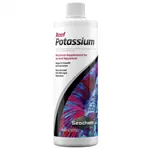
Seachem Reef Potassium 250 mL – Concentrated Potassium Supplement for Reef Aquariums
Seachem Reef Potassium 250 mL is a concentrated potassium supplement formulated specifically for saltwater reef aquariums. It provides 100,000 mg/L of elemental potassium, allowing reef keepers to restore and maintain potassium without intentionally adding phosphate or dissolved organic nutrients.
Potassium is an essential major element involved in coral and macroalgae metabolism, protein synthesis, tissue development, and normal growth. It is also commonly associated with the development of red and pink coloration in many corals when all other nutritional and environmental requirements are properly balanced.
In actively growing reef aquariums, potassium may be consumed by corals, macroalgae, bacteria, and other organisms. Reef Potassium provides a targeted way to replenish that consumption without increasing nitrogen or phosphorus at the same time.
Key Features
- Concentrated Potassium Supplement: Contains 100,000 mg/L of elemental potassium
- Supports Coral Metabolism: Supplies potassium required for protein synthesis, cellular function, and normal growth
- Supports Macroalgae Growth: Helps maintain potassium availability in refugiums and ornamental macroalgae systems
- May Support Coral Coloration: Adequate potassium may contribute to normal red and pink coloration in some corals
- No Added Phosphate: Allows potassium to be adjusted independently from phosphorus
- No Added Dissolved Organics: Provides a direct inorganic potassium source without increasing feeding or organic waste
- Manual or Automated Dosing: Suitable for careful hand dosing or use with an appropriate aquarium dosing pump
- Convenient 250 mL Bottle: Well suited for nano, small, and medium reef aquariums
Product Information
- Brand: Seachem
- Product: Reef Potassium
- Size: 250 mL
- Equivalent Size: Approximately 8.5 fl oz
- Product Type: Reef aquarium potassium supplement
- Elemental Potassium Concentration: 100,000 mg/L
- Elemental Potassium: 10%
- Soluble Potash: 12.07% K2O equivalent
- Potassium Source: Potassium chloride
- Aquarium Type: Saltwater and reef aquariums
- Beginner Dosage: 5 mL per 40 US gallons twice weekly
- Increase per Standard Dose: Approximately 3 mg/L potassium
- General Target Range: Approximately 380–400 mg/L potassium
Best Used For
- SPS coral aquariums
- LPS coral aquariums
- Mixed reef systems
- Soft-coral aquariums
- Reef aquariums with measurable potassium depletion
- Macroalgae refugiums
- Ornamental marine macroalgae displays
- Systems receiving nitrogen and phosphorus supplementation
- Reef aquariums with high coral biomass
- Controlled supplementation using a dosing pump
Beginner Directions
Add one capful, or 5 mL, of Seachem Reef Potassium for every 40 US gallons of aquarium water twice per week or as needed to maintain the desired potassium concentration.
Add the measured dose to an area with strong water movement so it disperses throughout the aquarium. Avoid pouring concentrated supplement directly onto coral tissue or other livestock.
Test potassium regularly while establishing a supplementation routine. Adjust the amount or frequency according to the aquarium’s measured potassium consumption rather than continuing to dose automatically.
Approximate Beginner Dosage Guide
- 5-Gallon Aquarium: Approximately 0.6 mL twice weekly
- 10-Gallon Aquarium: Approximately 1.25 mL twice weekly
- 20-Gallon Aquarium: Approximately 2.5 mL twice weekly
- 30-Gallon Aquarium: Approximately 3.75 mL twice weekly
- 40-Gallon Aquarium: 5 mL twice weekly
- 55-Gallon Aquarium: Approximately 6.9 mL twice weekly
- 75-Gallon Aquarium: Approximately 9.4 mL twice weekly
- 100-Gallon Aquarium: Approximately 12.5 mL twice weekly
- 125-Gallon Aquarium: Approximately 15.6 mL twice weekly
- 150-Gallon Aquarium: Approximately 18.75 mL twice weekly
These amounts are proportional calculations based on Seachem’s standard dosage. Calculate the dose using the aquarium’s estimated actual water volume after accounting for live rock, sand, decorations, sump equipment, and other displacement.
How Much Potassium Does One Dose Add?
The standard dose of 5 mL per 40 gallons raises potassium by approximately 3 mg/L, also expressed as 3 ppm.
The original estimate of 1 mL per 25 gallons raising potassium by 4 ppm is incorrect. That amount would produce a much smaller increase because Reef Potassium’s official standard dose is 5 mL per 40 gallons for a 3 ppm increase.
Recommended Potassium Range
Seachem states that ideal potassium levels vary among reef aquariums but generally range from approximately 380 to 400 mg/L.
The best target may depend on:
- The salt mix being used
- Coral species and biomass
- Macroalgae growth
- Water-change frequency
- Use of nitrogen and phosphorus supplements
- Nutrient-export methods
- Existing potassium concentration
Do not increase potassium simply to reach the highest possible number. Select a reasonable target and prioritize stability rather than frequent large adjustments.
Advanced Dosing Formula
To calculate the amount of Reef Potassium needed for a specific increase, use Seachem’s formula:
0.01 × v × n = m
- v: Aquarium water volume in liters
- n: Desired potassium increase in mg/L
- m: Reef Potassium dose in milliliters
For example, raising 160 liters of aquarium water by 3 mg/L requires approximately 5 mL:
0.01 × 160 × 3 = 4.8 mL
This rounds to approximately 5 mL, matching Seachem’s standard beginner dose for about 40 gallons.
Correcting Low Potassium
When testing confirms that potassium is below the selected target, increase it gradually over several days rather than making one large correction.
Potassium may initially remain low despite dosing because corals, macroalgae, bacteria, and other organisms can consume the added potassium quickly. Continue testing until a consistent dosing routine maintains the desired concentration.
Avoid adding repeated large doses because the test result does not rise immediately. Confirm the aquarium’s actual water volume, review the test procedure, and allow the supplement to circulate before retesting.
Why Potassium Is Important
Potassium is involved in numerous biological processes within corals, macroalgae, bacteria, and other marine organisms. These processes include:
- Protein synthesis
- Cellular metabolism
- Enzyme activity
- Ion transport
- Osmotic regulation
- Tissue development
- Coral and macroalgae growth
Because potassium is required throughout normal biological activity, an aquarium with sustained growth may gradually consume it between water changes.
Potassium and Coral Coloration
Adequate potassium availability may support normal coral pigmentation, particularly red and pink coloration in some species. However, Reef Potassium should not be marketed as a guaranteed coral-color enhancer.
Coral coloration is also influenced by:
- Coral genetics
- Lighting spectrum and intensity
- Nitrate and phosphate availability
- Feeding and amino-acid availability
- Alkalinity stability
- Trace-element balance
- Temperature and salinity
- Water flow
- Stress, pests, and disease
Adding more potassium will not correct pale or faded corals caused by excessive lighting, nutrient starvation, unstable alkalinity, poor water quality, or coral-health problems.
Potassium and SPS Corals
SPS-dominant aquariums may have greater potassium demand because of their high coral biomass, rapid tissue growth, and intensive supplementation routines.
Reef Potassium may be useful in these systems when testing confirms that potassium is declining below the selected range. It should not be added automatically simply because SPS corals are present.
Test first and adjust gradually. Stability is especially important for sensitive SPS species.
Potassium and Macroalgae
Macroalgae require potassium for normal metabolism, protein synthesis, and growth. Systems with large refugiums, algae scrubbers, or ornamental macroalgae displays may consume potassium more rapidly than expected.
Potassium supplementation may become particularly relevant when nitrogen and phosphorus are being supplied because increased macroalgae growth can also increase potassium consumption.
Reef Potassium does not supply nitrogen, phosphorus, iron, or other nutrients that macroalgae may require. Each nutrient should be evaluated separately.
Using Reef Potassium with Reef Nitrogen and Reef Phosphorus
Seachem Reef Nitrogen, Reef Phosphorus, and Reef Potassium may be used as a targeted NPK supplementation system for reef aquariums and macroalgae systems.
- Reef Nitrogen: Supplies testable nitrogen
- Reef Phosphorus: Supplies controlled phosphorus
- Reef Potassium: Supplies concentrated elemental potassium
Do not automatically dose all three products in equal amounts. Nitrogen, phosphorus, and potassium are consumed at different rates and must be adjusted according to separate testing and aquarium demand.
Reef Potassium vs. Reef Pack NPK
Reef Potassium is sold as an individual supplement for reef keepers who need to adjust potassium independently.
Seachem Reef Pack NPK includes Reef Nitrogen, Reef Phosphorus, and Reef Potassium together. The individual 250 mL bottle may be preferable when:
- Only potassium is deficient
- The aquarium consumes potassium faster than nitrogen or phosphorus
- A larger replacement bottle is needed
- The reef keeper already owns the other NPK products
Do Water Changes Replace Potassium?
Water changes may replenish potassium when the new saltwater contains an appropriate potassium concentration. The amount replaced depends on the salt mix, mixing procedure, salinity, and volume of the water change.
Water changes do not inherently deplete potassium. However, normal biological consumption between water changes may exceed the amount being replaced, especially in heavily stocked coral or macroalgae systems.
Test the aquarium and newly mixed saltwater before assuming that supplementation is required.
Reef Potassium and Algae
Potassium is used by desirable macroalgae as well as nuisance algae. Excessive supplementation may support unwanted algae when nitrogen, phosphorus, lighting, and other conditions are also favorable.
Reef Potassium does not intentionally add nitrogen, phosphate, or dissolved organic matter, but it can still contribute to nutrient imbalance when overdosed.
If unwanted algae increases after beginning supplementation, test potassium, nitrate, and phosphate and review the aquarium’s lighting and maintenance routine.
Using Reef Potassium with a Dosing Pump
Reef Potassium may be used with a properly configured aquarium dosing pump. Use a clean, dedicated reservoir, dosing-pump channel, tube, and outlet.
Determine the aquarium’s average potassium consumption before programming a permanent schedule. Test potassium consistently over several days and calculate the amount needed to replace the measured decline.
Dividing the required weekly amount into smaller daily additions may help maintain a more stable concentration.
Do not combine Reef Potassium with other concentrated supplements in the same reservoir unless the manufacturer has specifically confirmed compatibility.
Testing Potassium
A marine potassium test kit is strongly recommended for long-term or advanced supplementation. Potassium is already present at a high concentration in natural seawater, so a reliable marine-specific test is needed to identify relatively small changes.
Test potassium before the first dose and regularly while establishing the aquarium’s consumption rate. Use the same test method, lighting conditions, sample volume, and timing whenever possible.
If a result appears unexpectedly high or low, repeat the test before making a major correction.
Dosing Tips
- Test potassium before establishing a supplementation routine
- Use 5 mL per 40 gallons twice weekly as the beginner dose
- Calculate dosing from actual aquarium water volume
- Use a dosing syringe for nano aquariums
- Add the supplement to an area with strong water movement
- Raise low potassium gradually over several days
- Do not automatically dose nitrogen and phosphorus with potassium
- Test newly mixed saltwater to determine how much potassium water changes supply
- Recalculate demand as coral and macroalgae biomass increases
- Keep a written record of doses and test results
Important Reef Aquarium Note
Reef Potassium should be used when aquarium testing or a carefully established dosing history indicates a need for additional potassium.
It is not a medication or a guaranteed solution for pale corals, weak growth, tissue loss, poor polyp extension, or faded coloration. These symptoms may have many causes unrelated to potassium.
Excess potassium may create an unsuitable ionic balance or contribute to stress and unwanted algae growth. More supplement does not necessarily produce faster coral growth or stronger coloration.
Healthy reef aquariums depend on balanced potassium, calcium, alkalinity, magnesium, nitrate, phosphate, salinity, temperature, lighting, water movement, feeding, and overall stability.
Reef Potassium does not replace water changes, accurate testing, filtration, protein-skimmer maintenance, appropriate feeding, or complete reef aquarium husbandry.
Frequently Asked Questions
What is Seachem Reef Potassium used for?
Reef Potassium supplies concentrated elemental potassium for reef aquariums containing corals, macroalgae, and other organisms that consume potassium.
How concentrated is Reef Potassium?
It contains 100,000 mg/L, or 10%, elemental potassium.
What is the potassium source?
The potassium is derived from potassium chloride.
How much Reef Potassium should I use?
The beginner dosage is 5 mL for every 40 US gallons twice weekly or as needed to maintain the desired potassium level.
How much does the standard dose raise potassium?
A 5 mL dose per 40 gallons raises potassium by approximately 3 mg/L, or 3 ppm.
Does 1 mL per 25 gallons raise potassium by 4 ppm?
No. Seachem’s official standard dose is 5 mL per 40 gallons, and that amount raises potassium by approximately 3 ppm.
What potassium level should I maintain?
Seachem states that ideal levels vary but generally range from approximately 380 to 400 mg/L.
Why is potassium important in a reef aquarium?
Potassium is involved in metabolic processes, protein synthesis, cellular function, and normal coral and macroalgae growth.
Does Reef Potassium improve coral coloration?
Adequate potassium may support normal coral coloration, particularly red and pink pigments in some corals, but color also depends on lighting, nutrients, genetics, and overall aquarium stability.
Is Reef Potassium only for SPS corals?
No. It may be used in SPS, LPS, soft-coral, mixed reef, and macroalgae systems when additional potassium is needed.
Is Reef Potassium useful for macroalgae?
Yes. Macroalgae use potassium for normal metabolism, protein synthesis, and growth.
Do regular water changes provide potassium?
They may replenish potassium depending on the salt mix and water-change volume. Test the aquarium and newly mixed saltwater before adding a supplement.
Can Reef Potassium be used with Reef Nitrogen and Reef Phosphorus?
Yes, but each nutrient should be dosed according to separate testing rather than automatically adding equal quantities.
Does Reef Potassium contain nitrate or phosphate?
No. It provides potassium without intentionally adding nitrogen, phosphate, or dissolved organic nutrients.
Can Reef Potassium cause algae?
Excess potassium may support algae when other nutrients and lighting are also favorable. Test and avoid unnecessary dosing.
Can potassium be overdosed?
Yes. Excessive supplementation may create an unsuitable ionic balance or stress aquarium livestock.
Do I need a potassium test kit?
Testing is strongly recommended for long-term supplementation, major corrections, or systems receiving automated doses.
Can Reef Potassium be used with a dosing pump?
Yes. Use a dedicated reservoir and determine the aquarium’s potassium consumption before programming the dosing schedule.
Is Reef Potassium safe for mixed reef aquariums?
It is formulated for reef aquariums and may be used in mixed systems when dosed according to testing and the manufacturer’s directions.
Does Reef Potassium replace water changes?
No. It supplements potassium but does not replace water changes, testing, feeding, filtration, or complete reef aquarium maintenance.
Available at Tropical Treasures Wyo
Seachem Reef Potassium 250 mL provides concentrated elemental potassium for SPS, LPS, soft-coral, mixed reef, and macroalgae aquariums. It allows potassium to be adjusted without intentionally adding nitrogen, phosphate, or dissolved organic waste.
Visit Tropical Treasures Wyo in Cheyenne, Wyoming, to shop Seachem reef supplements, potassium test kits, calcium and alkalinity products, dosing equipment, coral foods, marine filtration, and saltwater aquarium care essentials.
Explore More Aquarium Products:
Low stock: 2 left
Couldn't load pickup availability
Explore Related Aquarium Products: