
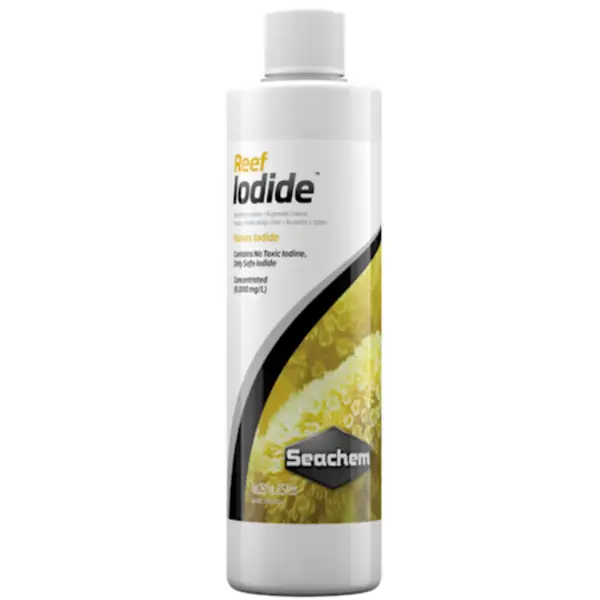
Seachem Reef Iodide 250 mL – Stabilized Iodide Supplement for Reef Aquariums
Seachem Reef Iodide 250 mL is a concentrated, stabilized potassium iodide supplement formulated for saltwater reef aquariums. It provides iodide in a bioavailable form used by many marine invertebrates and soft corals for normal soft-tissue development and biological processes.
Reef Iodide contains 8,000 mg/L of iodide and is complexed with a stabilizing compound that helps keep it in the iodide form after it is added to aquarium water. This helps prevent rapid conversion into less useful or potentially harmful iodine forms.
The 250 mL bottle is well suited for nano, small, and medium reef aquariums, including systems containing soft corals, gorgonians, crustaceans, and other marine invertebrates.
Key Features
- Stabilized Potassium Iodide: Supplies iodide in a stabilized, bioavailable form
- Highly Concentrated: Contains 8,000 mg/L of iodide
- Supports Soft-Tissue Growth: Provides an important trace element used by many marine invertebrates and soft corals
- Reef Aquarium Formula: Developed specifically for saltwater reef systems
- Remains in the Iodide Form: Complexed to reduce conversion into elemental iodine or iodate
- No Lugol’s Solution: Does not use the highly concentrated iodine-and-iodide mixture found in Lugol’s products
- Flexible Dosing: Suitable for beginner maintenance dosing or test-based advanced supplementation
- Convenient 250 mL Bottle: Ideal for nano to medium reef aquariums
Product Information
- Brand: Seachem
- Product: Reef Iodide
- Size: 250 mL
- Equivalent Size: Approximately 8.5 fl oz
- Product Type: Stabilized reef aquarium iodide supplement
- Iodide Source: Potassium iodide
- Iodide Concentration: 8,000 mg/L
- Aquarium Type: Saltwater and reef aquariums
- Beginner Dosage: 5 mL per 50 US gallons every other day
- Recommended Iodide Range: Approximately 0.06–0.08 mg/L
Best Used For
- Soft-coral reef aquariums
- Gorgonian aquariums
- Sarcophyton and leather coral systems
- Mixed reef aquariums
- Marine crustaceans and other invertebrates
- Reef aquariums with measurable iodide depletion
- Systems using protein skimming and chemical filtration
- Routine test-based trace-element supplementation
- Nano and medium reef aquariums
Beginner Directions
Add one capful, or 5 mL, of Seachem Reef Iodide for every 50 US gallons of aquarium water every other day.
Add the supplement to an area with good water movement so it disperses quickly throughout the aquarium. Avoid pouring concentrated product directly onto corals or other livestock.
Calculate dosage from the aquarium’s estimated actual water volume after accounting for live rock, sand, decorations, and equipment displacement.
Approximate Beginner Dosage Guide
- 5-Gallon Aquarium: Approximately 0.5 mL every other day
- 10-Gallon Aquarium: Approximately 1 mL every other day
- 20-Gallon Aquarium: Approximately 2 mL every other day
- 30-Gallon Aquarium: Approximately 3 mL every other day
- 40-Gallon Aquarium: Approximately 4 mL every other day
- 50-Gallon Aquarium: 5 mL every other day
- 75-Gallon Aquarium: Approximately 7.5 mL every other day
- 100-Gallon Aquarium: 10 mL every other day
- 125-Gallon Aquarium: Approximately 12.5 mL every other day
- 150-Gallon Aquarium: Approximately 15 mL every other day
These amounts are proportional calculations based on Seachem’s beginner directions. Use a dosing syringe for small aquariums and amounts below one capful.
Advanced Dosing
Add 1 mL of Reef Iodide for every 20 US gallons daily. This raises iodide by approximately 0.10 mg/L.
Test iodide 6–12 hours after the most recent dose. Adjust the amount so that iodide measures approximately 0.06–0.08 mg/L during that testing window.
Once the aquarium’s daily iodide requirement has been established, continue the calculated amount and test iodide approximately twice per month.
Why Iodide Is Used in Reef Aquariums
Iodide is used by many reef invertebrates and soft corals. It is particularly associated with soft-tissue growth in organisms such as gorgonians, leather corals, and other soft-coral species.
Iodide can become depleted through biological uptake and chemical reactions within the aquarium. Protein skimming, activated carbon, water changes, livestock growth, and other aquarium processes may also influence the amount that remains available.
Because iodide is needed only in trace quantities, supplementation should remain conservative and preferably be guided by testing.
Iodide, Iodine & Iodate
The terms iodide, iodine, and iodate describe different chemical forms and should not be treated as interchangeable.
- Iodide: The form Seachem identifies as available for coral uptake
- Elemental Iodine: A reactive, biocidal form that can be toxic to reef organisms
- Iodate: A form Seachem states is not useful to corals and may become harmful at elevated concentrations
Reef Iodide is stabilized to help it remain in the iodide form rather than rapidly converting into elemental iodine or iodate.
Reef Iodide vs. Lugol’s Solution
Reef Iodide is not Lugol’s Solution. Lugol’s is a concentrated mixture of iodine and iodide traditionally used as a disinfectant.
Seachem advises against routine Lugol’s-style iodine dosing in a reef aquarium because elemental iodine is highly reactive and potentially toxic. Reef Iodide instead supplies stabilized potassium iodide without adding free elemental iodine.
Do not use Reef Iodide as a coral disinfectant or dip. Seachem Reef Dip is a separate product specifically formulated for external coral dipping procedures.
Testing Iodide
Long-term iodide supplementation is best managed with a test kit capable of measuring iodide at low marine concentrations.
Seachem recommends testing for an iodide concentration of approximately 0.06–0.08 mg/L, measured 6–12 hours after dosing.
Iodide levels may decline within a few days because of biological use and chemical depletion. A low reading does not automatically mean a large dose should be added. Review the dose, timing of the test, aquarium volume, and test-kit procedure before making a correction.
Reef Iodide & Coral Coloration
Adequate trace-element availability may help support normal coral health and tissue condition, but Reef Iodide should not be presented as a guaranteed coral-color enhancer.
Coral coloration is also influenced by genetics, lighting, nutrient levels, feeding, water flow, trace-element balance, stress, and aquarium stability.
Adding extra iodide will not correct poor coloration caused by inappropriate lighting, unstable alkalinity, excessive nutrients, starvation, pests, or disease.
Reef Iodide & Crustaceans
Marine shrimp, crabs, and other crustaceans require a suitable trace-element environment as part of their normal biology. However, iodide should not be marketed as a stand-alone treatment for failed molts or molting problems.
Molting success also depends on salinity, temperature, nutrition, water quality, mineral balance, species requirements, and the overall health of the animal.
Do not increase Reef Iodide dosing solely because a shrimp or crab is experiencing difficulty molting. Test the aquarium and investigate the complete environment.
Using Reef Iodide with Other Supplements
Reef Iodide may be incorporated into a broader reef supplementation program that includes calcium, alkalinity, magnesium, strontium, vitamins, and other trace elements.
Account for iodide supplied by every product in the routine. Reef Trace, Reef Plus, salt mixes, foods, and other supplements may already contribute iodine-related compounds.
Avoid automatically dosing multiple trace-element products at their maximum label amounts without testing or evaluating the aquarium’s livestock demand.
Using Reef Iodide with Reef Trace
Seachem Reef Trace provides a blend of trace elements formulated for corals and other reef invertebrates. Reef Iodide is a targeted supplement used specifically to maintain iodide.
The products may be included in the same reef-care routine, but review every source of trace elements and avoid unnecessary overlap.
Using Reef Iodide with Reef Plus
Reef Plus supplies vitamins, amino acids, fatty acids, and other nutritional components for reef aquariums. Reef Iodide provides stabilized potassium iodide.
Both products may be used when appropriate, but dosing should be based on aquarium demand rather than the assumption that every reef system requires every available supplement.
Dosing Tips
- Calculate dosing from actual aquarium water volume
- Use a syringe for small or precise doses
- Add the product to an area with good water movement
- Do not pour concentrated supplement directly onto corals
- Test iodide during long-term supplementation
- Test 6–12 hours after dosing for advanced control
- Track all products that may contribute iodine or iodide
- Do not use Lugol’s dosing instructions for Reef Iodide
- Do not use Reef Iodide as a coral dip
- Keep a written record of dosage and test results
Important Reef Aquarium Note
Iodide is required only in trace quantities. Excess supplementation may be harmful to corals, crustaceans, and other aquarium livestock.
Do not dose more simply because iodide is depleted quickly. Determine aquarium demand through conservative dosing, consistent testing, and observation.
Reef Iodide is not a medication, coral disinfectant, parasite treatment, or cure for tissue loss, failed molts, bleaching, or poor coral coloration.
Healthy reef aquariums also depend on stable salinity, temperature, alkalinity, calcium, magnesium, nutrients, lighting, water flow, feeding, and regular maintenance.
Frequently Asked Questions
What is Seachem Reef Iodide used for?
Reef Iodide supplies stabilized, bioavailable iodide for marine invertebrates and many soft corals in reef aquariums.
How concentrated is Reef Iodide?
It contains 8,000 mg/L of stabilized iodide derived from potassium iodide.
How much Reef Iodide should I use?
The beginner dose is 5 mL for every 50 US gallons every other day.
Is the official dosage twice per week?
No. Seachem’s beginner directions specify one 5 mL dose per 50 gallons every other day.
What iodide level should I maintain?
For advanced dosing, Seachem recommends approximately 0.06–0.08 mg/L when tested 6–12 hours after the latest dose.
What is the difference between iodide and iodine?
Iodide is the form Seachem identifies as bioavailable to corals. Elemental iodine is highly reactive and can be toxic to reef organisms.
Does Reef Iodide contain elemental iodine?
No. It supplies stabilized potassium iodide and is formulated not to convert into toxic free iodine under normal storage or reef conditions.
Is Reef Iodide the same as Lugol’s Solution?
No. Lugol’s is a highly concentrated iodine-and-iodide disinfectant solution. Reef Iodide is a stabilized potassium iodide supplement.
Can Reef Iodide be used as a coral dip?
No. Use a product specifically formulated for coral dipping, such as Seachem Reef Dip.
Does Reef Iodide improve coral coloration?
It supports appropriate iodide availability, but coral color also depends on lighting, nutrients, genetics, feeding, stress, and overall aquarium stability.
Is Reef Iodide useful for soft corals?
Yes. Seachem specifically notes that iodide is important for many soft corals, including gorgonians and Sarcophyton species.
Is Reef Iodide safe for shrimp and crabs?
It is intended for reef aquariums containing marine invertebrates when used according to the directions. Accurate dosing is important because excess trace elements may be harmful.
Does Reef Iodide guarantee successful molting?
No. Molting also depends on nutrition, salinity, temperature, water quality, species requirements, and general animal health.
Do water changes replace iodide?
Saltwater changes may replenish some trace elements, but actual iodide availability depends on the salt mix, aquarium consumption, filtration, and biological depletion.
Why does iodide decline quickly?
Iodide may be consumed by livestock or converted and removed through chemical and biological aquarium processes.
Can Reef Iodide be used with Reef Trace or Reef Plus?
Yes, but review all sources of iodine-related compounds and avoid unnecessary overlapping supplementation.
Should iodide be tested?
Testing is strongly recommended when making advanced adjustments or using Reef Iodide continuously over an extended period.
Can Reef Iodide be overdosed?
Yes. Trace elements should be dosed conservatively and according to the manufacturer’s instructions and aquarium testing.
Does Reef Iodide replace water changes?
No. It supplements iodide but does not replace water changes, testing, filtration, nutrient management, or complete reef maintenance.
Available at Tropical Treasures Wyo
Seachem Reef Iodide 250 mL provides concentrated, stabilized potassium iodide for soft corals, crustaceans, and other marine invertebrates. Visit Tropical Treasures Wyo in Cheyenne, Wyoming, to shop Seachem reef supplements, marine test kits, coral foods, calcium and alkalinity products, filtration media, and saltwater aquarium care essentials.
Explore More Aquarium Products:
Low stock: 2 left
Couldn't load pickup availability
Explore Related Aquarium Products: