
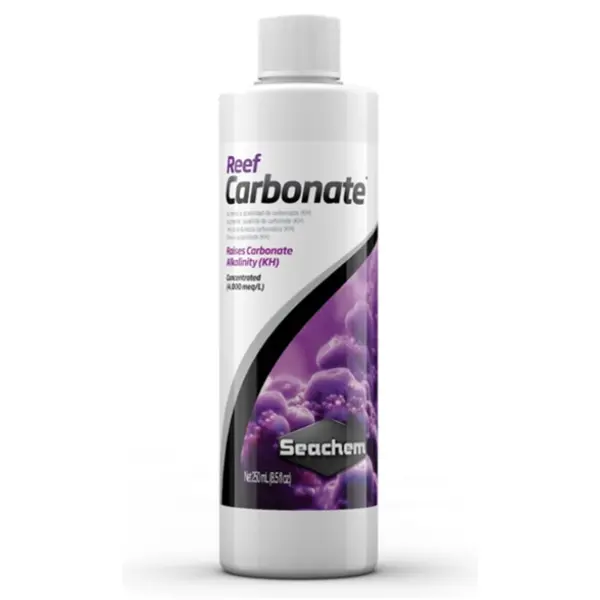
Seachem Reef Carbonate 250 mL – Liquid Reef Alkalinity Supplement
Seachem Reef Carbonate 250 mL is a concentrated liquid carbonate alkalinity supplement formulated for saltwater reef aquariums. It replenishes the carbonate and bicarbonate alkalinity consumed as stony corals, coralline algae, clams, and other calcifying reef organisms build calcium-carbonate structures.
Reef Carbonate raises carbonate alkalinity with minimal immediate impact on aquarium pH. This makes it particularly useful when alkalinity is below the desired range but pH is already acceptable and does not require a strong upward adjustment.
Each milliliter contains a minimum of 4 meq of alkalinity. The liquid formula allows precise measurement for nano and medium reef aquariums and can be used for routine maintenance, targeted corrections, or automated dosing after the aquarium’s alkalinity consumption has been established.
Key Features
- Raises Carbonate Alkalinity: Replenishes KH consumed by stony corals, coralline algae, clams, and other calcifying organisms
- Minimal Immediate pH Impact: Ideal when alkalinity needs to increase but aquarium pH is already acceptable
- Highly Concentrated Liquid: Each milliliter supplies a minimum of 4 meq of alkalinity
- Supports Reef Calcification: Helps maintain carbonate availability for coral skeletal growth
- Precise Dosing: Liquid format makes small and frequent additions easier to measure
- Balanced Reef Chemistry: Will not deplete calcium, magnesium, or strontium when used according to the directions
- Manual or Automated Use: Suitable for hand dosing or a properly configured aquarium dosing pump
- Convenient 250 mL Bottle: Well suited for nano, small, and medium reef aquariums
Product Information
- Brand: Seachem
- Product: Reef Carbonate
- Size: 250 mL
- Equivalent Size: Approximately 8.5 fl oz
- Product Type: Liquid carbonate alkalinity supplement
- Aquarium Type: Saltwater and reef aquariums
- Beginner Dosage: 5 mL per 20 US gallons twice weekly
- Alkalinity Concentration: Minimum of 4 meq per mL
- Effect per Standard Dose: Approximately 0.25 meq/L or 0.7 dKH
- Recommended Alkalinity Range: Approximately 3–6 meq/L or 8–17 dKH
Best Used For
- SPS coral aquariums
- LPS coral aquariums
- Mixed reef systems
- Reef aquariums with growing coral colonies
- Systems with active coralline algae growth
- Marine aquariums containing clams
- Correcting low carbonate alkalinity
- Maintaining stable KH between water changes
- Nano and medium reef aquariums
- Reef systems using automated liquid dosing equipment
Beginner Directions
Use one capful, or 5 mL, of Seachem Reef Carbonate for every 20 US gallons of aquarium water twice per week.
For best distribution, dilute the measured dose in approximately one cup of freshwater before adding it to the aquarium. Slowly add the diluted solution to an area with strong water movement.
Check alkalinity every two weeks when beginning a supplementation routine. Adjust the amount or frequency according to the aquarium’s measured alkalinity consumption.
Approximate Beginner Dosage Guide
- 5-Gallon Aquarium: Approximately 1.25 mL twice weekly
- 10-Gallon Aquarium: Approximately 2.5 mL twice weekly
- 20-Gallon Aquarium: 5 mL twice weekly
- 30-Gallon Aquarium: Approximately 7.5 mL twice weekly
- 40-Gallon Aquarium: 10 mL twice weekly
- 55-Gallon Aquarium: Approximately 13.75 mL twice weekly
- 75-Gallon Aquarium: Approximately 18.75 mL twice weekly
- 100-Gallon Aquarium: 25 mL twice weekly
- 125-Gallon Aquarium: Approximately 31.25 mL twice weekly
- 150-Gallon Aquarium: Approximately 37.5 mL twice weekly
These amounts are proportional calculations based on Seachem’s beginner dosage. Calculate the dose using the aquarium’s estimated actual water volume after accounting for live rock, sand, equipment, and other displacement.
How Much Does the Standard Dose Raise Alkalinity?
A dose of 5 mL per 20 gallons raises alkalinity by approximately 0.25 meq/L.
This is equivalent to approximately 0.7 dKH. The standard dose is designed for gradual maintenance rather than a large one-time alkalinity correction.
One milliliter per 20 gallons does not raise alkalinity by 0.5 dKH. At that water volume, 1 mL would provide only one-fifth of the standard 5 mL dose.
Advanced Alkalinity Correction
Test aquarium alkalinity before making a correction. Follow the regular dosing schedule until alkalinity reaches the desired range, then adjust the amount or frequency to match ongoing consumption.
Seachem recommends adjusting alkalinity toward approximately 4–5 meq/L during the advanced correction process, while maintaining the aquarium within an overall range of approximately 3–6 meq/L, equivalent to about 8–17 dKH.
Do not increase alkalinity by more than 1 meq/L in one day. This is equivalent to approximately 2.8 dKH. Large corrections should be divided into smaller additions and followed by retesting.
Calculating a Precise Correction
Seachem provides the following formula for determining a calculated alkalinity correction:
m = v × a ÷ 4
- m: Milliliters of Reef Carbonate required
- v: Aquarium water volume in liters
- a: Desired alkalinity increase in meq/L
For example, raising 100 liters of aquarium water by 0.5 meq/L would require approximately 12.5 mL:
100 × 0.5 ÷ 4 = 12.5 mL
Calculated corrections should still be made gradually, particularly in established reef systems containing sensitive SPS corals or clams.
Recommended Reef Alkalinity
Seachem recommends maintaining reef aquarium alkalinity between approximately 3 and 6 meq/L, equivalent to about 8–17 dKH. Alkalinity should not be allowed to fall below 2 meq/L.
Many reef aquariums are maintained successfully within a narrower portion of that range. Select a stable target appropriate for the aquarium’s coral species, nutrient level, salt mix, calcium level, and supplementation method.
Stability is generally more important than repeatedly chasing one exact number. Rapid changes in alkalinity may stress sensitive corals even when the final test result falls within an acceptable range.
How Reef Carbonate Works
Corals, coralline algae, clams, and other calcifying organisms combine calcium with carbonate to build calcium-carbonate structures. As calcification occurs, carbonate alkalinity is gradually consumed.
Reef Carbonate replaces this alkalinity and helps preserve the buffering capacity of reef aquarium water. Adequate alkalinity also helps resist rapid downward changes in pH caused by respiration and organic acid production.
Reef Carbonate is intended to raise alkalinity without producing the stronger immediate pH increase associated with a dedicated high-pH reef buffer.
Reef Carbonate and pH
Reef Carbonate primarily raises alkalinity and has minimal immediate effect on pH. It should not be marketed as a strong pH-raising product.
Maintaining adequate alkalinity can help support long-term pH stability, but persistent low pH may be caused by elevated indoor carbon dioxide, poor surface movement, insufficient aeration, accumulated organic waste, or inaccurate testing.
Do not continue increasing alkalinity solely to chase a higher pH when alkalinity is already within or above the desired range.
Reef Carbonate vs. Reef Buffer
- Reef Carbonate: Raises carbonate alkalinity with minimal immediate effect on pH
- Reef Buffer: Raises both carbonate alkalinity and pH and is intended for systems where maintaining pH near 8.3 is difficult
Choose Reef Carbonate when aquarium pH is satisfactory but alkalinity needs to be increased. Choose Reef Buffer when testing confirms that both pH and alkalinity require correction.
Reef Carbonate vs. Reef Builder
Reef Carbonate and Reef Builder perform similar alkalinity-maintenance functions with minimal immediate effect on pH.
- Reef Carbonate: Concentrated premixed liquid for precise manual or automated dosing
- Reef Builder: Concentrated dry powder that must be measured and dissolved before use
Reef Carbonate may be more convenient for nano systems, frequent additions, and dosing pumps. Reef Builder may provide greater economy for large aquariums and reef keepers who prefer dry supplements.
Reef Carbonate vs. Reef Fusion 2
Both Reef Carbonate and Reef Fusion 2 raise carbonate alkalinity, but they are designed for different supplementation approaches.
- Reef Carbonate: Standalone alkalinity supplement used according to measured KH demand
- Reef Fusion 2: Alkalinity component of the Reef Fusion two-part system, designed to be paired in equal quantities with calcium-rich Reef Fusion 1
Reef Carbonate is useful when alkalinity needs to be controlled independently. Reef Fusion 2 is convenient when calcium and alkalinity are being consumed proportionally and maintained through a balanced two-part dosing routine.
Using Reef Carbonate with Calcium Supplements
Reef Carbonate may be used with calcium supplements as part of a balanced reef aquarium routine. However, concentrated calcium and carbonate products must never be directly mixed together.
Direct contact can form insoluble calcium carbonate, reducing the amount of usable calcium and alkalinity available to the aquarium.
Add calcium and carbonate supplements on alternate days whenever practical or separate their dosing by at least 30 minutes. Add each product to a high-flow area and use separate measuring containers, tubing, and dosing-pump channels.
Using Reef Carbonate with Magnesium or Strontium
Do not directly mix Reef Carbonate with concentrated magnesium or strontium supplements. Dose these products on alternate days or separate their additions by at least 30 minutes.
Seachem states that Reef Carbonate will not deplete calcium, magnesium, or strontium when used as directed. Excess alkalinity, however, may encourage precipitation and loss of these elements.
Using Reef Carbonate with a Dosing Pump
Reef Carbonate’s liquid form makes it suitable for automated aquarium dosing systems. Use a dedicated reservoir, tube, and dosing-pump channel that is not shared with calcium, magnesium, or strontium supplements.
Determine the aquarium’s average daily alkalinity consumption before programming the pump. Test alkalinity at approximately the same time each day for several days without changing the existing routine, then calculate the amount required to replace the measured decline.
Dividing the daily requirement into several smaller doses can improve stability and reduce sudden changes in alkalinity.
Using Reef Carbonate in Top-Off Water
Experienced reef keepers may add a calculated amount of Reef Carbonate to freshwater top-off water for gradual dosing.
The amount should be based on measured alkalinity consumption rather than simply the volume of evaporation. Alkalinity does not evaporate with water, so improper top-off dosing can cause alkalinity to rise over time.
Keep calcium, magnesium, and strontium supplements out of the same top-off reservoir to prevent precipitation.
Dosing Tips
- Test alkalinity before establishing a dosing routine
- Calculate dosage using actual aquarium water volume
- Dilute the dose in freshwater when practical
- Add slowly to an area with strong water movement
- Make significant corrections gradually
- Do not raise alkalinity by more than 1 meq/L per day
- Separate Reef Carbonate from calcium, magnesium, and strontium supplements
- Use dedicated dosing-pump channels and tubing
- Test at approximately the same time of day
- Keep a written log of alkalinity results and dosing amounts
Signs Alkalinity May Be Low
- Declining alkalinity test results between water changes
- Difficulty maintaining stable reef aquarium pH
- Reduced skeletal growth in SPS or LPS corals
- Slow coralline algae development
- Increasing alkalinity demand as coral colonies grow
- Alkalinity repeatedly falling below the selected target
Visual symptoms alone cannot confirm low alkalinity. Poor coral growth, reduced polyp extension, faded coloration, or tissue loss may also result from lighting, nutrient imbalance, pests, disease, salinity changes, unstable temperature, or inadequate water movement.
Important Reef Aquarium Note
Reef Carbonate supplies carbonate alkalinity but does not provide calcium. A separate calcium supplement may be required when calcium is being consumed by corals and other calcifying organisms.
Healthy reef growth depends on balanced alkalinity, calcium, magnesium, salinity, temperature, nutrients, lighting, water flow, and overall aquarium maturity.
Excess alkalinity may promote the precipitation and loss of calcium, magnesium, and strontium. Cloudy water or white deposits on pumps, heaters, and aquarium surfaces may indicate precipitation caused by excessive dosing or direct contact between incompatible supplements.
Reef Carbonate does not replace regular water changes, accurate testing, protein skimmer maintenance, nutrient management, or complete reef aquarium husbandry.
Frequently Asked Questions
What is Seachem Reef Carbonate used for?
Reef Carbonate raises and maintains carbonate alkalinity in saltwater reef aquariums with minimal immediate effect on pH.
How much Reef Carbonate should I use?
The beginner dosage is 5 mL for every 20 US gallons twice weekly.
How much does the standard dose raise alkalinity?
A 5 mL dose per 20 gallons raises alkalinity by approximately 0.25 meq/L, equivalent to about 0.7 dKH.
Does 1 mL per 20 gallons raise alkalinity by 0.5 dKH?
No. The official standard dose is 5 mL per 20 gallons, and that raises alkalinity by approximately 0.7 dKH.
How concentrated is Reef Carbonate?
Each milliliter contains a minimum of 4 meq of alkalinity.
Does Reef Carbonate raise pH?
It has minimal immediate impact on pH. Maintaining suitable alkalinity can support long-term pH stability, but Reef Carbonate is primarily an alkalinity supplement.
What alkalinity level should I maintain?
Seachem recommends approximately 3–6 meq/L, equivalent to about 8–17 dKH.
How quickly can alkalinity be raised?
Do not increase alkalinity by more than 1 meq/L, or approximately 2.8 dKH, in one day.
What is the difference between Reef Carbonate and Reef Buffer?
Reef Carbonate raises alkalinity with minimal immediate pH impact. Reef Buffer raises both pH and alkalinity.
What is the difference between Reef Carbonate and Reef Builder?
Both primarily raise alkalinity. Reef Carbonate is a premixed liquid, while Reef Builder is a concentrated dry powder.
What is the difference between Reef Carbonate and Reef Fusion 2?
Reef Carbonate is a standalone alkalinity supplement. Reef Fusion 2 is the alkalinity component of Seachem’s balanced two-part Reef Fusion system.
Can Reef Carbonate be used with calcium supplements?
Yes, but never mix the concentrated products directly. Dose them on alternate days or at least 30 minutes apart.
Can Reef Carbonate be used with magnesium or strontium?
Yes, but concentrated supplements should be added separately and never mixed directly.
Will Reef Carbonate deplete calcium?
Seachem states that it will not deplete calcium, magnesium, or strontium when used as directed.
Can Reef Carbonate be used with a dosing pump?
Yes. Use a dedicated reservoir, dosing channel, and tubing separate from calcium and other concentrated supplements.
Is Reef Carbonate safe for SPS corals?
Yes, when dosing is based on accurate testing and alkalinity is adjusted gradually.
Can alkalinity be overdosed?
Yes. Excessive alkalinity can stress corals and promote calcium, magnesium, and strontium precipitation.
Does Reef Carbonate replace water changes?
No. It replenishes alkalinity but does not replace water changes, testing, nutrient control, or complete reef aquarium maintenance.
Available at Tropical Treasures Wyo
Seachem Reef Carbonate 250 mL provides concentrated liquid carbonate alkalinity supplementation for SPS, LPS, mixed reef, and coralline algae aquariums. Visit Tropical Treasures Wyo in Cheyenne, Wyoming, to shop Seachem reef supplements, calcium and alkalinity test kits, dosing pumps, marine salt, coral foods, and saltwater aquarium care essentials.
Explore More Aquarium Products:
Low stock: 2 left
Couldn't load pickup availability
Explore Related Aquarium Products: