
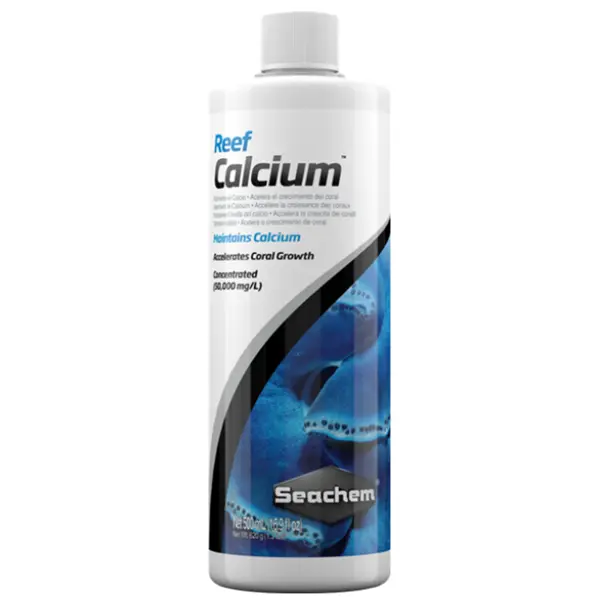
Seachem Reef Calcium 500 mL – Organic Calcium Supplement for Reef Aquariums
Seachem Reef Calcium 500 mL is a concentrated organic calcium supplement formulated to maintain calcium availability and support coral growth in saltwater reef aquariums. It contains 50,000 mg/L of bioavailable calcium supplied as a polygluconate complex.
Unlike traditional ionic calcium supplements based on calcium chloride, Reef Calcium uses an uncharged organic calcium complex. This allows corals to obtain multiple calcium atoms along with an easily metabolized source of energy while using less energy than may be required for the uptake of charged ionic calcium.
Reef Calcium is intended primarily for maintaining calcium that is already within an appropriate range. It may be used by itself or alongside an ionic calcium supplement as part of a complete reef aquarium calcium and alkalinity routine.
Key Features
- Concentrated Organic Calcium: Contains 50,000 mg/L of bioavailable polygluconate-complexed calcium
- Supports Coral Growth: Supplies calcium and an easily metabolized organic component for calcifying reef organisms
- Designed for Calcium Maintenance: Helps maintain calcium after the aquarium has reached the appropriate range
- Minimal Alkalinity Depletion: Polygluconate complexation helps reduce calcium precipitation and unnecessary alkalinity loss
- Does Not Alter pH: Maintains calcium without functioning as a pH-adjusting supplement
- No Nitrogen or Phosphorus: Does not intentionally add nitrate or phosphate to the aquarium
- Compatible with Ionic Calcium: May be paired with Reef Complete or Reef Advantage Calcium
- Large 500 mL Bottle: Suitable for medium and larger reef aquariums or ongoing supplementation routines
Product Information
- Brand: Seachem
- Product: Reef Calcium
- Size: 500 mL
- Equivalent Size: Approximately 17 fl oz
- Product Type: Organic reef aquarium calcium supplement
- Calcium Source: Calcium gluconate in a polygluconate complex
- Calcium Concentration: 50,000 mg/L
- Aquarium Type: Saltwater and reef aquariums
- Standard Dosage: 5 mL per 20 US gallons twice weekly
- Calcium Increase per Standard Dose: Approximately 3 mg/L
- Recommended Calcium Range: Approximately 380–420 mg/L
Best Used For
- SPS coral aquariums
- LPS coral aquariums
- Mixed reef systems
- Soft-coral aquariums containing calcifying organisms
- Maintaining established calcium levels
- Supporting coralline algae growth
- Marine aquariums containing clams
- Reef systems with ongoing calcium consumption
- Use alongside Reef Complete or Reef Advantage Calcium
- Manual reef supplementation routines
Directions for Use
Shake Seachem Reef Calcium before use. Add one capful, or 5 mL, for every 20 US gallons of aquarium water twice per week.
The amount or dosing frequency may be increased according to coral growth and measured calcium demand. Do not exceed three capfuls, or 15 mL, per 20 gallons in one day.
Add Reef Calcium to an area with good water movement so the supplement disperses throughout the aquarium. Avoid pouring concentrated supplement directly onto corals or other livestock.
Approximate Standard Dosage Guide
- 5-Gallon Aquarium: Approximately 1.25 mL twice weekly
- 10-Gallon Aquarium: Approximately 2.5 mL twice weekly
- 20-Gallon Aquarium: 5 mL twice weekly
- 30-Gallon Aquarium: Approximately 7.5 mL twice weekly
- 40-Gallon Aquarium: 10 mL twice weekly
- 55-Gallon Aquarium: Approximately 13.75 mL twice weekly
- 75-Gallon Aquarium: Approximately 18.75 mL twice weekly
- 100-Gallon Aquarium: 25 mL twice weekly
- 125-Gallon Aquarium: Approximately 31.25 mL twice weekly
- 150-Gallon Aquarium: Approximately 37.5 mL twice weekly
These amounts are proportional calculations based on Seachem’s official dosage. Calculate the dose using the aquarium’s estimated actual water volume after accounting for live rock, sand, equipment, and other displacement.
How Much Calcium Does One Dose Add?
One standard dose of 5 mL per 20 gallons raises calcium by approximately 3 mg/L, also expressed as approximately 3 ppm.
Reef Calcium is designed for regular maintenance rather than rapid correction of a severely depleted calcium level. Its relatively modest calcium increase allows it to support ongoing coral demand without producing a large sudden change.
Recommended Calcium Level
Seachem recommends maintaining calcium between approximately 380 and 420 mg/L with alkalinity between approximately 3 and 6 meq/L, equivalent to about 8–17 dKH.
Seachem also notes that it is not necessary to exceed approximately 380 mg/L total calcium when using Reef Calcium because its organic calcium complex remains highly bioavailable to corals.
Choose a stable target appropriate for the aquarium’s livestock, salt mix, alkalinity, magnesium level, and supplementation routine.
Maintaining vs. Raising Calcium
Reef Calcium is formulated primarily to maintain calcium that is already within the desired range. It is not Seachem’s preferred product for making a large calcium correction.
When testing shows that calcium is significantly below the desired range, first restore it gradually with an ionic calcium supplement such as:
- Seachem Reef Complete: Concentrated liquid ionic calcium with magnesium and strontium
- Seachem Reef Advantage Calcium: Concentrated dry ionic calcium supplement
Once the aquarium reaches the intended calcium level, Reef Calcium may be used to help maintain that level and support continued coral growth.
How Polygluconate Calcium Works
Reef Calcium uses chained organic calcium rather than a conventional charged ionic calcium source. The calcium is bound within an uncharged polygluconate complex that corals can absorb into their tissue.
When the complex is absorbed, the coral receives multiple calcium atoms along with an organic component that may be metabolized for energy. This allows calcium to remain biologically useful even when the measured total calcium concentration is not unusually high.
The polygluconate complex also helps keep calcium soluble and reduces the tendency for calcium to precipitate with carbonate alkalinity.
Does Reef Calcium Contain Sugar?
Polygluconate should not be confused with simple glucose or ordinary sugar. Although polygluconate may eventually be broken down into gluconate, it is a complex organic compound rather than a simple sugar.
Reef Calcium contains no nitrogen or phosphorus and should not directly cause algae growth in a properly maintained reef aquarium.
Nuisance algae may still develop because of excessive lighting, elevated nitrate or phosphate, overfeeding, accumulated organic waste, source-water contamination, or inadequate aquarium maintenance.
Reef Calcium and Alkalinity
Reef Calcium is designed to maintain calcium without unnecessarily depleting carbonate alkalinity. Its polygluconate complex helps reduce calcium precipitation compared with improperly dosed concentrated calcium and carbonate products.
However, it does not supply carbonate alkalinity. Reef aquariums still require an appropriate alkalinity supplement when KH is being consumed by corals and other calcifying organisms.
Test both calcium and alkalinity regularly rather than adjusting calcium alone.
Using Reef Calcium with Alkalinity Supplements
Reef Calcium may be used with Reef Builder, Reef Buffer, Reef Carbonate, Reef Fusion 2, or another appropriate marine alkalinity product.
Do not directly mix Reef Calcium with a concentrated carbonate supplement. Add calcium and carbonate products on alternate days when practical or separate their additions by at least 30 minutes.
Add each supplement separately to an area with strong water movement. Use separate measuring tools and storage containers.
Using Reef Calcium with Ionic Calcium
Reef Calcium may be used alongside an ionic calcium supplement. This combination can provide rapid ionic calcium availability along with the growth-supporting benefits of polygluconate-complexed calcium.
An ionic product may be used to correct a low measured calcium level, while Reef Calcium supports maintenance after the target has been reached.
Account for calcium supplied by every product in the dosing routine to avoid unnecessary accumulation.
Maximum Daily Dose
Do not exceed 15 mL of Reef Calcium per 20 US gallons in one day.
The maximum daily amount is an upper limit rather than a routine recommendation. Most aquariums should begin with the standard dose of 5 mL per 20 gallons twice weekly.
Large calcium changes should be made gradually. Excess calcium may promote carbonate precipitation and reduce measurable alkalinity.
Testing and Adjusting the Dose
Test calcium before beginning regular dosing and continue testing as coral growth and aquarium demand change.
Measure calcium at approximately the same time of day and under similar aquarium conditions whenever possible. This helps reduce confusion caused by normal variation and inconsistent testing technique.
If calcium remains stable, continue the current schedule. If it gradually declines, increase the amount or frequency conservatively. If calcium rises above the target, reduce or pause dosing.
Dosing Tips
- Shake the bottle before each use
- Test calcium and alkalinity before establishing a routine
- Calculate dosing from actual aquarium water volume
- Add Reef Calcium to an area with strong circulation
- Begin with the standard twice-weekly dosage
- Adjust according to measured calcium consumption
- Use an ionic calcium product for major corrections
- Separate calcium and carbonate supplements by at least 30 minutes
- Do not exceed 15 mL per 20 gallons in one day
- Keep a written record of calcium, alkalinity, and dosing amounts
Signs Calcium May Be Low
- Declining calcium test results between water changes
- Reduced skeletal growth in SPS or LPS corals
- Slow coralline algae development
- Increasing calcium demand as coral colonies grow
- Difficulty maintaining calcium in a heavily stocked reef system
Visual symptoms alone cannot confirm calcium deficiency. Poor coral growth may also result from unstable alkalinity, low magnesium, inappropriate lighting, excessive nutrients, insufficient nutrients, pests, disease, or inadequate water movement.
Important Reef Aquarium Note
Reef Calcium supplies organic calcium but does not replace alkalinity, magnesium, trace-element, or complete reef aquarium supplementation.
Healthy coral growth depends on balanced calcium and alkalinity along with stable magnesium, salinity, temperature, nutrients, lighting, water flow, and overall aquarium maturity.
Do not continually increase calcium because coral growth appears slow. Test the water and evaluate the complete aquarium environment before changing the dosing schedule.
Reef Calcium does not replace regular water changes, accurate water testing, protein skimmer maintenance, nutrient management, or complete reef aquarium husbandry.
Frequently Asked Questions
What is Seachem Reef Calcium used for?
Reef Calcium supplies bioavailable organic calcium to help maintain reef aquarium calcium levels and support coral growth.
What type of calcium does Reef Calcium contain?
It contains calcium gluconate in a bioavailable polygluconate complex.
Is Reef Calcium made from calcium chloride?
No. Reef Calcium is an organic polygluconate-complexed calcium supplement rather than a calcium chloride product.
How concentrated is Reef Calcium?
It contains 50,000 mg/L of calcium.
How much Reef Calcium should I use?
Use 5 mL for every 20 US gallons twice per week.
How much does the standard dose raise calcium?
The standard dose raises calcium by approximately 3 mg/L, or 3 ppm.
Does 5 mL per 20 gallons raise calcium by 10 ppm?
No. Seachem states that the standard dose raises calcium by approximately 3 ppm.
Is Reef Calcium intended to raise very low calcium?
It is primarily intended to maintain calcium. Use Reef Complete or Reef Advantage Calcium for a significant calcium correction.
What calcium level should I maintain?
Seachem recommends approximately 380–420 mg/L with alkalinity around 3–6 meq/L, equivalent to about 8–17 dKH.
Does Reef Calcium raise alkalinity?
No. It supplies calcium but does not replace a carbonate alkalinity supplement.
Does Reef Calcium affect pH?
It is designed to maintain calcium without altering aquarium pH.
Can Reef Calcium be used with an alkalinity supplement?
Yes. Add the products separately on alternate days or at least 30 minutes apart.
Can Reef Calcium be used with Reef Complete?
Yes. Reef Complete may be used to restore a low calcium level, while Reef Calcium may support ongoing maintenance and coral growth.
Can Reef Calcium be used with Reef Advantage Calcium?
Yes. Account for the calcium supplied by both products and adjust dosing according to testing.
Does Reef Calcium contain nitrogen or phosphorus?
No. It does not intentionally add nitrogen or phosphorus.
Can Reef Calcium cause algae?
The product contains no nitrogen or phosphorus and should not directly cause algae growth when used in a properly maintained reef aquarium.
Is Reef Calcium safe for SPS corals?
Yes. It may be used in SPS, LPS, mixed reef, and other marine systems when dosed according to testing.
What is the maximum daily dose?
Do not exceed 15 mL per 20 US gallons in one day.
Does Reef Calcium replace two-part dosing?
No. It may maintain calcium, but it does not supply carbonate alkalinity. A separate alkalinity product is still required when KH is being consumed.
Does Reef Calcium replace water changes?
No. It supplements calcium but does not replace water changes, testing, nutrient management, or complete reef maintenance.
Available at Tropical Treasures Wyo
Seachem Reef Calcium 500 mL provides concentrated polygluconate-complexed calcium to help maintain calcium availability and support coral growth in saltwater reef aquariums. Visit Tropical Treasures Wyo in Cheyenne, Wyoming, to shop Seachem reef supplements, calcium and alkalinity test kits, dosing supplies, coral foods, marine filtration, and saltwater aquarium care essentials.
Explore More Aquarium Products:
Low stock: 2 left
Couldn't load pickup availability
Explore Related Aquarium Products: