
Seachem PhosBond Bagged 100 mL – Phosphate & Silicate Remover
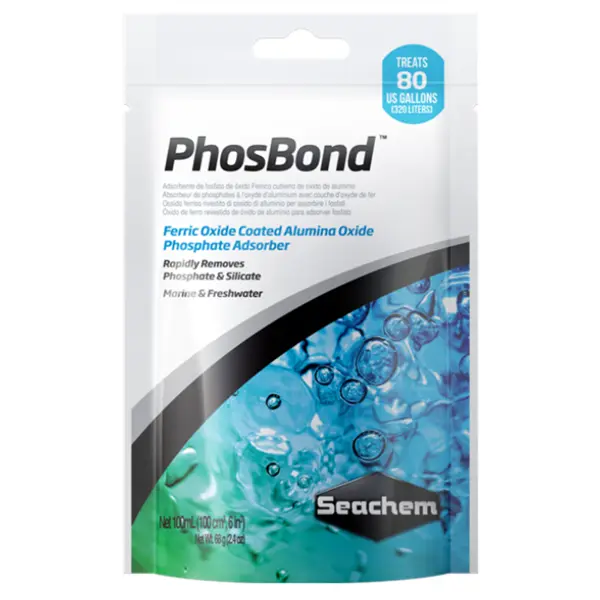
Seachem PhosBond Bagged 100 mL is a high-capacity chemical filtration media designed to remove phosphate and silicate from freshwater and saltwater aquariums. It combines granular ferric oxide with activated alumina to provide the phosphate-binding benefits of both media types in one convenient formula.
Reducing excess phosphate and silicate can help address conditions that contribute to nuisance algae and diatom growth. PhosBond also helps aquarium keepers maintain more controlled nutrient levels and improve overall aquarium water quality.
This 100 mL version comes inside a ready-to-use filter bag, eliminating the need to purchase or fill a separate media bag. The bag should still be rinsed thoroughly before installation to remove loose dust.
Key Features
- Removes Phosphate: Binds excess phosphate from freshwater and saltwater aquarium water
- Removes Silicate: Helps reduce silicate that may contribute to diatom growth
- Hybrid Filtration Media: Combines granular ferric oxide and activated alumina
- Pre-Bagged Convenience: Supplied inside a filter bag for simple placement and removal
- Freshwater & Marine Use: Suitable for freshwater, planted, marine, and reef aquariums
- Irreversible Binding: Does not release bound phosphate or silicate back into the aquarium
- Compact 100 mL Size: Ideal for nano aquariums, small systems, and targeted nutrient control
- Versatile Placement: Suitable for canister filters, media chambers, box filters, sumps, and high-flow trickle-filter areas
Product Information
- Brand: Seachem
- Product: PhosBond Bagged
- Size: 100 mL
- Product Type: Phosphate- and silicate-removing chemical filtration media
- Media Composition: Granular ferric oxide and activated alumina hybrid
- Removes: Phosphate and silicate
- Aquarium Type: Freshwater and saltwater aquariums
- Configuration: Pre-filled media bag
- Regenerable: No
Best Used For
- Elevated aquarium phosphate levels
- Elevated silicate levels
- Nuisance algae management
- Diatom-prone aquariums
- Freshwater planted aquariums with excess phosphate
- Marine fish-only aquariums
- Reef aquariums requiring controlled phosphate reduction
- Nano and small aquariums
- Canister filters and hang-on-back filter media chambers
- Sumps, box filters, and trickle-filter systems
Directions for Use
Rinse the bagged PhosBond thoroughly under freshwater before placing it into the filter. Continue rinsing until loose dust has been removed and the rinse water becomes substantially clearer.
Place the bag in an area where aquarium water is forced through the media. Strong flow improves contact between the aquarium water and the PhosBond, but the media should not tumble or grind against itself.
Use 60 mL of PhosBond for every 50 US gallons of saltwater or every 100 US gallons of freshwater.
Approximate Treatment Capacity of the 100 mL Bag
- Saltwater Aquariums: Approximately 83 gallons at the standard dosage
- Freshwater Aquariums: Approximately 167 gallons at the standard dosage
These capacities are proportional calculations based on Seachem’s official dosage. Aquariums with very high phosphate or silicate levels may exhaust the media more quickly.
Approximate Saltwater Dosage Guide
- 10-Gallon Aquarium: Approximately 12 mL
- 20-Gallon Aquarium: Approximately 24 mL
- 30-Gallon Aquarium: Approximately 36 mL
- 40-Gallon Aquarium: Approximately 48 mL
- 50-Gallon Aquarium: 60 mL
- 75-Gallon Aquarium: Approximately 90 mL
Approximate Freshwater Dosage Guide
- 10-Gallon Aquarium: Approximately 6 mL
- 20-Gallon Aquarium: Approximately 12 mL
- 40-Gallon Aquarium: Approximately 24 mL
- 55-Gallon Aquarium: Approximately 33 mL
- 75-Gallon Aquarium: Approximately 45 mL
- 100-Gallon Aquarium: 60 mL
- 150-Gallon Aquarium: Approximately 90 mL
The full 100 mL bag may be more media than some nano aquariums require. Avoid overtreating, particularly in reef systems where rapid nutrient reduction can stress corals.
Testing After Installation
Leave PhosBond in place for four days and then test the aquarium’s phosphate or silicate concentration.
If the level has not fallen to approximately 0.02 mg/L, replace the media with fresh PhosBond. If the desired level has been reached, the media may remain in the filter until phosphate or silicate begins to rise again.
PhosBond is not exhausted solely because it has been in the filter for a certain number of days. Continue using it as long as testing confirms that phosphate or silicate remains controlled.
When to Replace PhosBond
Replace the media when aquarium testing shows that phosphate or silicate levels are beginning to rise again. The exact lifespan varies according to:
- Starting phosphate and silicate concentrations
- Aquarium volume
- Amount of media used
- Feeding level
- Livestock load
- Source-water quality
- Organic waste accumulation
- Filter flow through the media
PhosBond cannot be regenerated. Dispose of exhausted media and replace it with a new bag or fresh loose media.
Proper Filter Placement
For best results, place the PhosBond bag where water must pass directly through it rather than flowing around it.
Suitable locations include:
- Canister filter media baskets
- Hang-on-back filter compartments
- Internal filter chambers
- Saltwater sump baffles
- High-flow trickle-filter sections
- Box filters
- Dedicated media chambers
Avoid placing the bag loosely in a low-flow corner of the aquarium. Passive placement provides less contact and may reduce performance.
Use in Media Reactors
PhosBond may receive strong flow, but it should not be allowed to tumble aggressively. Constant grinding can break down the media and release fine particles into the aquarium.
When using a reactor, adjust the flow so water passes through the media without causing visible tumbling. A media chamber or filter basket is often easier to manage with the pre-bagged format.
Phosphate Control & Algae
Excess phosphate can contribute to conditions that favor nuisance algae, but phosphate is not the only cause of algae growth. Lighting duration, lighting intensity, nitrate, accumulated organic waste, overfeeding, source water, plant health, and aquarium maintenance also affect algae growth.
PhosBond helps control one contributing nutrient. It should be used alongside appropriate feeding, water changes, mechanical cleaning, filtration, and light management.
Silicate Control & Diatoms
Silicate may contribute to brown diatom growth, particularly in newer aquariums or systems using source water with measurable silicate.
PhosBond binds silicate as water passes through the media. Continue monitoring the aquarium and source water because persistent silicate input may exhaust the media more quickly.
Reef Aquarium Use
PhosBond may be used in reef aquariums when dosed conservatively and monitored with a reliable low-range phosphate test.
Corals require some available phosphorus for normal biological processes. Rapidly reducing phosphate from a high level to an extremely low level can stress corals and disrupt aquarium stability.
Avoid overtreating. Use only the amount needed and reduce phosphate gradually when levels are significantly elevated.
Freshwater & Planted Aquarium Use
PhosBond is suitable for freshwater aquariums, but phosphate is also an essential nutrient for aquatic plants. It should not be used automatically in a planted tank simply because algae is present.
Test phosphate before use. Excessive phosphate removal may create a plant nutrient deficiency and reduce healthy plant growth.
In freshwater aquariums, the standard dosage is lower than in saltwater because PhosBond has greater relative treatment capacity in freshwater.
Important Aquarium Care Note
PhosBond removes phosphate and silicate but does not remove ammonia, nitrite, nitrate, chlorine, chloramine, medications, or every dissolved contaminant.
It does not replace water changes, biological filtration, mechanical filtration, water conditioning, source-water testing, or routine aquarium maintenance.
Rapid nutrient changes can stress aquarium livestock. Test before treatment, use an appropriate amount, and monitor levels throughout use.
Frequently Asked Questions
What does Seachem PhosBond remove?
PhosBond removes phosphate and silicate from freshwater and saltwater aquarium water.
What is PhosBond made from?
It is a hybrid media combining granular ferric oxide and activated alumina.
Is the 100 mL version pre-bagged?
Yes. The media is supplied inside a filter bag for convenient placement and removal.
Does the bagged PhosBond need to be rinsed?
Yes. Seachem instructs users to rinse PhosBond before use to remove loose dust.
How much PhosBond should I use in saltwater?
Use 60 mL for every 50 US gallons of saltwater.
How much should I use in freshwater?
Use 60 mL for every 100 US gallons of freshwater.
How much water does the 100 mL bag treat?
At the standard dosage, it treats approximately 83 gallons of saltwater or 167 gallons of freshwater.
How long should PhosBond remain in the filter?
Test after four days. If the desired level has been reached, leave it in place until phosphate or silicate begins to rise again.
Does PhosBond need to be replaced every month?
No fixed replacement schedule applies. Replace it when testing shows that phosphate or silicate is no longer being controlled.
Can PhosBond be regenerated?
No. Dispose of exhausted media and replace it with fresh PhosBond.
Will PhosBond release phosphate back into the aquarium?
No. Seachem states that PhosBond binds phosphate and silicate irreversibly and does not release them back into the water.
Is PhosBond reef safe?
Yes, when used as directed. Avoid overtreating or reducing phosphate too quickly in reef aquariums.
Can PhosBond be used in a planted aquarium?
Yes, but phosphate is a plant nutrient. Use it only when testing confirms excess phosphate and avoid stripping the water excessively.
Can it be used in a canister filter?
Yes. Place the bag where water is forced through it.
Can it be used in a media reactor?
It may receive strong flow, but the media should not tumble or grind against itself.
Does PhosBond eliminate algae?
It helps reduce phosphate and silicate that may contribute to algae and diatoms, but complete algae control also requires balanced lighting, feeding, maintenance, and nutrient management.
Available at Tropical Treasures Wyo
Seachem PhosBond Bagged 100 mL provides convenient phosphate and silicate removal for freshwater and saltwater aquariums. Visit Tropical Treasures Wyo in Cheyenne, Wyoming, to shop Seachem chemical filtration media, phosphate test kits, canister filters, hang-on-back filters, media bags, and aquarium maintenance supplies.
Explore More Aquarium Products:
Out of stock
Couldn't load pickup availability
Explore Related Aquarium Products: