
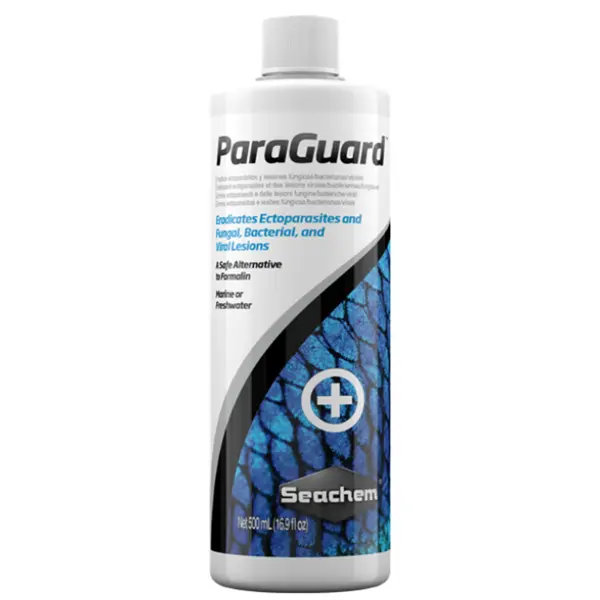
Seachem ParaGuard 500 mL – External Parasite & Lesion Treatment
Seachem ParaGuard 500 mL is a broad-spectrum aquarium treatment formulated for external parasites and external fungal, bacterial, and viral lesions affecting freshwater and marine ornamental fish. Its proprietary formula combines aldehydes, malachite green, and fish-protective polymers.
ParaGuard contains no formaldehyde or methanol and is designed to provide an easier-to-dose alternative to traditional formalin-based treatments. It is especially useful in quarantine, hospital, receiving, and observation aquariums when treating newly introduced or visibly affected fish.
Key Features
- Broad-Spectrum External Treatment: Used for many ectoparasites and external fungal, bacterial, and viral lesions
- Aldehyde-Based Formula: Contains a proprietary blend of aldehydes, malachite green, and fish-protective polymers
- No Formaldehyde or Methanol: Provides an alternative to traditional formalin-based aquarium treatments
- Freshwater & Marine Use: Suitable for freshwater and saltwater ornamental fish
- Biofilter Compatible: Seachem states that ParaGuard will not adversely affect biological filtration when used as directed
- Daily Dosing: May be dosed every day as required while fish continue to tolerate treatment
- Large 500 mL Bottle: Convenient for larger aquariums, quarantine systems, fish rooms, and repeated treatment use
Product Information
- Brand: Seachem
- Product: ParaGuard
- Size: 500 mL
- Equivalent Size: Approximately 17 fl oz
- Product Type: Broad-spectrum external fish treatment
- Formula: Proprietary aldehyde blend, malachite green, and fish-protective polymers
- Aquarium Type: Freshwater and marine ornamental fish aquariums
- Standard Dosage: 5 mL per 10 gallons daily as required
- Primary Use: Ectoparasites and external fungal, bacterial, and viral lesions
Commonly Used For
- Freshwater ich
- Marine white spot affecting fish in quarantine
- External parasitic infections
- Skin and gill flukes
- External fungal patches
- Fin deterioration associated with external infection
- External bacterial lesions
- Receiving and quarantine procedures for new fish
Many aquarium diseases produce similar symptoms. White spots, flashing, excess mucus, damaged fins, cloudy patches, sores, rapid breathing, and loss of appetite do not always identify one specific infection. Confirm the likely cause before beginning treatment whenever possible.
How to Use
Remove all shrimp, snails, corals, crabs, and other invertebrates before dosing ParaGuard. Remove activated carbon, Purigen, and other chemical filtration media that may remove part of the medication.
Add one capful, or 5 mL, of Seachem ParaGuard for every 10 US gallons of actual aquarium water. Repeat the dose daily as required, provided the fish do not show signs of medication-related stress.
Calculate dosage using actual water volume rather than the aquarium’s listed capacity. Substrate, rocks, driftwood, decorations, and equipment reduce the amount of water in the system.
Approximate Daily Dosage Guide
- 2-Gallon Aquarium: Approximately 1 mL
- 5-Gallon Aquarium: Approximately 2.5 mL
- 10-Gallon Aquarium: 5 mL
- 20-Gallon Aquarium: 10 mL
- 40-Gallon Aquarium: 20 mL
- 55-Gallon Aquarium: Approximately 27.5 mL
- 75-Gallon Aquarium: Approximately 37.5 mL
- 100-Gallon Aquarium: 50 mL
These are proportional calculations based on the official dosage of 5 mL per 10 gallons. Always follow the current directions printed on the product label.
Treatment Duration
Continue daily treatment as required while the fish show no signs of medication-related stress. The necessary treatment period depends on the organism involved, its life cycle, the severity of the infection, and how quickly the fish respond.
Do not automatically stop after an arbitrary number of days if the diagnosed parasite requires a longer life-cycle treatment. Seachem suggests approximately 14 days or until the infection clears for certain fluke infections, while other conditions may require different treatment periods.
Before Treatment
- Move affected fish to a quarantine or hospital aquarium when possible
- Remove all invertebrates from the treatment system
- Remove activated carbon, Purigen, and other chemical filtration media
- Turn off ultraviolet sterilizers during treatment
- Provide adequate aeration and surface movement
- Test ammonia, nitrite, nitrate, pH, and temperature
- Calculate the aquarium’s actual water volume
- Observe fish closely after every dose
Chemical Filtration
Remove activated carbon, Purigen, and other chemical filtration media while treating with ParaGuard. Although Purigen may not remove every component equally, it can remove malachite green and reduce the effectiveness of the complete formula.
Mechanical and biological filtration may continue operating. Maintain sufficient oxygenation and monitor filter flow throughout treatment.
Biological Filtration
Seachem states that ParaGuard will not adversely affect the biological filter when used as directed. However, sick fish, reduced feeding, medication use, and quarantine conditions can still affect aquarium stability.
Test ammonia and nitrite throughout treatment, particularly in newly established hospital tanks or heavily stocked systems. Perform an appropriately conditioned water change if water quality becomes unsafe.
Plants & Invertebrates
All invertebrates should be removed before ParaGuard is added to aquarium water. This includes shrimp, snails, crabs, corals, and other sensitive invertebrate livestock.
Seachem indicates that ParaGuard has generally been used successfully in planted aquariums, but individual plant sensitivity can vary. A separate hospital aquarium remains the safest choice when treating fish from a planted display.
Scaleless & Sensitive Fish
Loaches, catfish, eels, and other scaleless or medication-sensitive fish may be more reactive to aquarium treatments. Seachem recommends beginning with approximately one-quarter to one-half of the normal ParaGuard dose and gradually increasing toward the full dosage if the fish tolerate it.
Watch for rapid breathing, loss of balance, unusual darting, severe lethargy, surface gasping, or other abnormal behavior. Stop redosing and perform an appropriately conditioned partial water change if fish show significant distress.
Quarantine & Receiving Tank Use
ParaGuard is particularly useful in quarantine and receiving systems for newly obtained fish. Quarantine allows fish to be observed and treated without exposing display-tank invertebrates or removing chemical filtration from the main aquarium.
Preventive medication should still be used thoughtfully. Observe new fish, maintain excellent water quality, and avoid combining multiple treatments without confirming compatibility.
Important Medication Note
ParaGuard is intended for ornamental aquarium fish only. It is not intended for humans or animals used for human consumption. Keep it away from children and avoid ingestion or contact with the eyes.
ParaGuard treats external conditions and should not automatically be selected for internal parasites, intestinal infections, unexplained swelling, or diseases requiring a different medication.
Poor water quality, ammonia, nitrite, aggression, injuries, and unstable temperature can resemble or worsen infectious disease. Correct these underlying conditions as part of treatment.
Frequently Asked Questions
What is Seachem ParaGuard used for?
ParaGuard is used to treat many external parasites and external fungal, bacterial, and viral lesions affecting freshwater and marine ornamental fish.
How much ParaGuard should I use?
Use 5 mL for every 10 US gallons of actual aquarium water.
How often should ParaGuard be dosed?
Repeat the dose daily as required, as long as the fish show no signs of medication-related stress.
How long should ParaGuard treatment continue?
Treatment duration depends on the diagnosed condition and its life cycle. Continue as required while the fish tolerate treatment and follow Seachem’s condition-specific guidance.
Does ParaGuard treat ich?
Yes. Seachem lists ParaGuard for ectoparasites, including freshwater ich and similar external parasitic infections.
Does ParaGuard treat velvet?
ParaGuard is a broad external parasite treatment, but suspected velvet can progress quickly and may require species-specific treatment planning. Accurate diagnosis and prompt quarantine are important.
Can ParaGuard treat fin rot?
It may be used for external bacterial lesions, including fin deterioration associated with external infection. Water quality and the cause of the fin damage must also be corrected.
Can ParaGuard be used in freshwater aquariums?
Yes. It is formulated for freshwater and marine ornamental fish.
Can ParaGuard be used in a reef aquarium?
Do not dose it into a reef display containing invertebrates. Remove the fish to a quarantine or hospital aquarium for treatment.
Is ParaGuard safe for shrimp and snails?
No assumption of safety should be made for invertebrates. Seachem instructs users to remove all invertebrates before water treatment.
Is ParaGuard safe for aquarium plants?
Seachem indicates that it is generally usable in planted aquariums, but individual plant sensitivity may vary. A separate hospital aquarium is preferable when possible.
Will ParaGuard harm beneficial bacteria?
Seachem states that ParaGuard will not adversely affect the biological filter when used as directed. Continue monitoring ammonia and nitrite during treatment.
Should activated carbon be removed?
Yes. Remove activated carbon and other chemical filtration media because they may remove medication from the water.
Should Purigen be removed?
Yes. Purigen may remove the malachite green component and reduce overall treatment effectiveness.
Should ultraviolet sterilizers be turned off?
Yes. Turn off ultraviolet sterilizers while treating so they do not interfere with the medication.
Is ParaGuard safe for loaches and scaleless fish?
They may be treated cautiously. Seachem recommends beginning with one-quarter to one-half dose and gradually increasing if the fish tolerate treatment.
Can ParaGuard be used preventively?
It may be used in receiving or quarantine tanks for new fish, but preventive treatment should be performed carefully with close observation and good water quality.
Available at Tropical Treasures Wyo
Seachem ParaGuard 500 mL is a broad-spectrum external parasite and lesion treatment for freshwater and marine ornamental fish. Visit Tropical Treasures Wyo in Cheyenne, Wyoming, to shop Seachem fish medications, quarantine supplies, hospital tank equipment, water conditioners, test kits, filters, and aquarium care essentials.
Explore More Aquarium Products:
Low stock: 3 left
Couldn't load pickup availability
Explore Related Aquarium Products: