

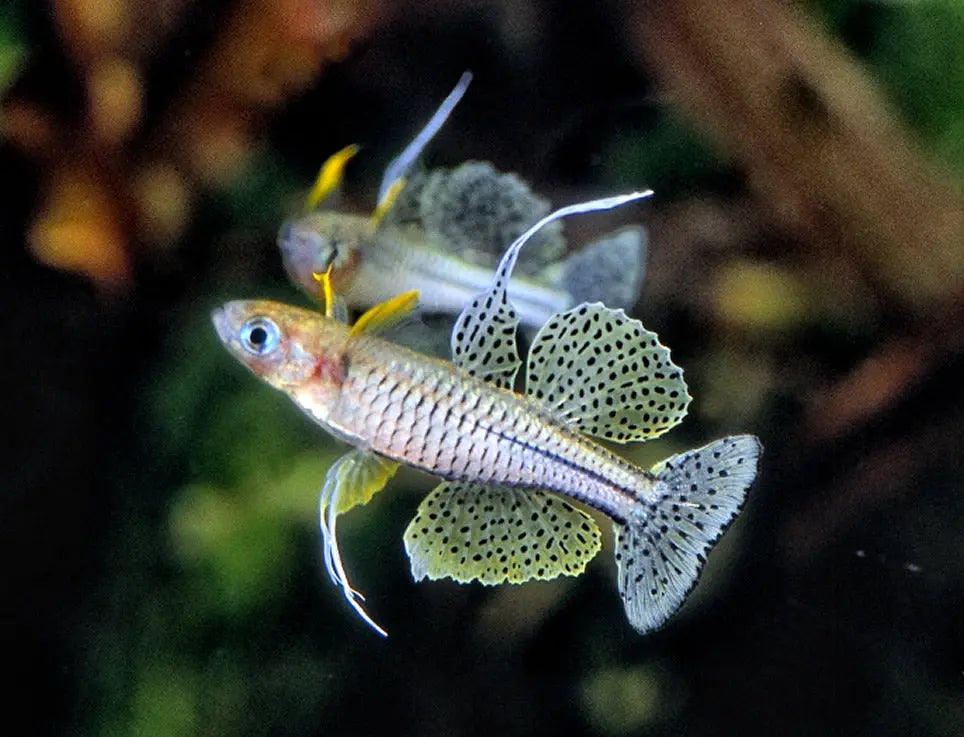
Gertrude's Blue-Eye Rainbowfish (Pseudomugil gertrudae)
Gertrude's Blue-Eye Rainbowfish (Pseudomugil gertrudae)
Out of stock
Live fish, shrimp, snails and aquatic plants are not shipped. Visit Tropical Treasures Wyo in Cheyenne, Wyoming or select pickup at checkout.
Couldn't load pickup availability
Gertrude’s Blue-Eye Rainbowfish Care — Pseudomugil gertrudae
The Gertrude’s Blue-Eye Rainbowfish (Pseudomugil gertrudae), also called the Spotted Blue-Eye, is a small, peaceful freshwater fish admired for its bright blue eyes, patterned fins, and lively display behavior. Males spread their spotted fins during courtship and social interactions. These fish are best enjoyed in a group in an established, densely planted aquarium.
Native populations occur in northern Australia, New Guinea and the Aru Islands. Color and fin patterns can vary by locality or breeding line. This general Gertrude’s Blue-Eye listing should not be assumed to represent the separate “Aru IV” locality-form listing without supplier confirmation.
Gertrude’s Blue-Eye Care Guide
- Scientific name: Pseudomugil gertrudae
- Other names: Gertrude’s Blue-Eye, Spotted Blue-Eye, Gertrudae Rainbowfish
- Adult size: Approximately 1–1.5 inches (2.5–3.8 cm)
- Recommended aquarium: A mature, planted aquarium of approximately 15 gallons or larger for a group, with a footprint at least around 18 inches long
- Group size: Keep at least 8–10 together, preferably more when space allows
- Temperature: Approximately 70–82°F
- pH: Approximately 5.5–7.5 for typical aquarium maintenance; stable conditions matter more than chasing an exact value
- General hardness: Soft to moderately hard water, roughly 5–12 dGH for many captive-bred aquarium fish
- Temperament: Peaceful, social and somewhat shy around large or fast fish
- Diet: Tiny live and frozen invertebrates along with finely crushed floating foods and micro pellets
- Care level: Moderate; needs a biologically mature tank and suitably small foods
Aquarium Setup and Water Quality
Use fine-leaved plants, floating cover, driftwood, and shaded retreat areas while leaving open swimming space. A mature, well-filtered aquarium with good oxygenation and gentle-to-moderate water movement is preferable to a newly established nano tank. Use a sponge prefilter where appropriate and a secure lid, because small blue-eyes may jump when startled. Keep ammonia and nitrite at zero and avoid abrupt changes in temperature or water chemistry.
Group Behavior and Tankmates
Gertrude’s Blue-Eyes are social shoaling fish. Keep at least eight to ten of their own species, ideally with more females than males so males can display without persistently chasing one female. In larger aquariums, compatible peaceful nano fish and adult dwarf shrimp can be suitable tankmates, though newly hatched shrimp may be eaten. Avoid boisterous fish that outcompete them for food and fish large enough to swallow them.
Feeding
Their mouths are small. Offer suitable live or frozen foods such as baby brine shrimp, daphnia, cyclops and microworms, supplemented with finely crushed flakes or high-quality tiny floating foods. Feed small portions and make sure these shy fish are not losing food to faster tankmates.
Breeding
Gertrude’s Blue-Eyes scatter adhesive eggs among fine plants or spawning mops. Males display colorful fins to attract females. Adults may eat eggs or fry, so separate spawning material or provide abundant moss and plant cover if you want to raise young. Fry require very small foods initially.
Frequently Asked Questions
How many Gertrude’s Blue-Eye Rainbowfish should I keep?
A group of at least eight to ten is recommended. More fish can improve confidence and natural displays in a sufficiently sized aquarium.
What size aquarium do Gertrude’s Blue-Eyes need?
We recommend an established, planted aquarium of around 15 gallons or larger for a group. Horizontal swimming space, plants and stable water conditions are more important than tank height alone.
How big does Pseudomugil gertrudae get?
Adults usually reach approximately 1–1.5 inches (2.5–3.8 cm), depending on the fish and breeding line.
Can Gertrude’s Blue-Eyes live with shrimp?
They often coexist with adult dwarf shrimp in a peaceful planted aquarium, but very small shrimplets may become food. Moss and dense cover help protect young shrimp.
Are Gertrude’s Blue-Eyes the same as the Aru IV variety?
Both are listed as Pseudomugil gertrudae, but “Aru IV” is used for a particular locality or breeding-line designation. Do not assume the general fish and the separately listed Aru IV fish came from the same line without supplier confirmation.
What do Gertrude’s Blue-Eyes eat?
Feed tiny live or frozen foods such as baby brine shrimp, daphnia and cyclops, plus finely crushed or micro-sized prepared foods.
Are these fish available for shipping?
No. Live fish are available for in-store purchase or local pickup only at Tropical Treasures Wyo in Cheyenne, Wyoming.
In-Store Purchase or Local Pickup Only
Live fish are not available for shipping. Visit Tropical Treasures Wyo in Cheyenne, Wyoming or arrange local pickup. Please confirm availability before traveling and inspect livestock before leaving the store.
Live Fish Sales Policy: All live fish sales are final once they leave our store. Ask our team for acclimation and species-specific care guidance.
Explore Related Aquarium Products: