
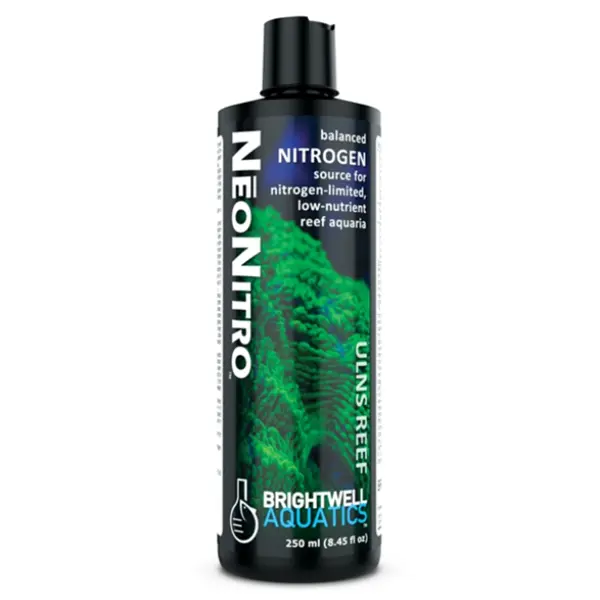
Brightwell Aquatics NeoNitro 250 mL – Reef Aquarium Nitrogen Supplement
Brightwell Aquatics NeoNitro 250 mL is a balanced nitrogen source formulated for nitrogen-limited marine and reef aquariums. It is designed for low-nutrient and ultra-low-nutrient systems where nitrate is below the desired range or cannot be detected with the testing method being used.
Nitrogen is required by beneficial microorganisms, zooxanthellae, and other reef organisms. When nitrate becomes too low, microbial nutrient processing may slow and phosphate may remain elevated even when carbon dosing, bacterial supplementation, protein skimming, and other nutrient-management methods are being used.
NeoNitro supplies nitrogen in a controlled form so experienced reef aquarists can restore nutrient balance. It may be used with Brightwell MicroBacter7, Reef BioFuel, Katalyst, and NeoPhos as part of a carefully monitored reef nutrient-management program.
Key Features
- Balanced Nitrogen Source: Raises available nitrogen in nitrogen-limited marine aquariums
- Supports Measurable Nitrate: Helps establish and maintain nitrate in low-nutrient reef systems
- Designed for ULNS Aquariums: Intended for experienced aquarists maintaining ultra-low nutrient reef tanks
- Supports Nutrient Balance: May allow microbial phosphate uptake to resume when nitrogen is the limiting nutrient
- Compatible with Microbial Programs: May be used with MicroBacter7 and an appropriate organic carbon source
- Works with NeoPhos: Allows nitrogen and phosphorus to be adjusted independently according to test results
- Test-Based Dosing: Intended for controlled dosing with accurate nitrate and phosphate testing
- Marine & Reef Formula: Not intended for routine freshwater aquarium fertilization
Product Information
- Brand: Brightwell Aquatics
- Product: NeoNitro
- Size: 250 mL
- Equivalent Size: Approximately 8.45 fl oz
- SKU: NNI250
- Product Type: Nitrogen and nitrate supplement
- Aquarium Type: Marine and reef aquariums
- Initial Target: Approximately 3 ppm nitrate
- Typical Balancing Range: Approximately 3–5 ppm nitrate
- Experience Level: Advanced
Best Used For
- Reef aquariums with undetectable or undesirably low nitrate
- Ultra-low nutrient systems
- Systems where phosphate remains elevated because nitrogen is limited
- SPS, LPS, soft-coral, and mixed reef aquariums
- Aquariums using MicroBacter7
- Systems using Reef BioFuel or Katalyst
- Experienced aquarists balancing carbon, nitrogen, and phosphorus
- Independent adjustment of nitrate without intentionally adding phosphate
How NeoNitro Works
Microorganisms require adequate carbon, nitrogen, and phosphorus to grow and process organic material. When one of these nutrients is deficient, microbial uptake may slow or stop while the other nutrients continue accumulating.
In a nitrogen-limited reef aquarium, nitrate may remain near zero while phosphate stays elevated. NeoNitro supplies nitrogen so the microbial community can continue growing and assimilating available phosphorus when adequate carbon and suitable microorganisms are also present.
The resulting microbial biomass may then be:
- Removed through protein skimming
- Captured by mechanical filtration
- Consumed by corals and other suspension-feeding organisms
- Removed during normal aquarium maintenance
Important Strength Notice
Brightwell has sold more than one concentration of NeoNitro.
Always use the dosage and number of gallons treated printed on the current bottle. Do not rely on a dosing chart from another bottle, an older product page, or a different retailer unless the concentration is confirmed to be identical.
The exact bottle strength must be verified before calculating how many milliliters are required to raise nitrate by a specific amount.
Directions for Use
- Shake the bottle well before use.
- Test nitrate and phosphate with accurate test kits or calibrated digital testing equipment.
- Confirm that nitrate is below the desired range or undetectable.
- Use the dosage printed on the bottle to raise nitrate to approximately 3 ppm.
- Allow 24 hours to pass.
- Retest nitrate and phosphate.
- Continue adjusting gradually according to the test results and the aquarium’s response.
Do not overdose. Calculate dosage from the aquarium’s estimated actual water volume after accounting for displacement from rock, sand, and equipment.
Initial Nutrient-Balancing Procedure
Brightwell recommends initially raising nitrate to approximately:
3 ppm.
After dosing, wait 24 hours and test nitrate and phosphate again.
If Nitrate and Phosphate Remain Unchanged
The aquarium may be carbon-limited. Brightwell recommends adding Reef BioFuel at:
1 mL per 25 US gallons.
Wait another 24 hours and retest. Continue daily Reef BioFuel dosing according to its directions until nitrate or phosphate begins decreasing.
Reef BioFuel should be used only in a system with active and effective protein skimming.
If Phosphate Begins Decreasing
Nitrate may also decrease as microorganisms assimilate nutrients. Continue dosing NeoNitro as required to maintain nitrate around:
3–5 ppm.
Continue until phosphate reaches the desired range for the individual reef aquarium. Thereafter, dose NeoNitro only as needed to maintain the selected nitrate and phosphate levels.
Does NeoNitro Directly Remove Phosphate?
No. NeoNitro does not chemically bind, adsorb, or precipitate phosphate.
It may indirectly support phosphate reduction when:
- The aquarium is nitrogen-limited
- A suitable microbial population is present
- Adequate organic carbon is available
- Microbial biomass is effectively exported
- Nutrient input does not exceed the aquarium’s removal capacity
If phosphate decreases after NeoNitro is added, the reduction occurs through biological uptake rather than direct chemical filtration.
Use with MicroBacter7
Brightwell states that NeoNitro results are generally most significant when the aquarium is being dosed with MicroBacter7 daily or every other day.
- MicroBacter7: Supplies selected microorganisms and natural enzymes
- NeoNitro: Supplies nitrogen when nitrate is deficient
- Reef BioFuel or Katalyst: Supplies organic carbon
- NeoPhos: Supplies phosphorus when phosphate is deficient
Do not automatically use every product at once. Add only the nutrient or microbial support that testing indicates is deficient.
Use with Reef BioFuel
Reef BioFuel supplies organic carbon to nutrient-assimilating microorganisms. It may be needed when nitrate and phosphate do not change after NeoNitro dosing, indicating that available carbon may be limiting microbial activity.
Carbon dosing can cause rapid bacterial growth, cloudy water, and reduced dissolved oxygen if overused. Maintain strong aeration and effective protein skimming.
Use with NeoPhos
NeoPhos is the corresponding phosphorus supplement for aquariums where phosphate is too low.
- NeoNitro: Used when nitrogen or nitrate is deficient
- NeoPhos: Used when phosphorus or phosphate is deficient
Test both nutrients before dosing. Do not add NeoNitro solely because phosphate is elevated, and do not add NeoPhos solely because nitrate is elevated.
When Not to Use NeoNitro
Do not use NeoNitro when:
- Nitrate is already within or above the desired range
- Nitrate has not been tested accurately
- The aquarium has elevated ammonia or nitrite
- The system is newly cycling and biological filtration is not established
- The aquarist cannot test nitrate and phosphate regularly
- The goal is to directly remove phosphate without managing microbial nutrient balance
Can NeoNitro Be Overdosed?
Yes. Excessive dosing can raise nitrate above the desired range and create an imbalance among carbon, nitrogen, and phosphorus.
Potential consequences include:
- Elevated nitrate
- Nuisance algae growth
- Cyanobacterial growth
- Changes in coral coloration
- Increased microbial growth
- Cloudy water when combined with excessive carbon dosing
- Reduced dissolved oxygen
Do not repeatedly dose without allowing time for testing and observing the aquarium’s response.
Avoid Driving Nutrients to Zero
Corals, zooxanthellae, microorganisms, and other reef organisms require nitrogen and phosphorus. Maintaining both nutrients at undetectable levels may contribute to pale coloration, reduced growth, tissue loss, or ecological imbalance.
NeoNitro should be used to correct nitrogen limitation—not to chase one exact number in every aquarium.
Does NeoNitro Improve Coral Coloration?
Restoring nitrogen availability in a severely nitrogen-limited system may support more normal zooxanthellae function and coral coloration. However, NeoNitro does not directly color corals or guarantee improved appearance.
Coral coloration also depends on:
- Lighting intensity and spectrum
- Phosphate availability
- Alkalinity stability
- Calcium and magnesium
- Water flow
- Feeding
- Trace-element balance
- Temperature and salinity
- Pests, disease, and coral health
Testing Recommendations
Use accurate low-range nitrate and phosphate testing methods. Standard broad-range tests may not provide sufficient precision for ultra-low nutrient systems.
For consistent results:
- Test before every significant adjustment
- Retest approximately 24 hours after dosing
- Use the same testing method for comparisons
- Confirm unexpected readings before adding more product
- Track dosage and test results in a log
- Observe coral appearance alongside numerical results
Automated Dosing
NeoNitro may be used with an accurately calibrated dosing pump after the aquarium’s nutrient demand and exact bottle concentration have been confirmed.
Before automating:
- Verify the strength printed on the bottle
- Establish the correct dose manually
- Calibrate the dosing pump
- Prevent siphoning or accidental continuous dosing
- Test nitrate and phosphate frequently
- Adjust the dose as livestock, feeding, and nutrient demand change
Is NeoNitro Suitable for Beginners?
Brightwell recommends NeoNitro for advanced reef aquarists maintaining low- or ultra-low-nutrient systems.
It requires an understanding of:
- Nitrate and phosphate testing
- Carbon, nitrogen, and phosphorus balance
- Microbial nutrient uptake
- Protein-skimmer operation
- Coral responses to nutrient changes
Is NeoNitro for Freshwater Aquariums?
NeoNitro is formulated and marketed for low-nutrient marine and reef aquariums. It should not be presented as a general freshwater planted-aquarium nitrogen fertilizer.
Use a nutrient supplement specifically labeled for freshwater planted aquariums when dosing freshwater systems.
Storage and Handling
Keep the bottle tightly closed and store it indoors in a cool location away from direct sunlight and excessive heat.
Prevent aquarium water or contaminated measuring equipment from entering the bottle.
Keep out of reach of children. Not for human consumption. Intended for ornamental marine aquarium use only.
Frequently Asked Questions
What does Brightwell NeoNitro do?
It supplies nitrogen to low-nutrient marine aquariums where nitrate is too low or undetectable.
What nitrate level should I initially target?
Brightwell recommends initially raising nitrate to approximately 3 ppm.
What nitrate range is commonly maintained during nutrient balancing?
Brightwell’s instructions reference maintaining approximately 3–5 ppm while phosphate is being brought into the desired range.
What is the exact dose for the 250 mL bottle?
Use the dosage printed on your bottle. Brightwell has sold more than one NeoNitro concentration, so one universal dose should not be assumed.
Should NeoNitro be shaken?
Yes. Shake the bottle well before dosing.
Does NeoNitro directly remove phosphate?
No. It may enable biological phosphate uptake when the aquarium is nitrogen-limited and sufficient carbon and microorganisms are present.
Can NeoNitro be used with MicroBacter7?
Yes. Brightwell states that results may be more significant when MicroBacter7 is dosed daily or every other day.
Can it be used with Reef BioFuel?
Yes. Reef BioFuel may supply carbon when the aquarium is carbon-limited. Use active protein skimming and dose carefully.
Can NeoNitro be used with NeoPhos?
Yes, when testing indicates that nitrogen and phosphorus require separate adjustment.
How soon should nitrate and phosphate be retested?
Brightwell recommends waiting approximately 24 hours after dosing before retesting.
Can NeoNitro be overdosed?
Yes. Excessive dosing can raise nitrate too quickly and create nutrient imbalance.
Will NeoNitro improve coral coloration?
Correcting nitrogen limitation may support normal coral and zooxanthellae function, but improved coloration is not guaranteed.
Should nitrate and phosphate be maintained at zero?
No. Reef organisms require measurable nitrogen and phosphorus.
Is NeoNitro intended for beginners?
No. Brightwell recommends it for advanced reef aquarists managing low- and ultra-low-nutrient systems.
Is NeoNitro suitable for freshwater aquariums?
No. It is intended for marine and reef nutrient-management programs.
Does NeoNitro replace water changes?
No. It adjusts nitrogen availability but does not remove waste or replace routine aquarium maintenance.
Available at Tropical Treasures Wyo
Brightwell Aquatics NeoNitro 250 mL supplies nitrogen for low-nutrient reef aquariums where nitrate is below the desired range or undetectable.
Visit Tropical Treasures Wyo in Cheyenne, Wyoming, to shop Brightwell NeoNitro, NeoPhos, MicroBacter7, Reef BioFuel, marine nitrate and phosphate tests, dosing equipment, and reef aquarium supplies.
Explore More Aquarium Products:
Low stock: 3 left
Couldn't load pickup availability
Explore Related Aquarium Products: