
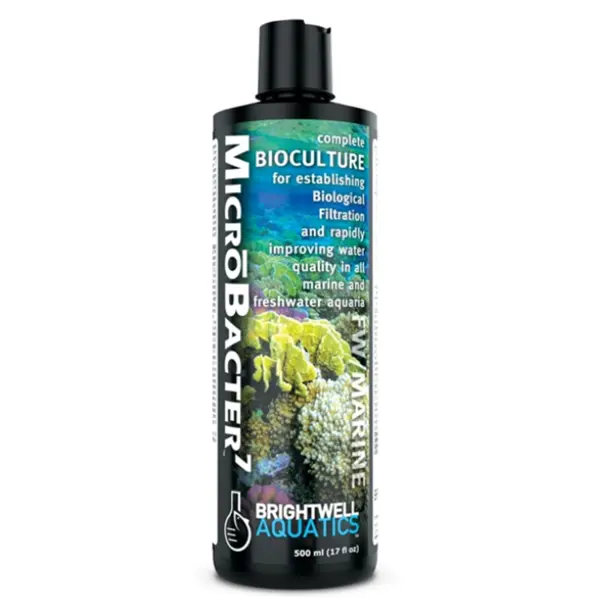
Brightwell Aquatics MicroBacter7 500 mL – Beneficial Bacteria & Biological Filtration Support
Brightwell Aquatics MicroBacter7 500 mL is a concentrated microbial and enzymatic supplement formulated to establish biological filtration and improve water quality in freshwater, marine, and reef aquariums.
Its proprietary blend of non-pathogenic aerobic and anaerobic microorganisms, together with natural enzymes, supports nitrification, denitrification, and the breakdown of dissolved and particulate organic waste. This can help reduce concentrations of organic carbon, ammonia, nitrite, nitrate, and phosphate while improving aquarium clarity and cleanliness.
MicroBacter7 may be used when establishing a new aquarium, after disruptions to biological filtration, following an increase in livestock, or as part of an ongoing nutrient-management and aquarium-maintenance routine.
Key Features
- Complete Microbial Culture: Contains a proprietary blend of non-pathogenic aerobic and anaerobic microorganisms
- Includes Natural Enzymes: Supports the breakdown and remineralization of organic waste
- Supports Biological Filtration: Helps establish and maintain microbial populations involved in aquarium nutrient processing
- Supports Nitrification & Denitrification: Helps process ammonia, nitrite, and nitrate through natural biological pathways
- Reduces Organic Waste: Helps digest uneaten food, fish waste, detritus, and other latent organic material
- Supports Nutrient Control: May help reduce nitrate and phosphate concentrations when used as part of proper aquarium husbandry
- Improves Water Clarity: Helps reduce dissolved and suspended organic material that can contribute to cloudy or discolored water
- Freshwater & Marine Use: Suitable for freshwater, planted, marine, and reef aquariums
- Concentrated 500 mL Bottle: Suitable for larger aquariums, multiple systems, and regular maintenance
Product Information
- Brand: Brightwell Aquatics
- Product: MicroBacter7
- Size: 500 mL
- Equivalent Size: Approximately 16.9 fl oz
- Product Type: Beneficial microbial and natural-enzyme aquarium supplement
- Microorganism Type: Non-pathogenic aerobic and anaerobic microorganisms
- Aquarium Type: Freshwater, planted, marine, and reef aquariums
- Refrigeration Required: No
- Recommended Storage: Cool, shaded location; refrigeration may maximize product longevity
Best Used For
- Establishing biological filtration in new aquariums
- Freshwater aquarium cycling support
- Marine and reef aquarium cycling support
- Medium- to high-nutrient aquarium systems
- Supporting recovery after filter cleaning or media replacement
- Increasing aquarium livestock or biological load
- Reducing accumulations of organic waste and detritus
- Supporting nitrate and phosphate management
- Improving water clarity
- Freshwater community aquariums
- Planted aquariums
- Marine fish-only and reef aquariums
How MicroBacter7 Works
MicroBacter7 contains microorganisms and enzymes involved in the natural remineralization of aquarium waste. Remineralization is the biological process through which complex organic material is broken down into simpler compounds that can be reused or further processed within the aquarium ecosystem.
The microorganisms support several important processes:
- Nitrification: Biological conversion of ammonia into nitrite and then nitrate
- Denitrification: Biological conversion of nitrate into nitrogen gas under suitable low-oxygen conditions
- Organic-Waste Degradation: Breakdown of food, fish waste, detritus, and dissolved organic compounds
- Nutrient Remineralization: Conversion of organic material into simpler nutrient forms
The effectiveness of these processes depends on aquarium oxygenation, available biological surface area, nutrient levels, water chemistry, temperature, and maintenance practices.
Directions Before Dosing
- Shake the bottle well before each use.
- Measure the appropriate dose according to the aquarium’s total water volume and current nutrient level.
- Mix the measured dose with approximately 250 mL, or 8 fl oz, of aquarium water in a clean container.
- Add the mixture to the aquarium or external biological filtration system.
- Do not pour the product directly into a pump intake.
- Turn off protein skimming and UV sterilization for four hours after dosing.
- Maintain normal aquarium circulation and oxygenation.
Brightwell states that the best results may be obtained by adding the prepared mixture to an external biological filtration system when one is present.
New Aquariums & Medium- to High-Nutrient Systems
For new aquarium startup, biological-filter seeding, or medium- to high-nutrient systems:
Add 5 mL, or one capful, per 25 US gallons every day for the first two weeks.
This is equivalent to approximately four drops per gallon.
Turn off protein skimming and UV sterilization for four hours after each dose. After the initial two-week period, switch to the stable low-nutrient maintenance dosage.
Initial Two-Week Dosage Guide
- 5 Gallons: Approximately 1 mL daily
- 10 Gallons: Approximately 2 mL daily
- 20 Gallons: Approximately 4 mL daily
- 25 Gallons: 5 mL daily
- 29 Gallons: Approximately 5.8 mL daily
- 40 Gallons: Approximately 8 mL daily
- 50 Gallons: 10 mL daily
- 55 Gallons: Approximately 11 mL daily
- 75 Gallons: 15 mL daily
- 100 Gallons: 20 mL daily
- 125 Gallons: 25 mL daily
- 150 Gallons: 30 mL daily
These quantities are proportional calculations based on Brightwell’s official dose of 5 mL per 25 gallons.
Stable Low-Nutrient Aquarium Maintenance
For stable aquariums with low nutrient concentrations:
Add 5 mL per 50 US gallons no more than once each week.
Alternative maintenance schedules provided by Brightwell include:
- 1 mL per 50 gallons daily
- 1 mL per 25 gallons every other day
Turn off protein skimming and UV sterilization for four hours after dosing.
Weekly Maintenance Dosage Guide
- 5 Gallons: Approximately 0.5 mL weekly
- 10 Gallons: Approximately 1 mL weekly
- 20 Gallons: Approximately 2 mL weekly
- 25 Gallons: Approximately 2.5 mL weekly
- 29 Gallons: Approximately 2.9 mL weekly
- 40 Gallons: Approximately 4 mL weekly
- 50 Gallons: 5 mL weekly
- 55 Gallons: Approximately 5.5 mL weekly
- 75 Gallons: Approximately 7.5 mL weekly
- 100 Gallons: 10 mL weekly
- 125 Gallons: Approximately 12.5 mL weekly
- 150 Gallons: 15 mL weekly
Maximum Recommended Maintenance Dose
Brightwell recommends that maintenance dosing not exceed:
1 mL per 25 gallons per day.
Increasing the dosage beyond the recommended level does not necessarily produce faster or better results. Excessive microbial activity may increase oxygen demand, especially in heavily stocked or poorly aerated aquariums.
Once the desired results have been achieved, some aquariums may maintain good conditions with a dosage or frequency reduced by as much as 50%.
After Adding Fish or Changing Biological Filtration
When increasing the aquarium’s biological load or making substantial changes to the filtration system:
Add 1 mL per 25 gallons daily for one week.
After the one-week support period, return to the normal low-nutrient maintenance dosage.
This may be useful after:
- Adding new fish
- Increasing feeding
- Replacing part of the biological media
- Cleaning filters more aggressively than normal
- Moving an aquarium
- Restarting circulation after an extended outage
How Much Does the 500 mL Bottle Treat?
The 500 mL bottle contains approximately 100 individual 5 mL capfuls.
- Initial or high-nutrient dose: Each 5 mL treats 25 gallons
- Weekly maintenance dose: Each 5 mL treats 50 gallons
The entire bottle provides enough product for approximately:
- 2,500 gallon-doses at the initial 5 mL-per-25-gallon rate
- 5,000 gallon-doses at the weekly 5 mL-per-50-gallon rate
These figures describe cumulative dosing capacity, not the volume of one aquarium that can complete the full two-week startup program.
Does MicroBacter7 Instantly Cycle an Aquarium?
No bacterial supplement can guarantee that every aquarium will become fully cycled immediately.
MicroBacter7 introduces microorganisms that support biological filtration, but the bacteria still require suitable surfaces, oxygen, nutrients, stable water chemistry, and time to establish effective populations.
Continue testing ammonia and nitrite throughout the cycling process. Do not assume that an aquarium is fully cycled simply because the water appears clear.
Using MicroBacter7 in a New Aquarium
- Set up the aquarium, filter, heater, and aeration.
- Condition all tap water to remove chlorine and chloramine.
- Add suitable biological filter media.
- Shake and dose MicroBacter7 at 5 mL per 25 gallons daily.
- Continue the daily dosage for two weeks.
- Provide an appropriate nutrient source for the bacteria.
- Test ammonia, nitrite, and nitrate regularly.
- Add livestock gradually rather than fully stocking the aquarium at once.
Brightwell recommends using FaStart-M according to its instructions to provide nutrients that help establish the bacterial population rapidly. The manufacturer states not to use FaStart-M with QuikCycl.
Does MicroBacter7 Reduce Ammonia?
MicroBacter7 supports microorganisms involved in ammonia processing and may help reduce ammonia concentrations as biological filtration develops.
It is not an instant ammonia-neutralizing water conditioner. During an ammonia emergency:
- Test and confirm the ammonia concentration
- Increase aeration
- Perform an appropriate conditioned water change
- Remove decaying food or livestock
- Check filter operation
- Use an appropriate ammonia-detoxifying conditioner when needed
MicroBacter7 can support long-term biological recovery but should not replace immediate emergency action.
Does MicroBacter7 Reduce Nitrite?
The microbial blend supports nitrification and may help process nitrite as the biological filter becomes established.
Detectable nitrite indicates that the aquarium’s nitrogen cycle is not yet keeping up with waste production. Continue testing, reduce feeding when appropriate, maintain aeration, and perform conditioned water changes as needed.
Does MicroBacter7 Reduce Nitrate?
MicroBacter7 supports denitrification and other microbial nutrient-processing pathways that can help reduce nitrate under appropriate aquarium conditions.
Nitrate reduction is not guaranteed and depends on factors including:
- Available low-oxygen biological zones
- Carbon availability
- Amount and type of biological media
- Feeding and waste production
- Water-change schedule
- Plant or macroalgae uptake
- Protein-skimmer performance in marine systems
Continue water changes and nitrate testing. Do not rely solely on bacterial supplementation to control excessive nitrate.
Does MicroBacter7 Reduce Phosphate?
Brightwell states that MicroBacter7 can help reduce phosphate through microbial nutrient uptake and remineralization.
The outcome depends on available carbon, nitrogen, aquarium conditions, microbial export, and the amount of phosphate entering the system.
Persistent phosphate problems may also require feeding adjustments, source-water testing, mechanical cleaning, protein skimming, refugium management, or phosphate-removing media.
Organic-Waste & Detritus Breakdown
MicroBacter7 helps break down latent organic material such as:
- Uneaten food
- Partially digested food
- Fish and invertebrate waste
- Detritus
- Decaying plant or algae material
- Dissolved organic compounds
This process can help maintain cleaner substrate and filter systems, but it does not eliminate the need to vacuum debris, clean mechanical media, remove dead material, and perform water changes.
Water-Clarity Support
Brightwell states that a noticeable improvement in water clarity is often apparent within approximately 30 minutes of dosing.
Results vary according to the cause of the cloudiness. MicroBacter7 may help when cloudiness is associated with organic material, but it will not directly correct every cause of cloudy water.
Other causes may include:
- New substrate dust
- Free-floating algae
- A bacterial bloom
- Calcium carbonate precipitation
- Overfeeding
- Decaying livestock or plants
- Insufficient mechanical filtration
Use with Protein Skimmers
MicroBacter7 may be used in marine aquariums with protein skimmers.
Brightwell directs users to turn the skimmer off for four hours after dosing. This gives the microorganisms time to settle into the aquarium and filtration surfaces instead of being immediately exported into the skimmer collection cup.
Restart the protein skimmer after four hours. Ongoing skimming can help remove microbial biomass and processed organic material from the aquarium.
Use with UV Sterilizers
Turn off UV sterilization for four hours after adding MicroBacter7.
UV sterilization may damage microorganisms while they are suspended in the water column. Turning it off temporarily allows more bacteria to reach the filter media, substrate, rock, and other colonization surfaces.
Do not turn off essential filtration, circulation, heating, or aeration.
Use with Ozone
Ozone may reduce the survival of newly added microorganisms. Temporarily discontinuing ozonation during and shortly after bacterial dosing may improve establishment.
Follow the instructions for the ozone system and monitor oxidation-reduction potential carefully. Never operate ozone without the recommended safety and carbon-filtration measures.
Use in Freshwater Aquariums
MicroBacter7 is formulated for freshwater as well as marine aquariums. It may be used in community tanks, cichlid aquariums, planted systems, breeding setups, and other established freshwater aquariums.
Brightwell also produces FlorinBacter7 specifically for freshwater and planted aquariums. Customers maintaining exclusively freshwater systems may compare the two products according to their aquarium goals.
Use in Planted Aquariums
MicroBacter7 may be used in planted aquariums. The microorganisms help process organic material and support the aquarium’s biological filtration.
Monitor nitrate and phosphate in heavily planted systems. Plants require available nutrients, and aggressive nutrient reduction may be counterproductive when nitrate or phosphate becomes deficient.
MicroBacter7 is not a plant fertilizer and does not replace appropriate macro- and micronutrient supplementation.
Use in Reef Aquariums
MicroBacter7 is suitable for marine and reef systems containing fish, corals, and invertebrates when used as directed.
In low-nutrient reef systems, bacterial supplementation should be guided by nitrate, phosphate, coral appearance, oxygenation, and protein-skimmer performance.
Reducing nitrate or phosphate to undetectable levels can be undesirable for corals and other photosynthetic organisms. Dose conservatively once the aquarium reaches the desired nutrient range.
Use with Carbon Dosing
MicroBacter7 may be paired with an appropriate microbial carbon source in systems where controlled nitrate and phosphate reduction is desired.
Brightwell recommends products such as Reef BioFuel or Katalyst for applicable marine systems. Carbon dosing should be approached carefully because excessive bacterial growth can reduce dissolved oxygen and cause cloudy water or bacterial films.
Do not begin aggressive carbon dosing without adequate protein skimming, aeration, and reliable nitrate and phosphate testing.
Use After Water Changes
Routine water changes do not normally remove all beneficial bacteria because most bacterial populations live on filter media, substrate, rock, decorations, and other surfaces rather than freely in the water.
MicroBacter7 may still be used after a water change as part of the normal maintenance schedule or when the aquarium has experienced a significant disturbance.
Do not automatically use the higher startup dose after every routine water change unless the aquarium’s conditions justify it.
Use After Filter Cleaning
MicroBacter7 may support biological recovery after filter cleaning, especially when a substantial amount of biological media has been disturbed or replaced.
To protect established bacteria:
- Rinse biological media in removed aquarium water or dechlorinated water
- Do not replace all biological media at once
- Avoid cleaning every filter on the same day in multi-filter systems
- Keep biological media wet and oxygenated during maintenance
- Never use soap or household cleaners
Use After Medication
Some aquarium medications, especially antibiotics, may disrupt biological filtration. MicroBacter7 may be used after treatment to help re-establish microbial populations.
Complete the medication course first and remove residual medication according to the product directions. Antibiotic residue may damage newly added bacteria.
Continue monitoring ammonia and nitrite closely after treatment.
Can MicroBacter7 Be Overdosed?
Using more than the recommended dosage does not necessarily accelerate biological filtration or nutrient reduction.
Excessive microbial growth may:
- Increase dissolved-oxygen demand
- Produce temporary water cloudiness
- Create bacterial films
- Cause protein-skimmer instability
- Reduce nitrate or phosphate below the desired range
Maintain strong aeration and do not exceed Brightwell’s recommended maximum maintenance dose of 1 mL per 25 gallons daily.
Storage Instructions
MicroBacter7 does not require refrigeration. Store it tightly closed in a cool, shaded location away from direct sunlight and excessive heat.
Refrigeration may help maximize shelf life, but the product should not be frozen.
Brightwell states that the microorganisms are supplied in suspended animation for longevity and identifies a two-year shelf life from the date of manufacture. For best results, the manufacturer recommends using the product within one year of purchase.
Avoiding Bottle Contamination
Do not allow aquarium water, food, dirty measuring tools, or used pipettes to enter the bottle.
When using a pipette below the aquarium waterline, rinse and clean it thoroughly with fresh water before returning it to the MicroBacter7 container. Introducing aquarium water into the bottle may contaminate the product.
Dosing Tips
- Shake the bottle well before every use
- Measure dosage according to actual aquarium water volume
- Mix the dose with approximately 250 mL of aquarium water
- Add to biological filtration when practical
- Do not pour directly into pump intake ports
- Turn off protein skimming and UV for four hours
- Maintain normal circulation and aeration
- Test ammonia, nitrite, nitrate, and phosphate regularly
- Reduce maintenance dosing once the desired result is achieved
- Do not exceed the recommended maximum dosage
Important Aquarium Care Note
MicroBacter7 supports biological filtration and nutrient processing but does not replace aquarium cycling, water conditioning, water changes, mechanical filtration, protein skimming, substrate cleaning, or proper stocking.
It is not an instant detoxifier or medication. During an ammonia or nitrite emergency, take immediate corrective action rather than relying solely on bacterial supplementation.
Clear aquarium water is not necessarily safe water. Continue testing all parameters appropriate for the system.
Rapid microbial growth can consume oxygen. Maintain good circulation and aeration, especially in heavily stocked, warm, or nutrient-rich aquariums.
Frequently Asked Questions
What is Brightwell MicroBacter7?
MicroBacter7 is a blend of non-pathogenic aerobic and anaerobic microorganisms and natural enzymes used to establish biological filtration and support aquarium nutrient processing.
Is MicroBacter7 suitable for freshwater aquariums?
Yes. It is formulated for freshwater and marine aquariums, including planted and reef systems.
Is MicroBacter7 reef safe?
Yes. It may be used in reef aquariums containing fish, corals, and invertebrates when used as directed.
How much should I use in a new aquarium?
Use 5 mL per 25 gallons daily for the first two weeks.
What is the weekly maintenance dose?
Use 5 mL per 50 gallons no more than once weekly in stable low-nutrient systems.
Can it be dosed daily for maintenance?
Yes. Brightwell provides an alternative dose of 1 mL per 50 gallons daily.
Should the bottle be shaken?
Yes. Shake well before each use.
Should MicroBacter7 be diluted before use?
Brightwell recommends mixing the dose with approximately 250 mL, or 8 fl oz, of aquarium water before adding it.
Can it be poured into a pump intake?
No. Brightwell advises against adding MicroBacter7 directly to pump intake ports.
Should the protein skimmer be turned off?
Yes. Turn the protein skimmer off for four hours after dosing.
Should UV sterilization be turned off?
Yes. Turn UV sterilization off for four hours after dosing.
Does MicroBacter7 instantly cycle an aquarium?
No. It supports establishment of biological filtration, but cycling still requires suitable conditions, testing, and time.
Does it remove ammonia?
It supports microorganisms involved in ammonia processing but is not an instant ammonia-neutralizing conditioner.
Does it reduce nitrite?
It supports nitrification and may help process nitrite as the biological filter develops.
Does it reduce nitrate?
It supports denitrification and microbial nutrient uptake, but nitrate reduction depends on aquarium conditions.
Does it reduce phosphate?
Brightwell states that it can support phosphate reduction through microbial processes. Continue testing and adjust dosing according to the aquarium’s nutrient level.
Does MicroBacter7 improve water clarity?
It can improve clarity by breaking down dissolved and particulate organic material. Brightwell states that visible improvement may occur within approximately 30 minutes, although results vary.
Can it replace water changes?
No. It supports biological processes but does not replace regular water changes and physical aquarium maintenance.
Can it be used after filter cleaning?
Yes. It may help support biological recovery after significant filter maintenance or media replacement.
Can it be used after medication?
Yes, after treatment is complete and residual medication has been removed. Continue monitoring ammonia and nitrite.
Does MicroBacter7 need refrigeration?
No. Refrigeration is not required, although cool storage or refrigeration may help maintain product longevity. Do not freeze it.
How long does MicroBacter7 last?
Brightwell identifies a two-year shelf life from manufacture and recommends using it within one year of purchase for best results.
Can MicroBacter7 be overdosed?
Yes. Excessive bacterial dosing can increase oxygen demand and may cause cloudiness or bacterial films. Follow the recommended dosage.
Available at Tropical Treasures Wyo
Brightwell Aquatics MicroBacter7 500 mL provides a concentrated blend of non-pathogenic microorganisms and natural enzymes for establishing biological filtration, processing organic waste, and supporting nutrient control in freshwater, marine, and reef aquariums.
Visit Tropical Treasures Wyo in Cheyenne, Wyoming, to shop Brightwell Aquatics beneficial bacteria, aquarium conditioners, biological filter media, nitrate and phosphate test kits, protein-skimmer supplies, and aquarium maintenance products.
Explore More Aquarium Products:
Low stock: 3 left
Couldn't load pickup availability
Explore Related Aquarium Products: