
Steel-Blue Killifish – Fundulopanchax gardneri
The Steel-Blue Killifish (Fundulopanchax gardneri), also known as the Gardneri Killifish or Blue Lyretail, is one of the most colorful and popular African killifish in the aquarium hobby.
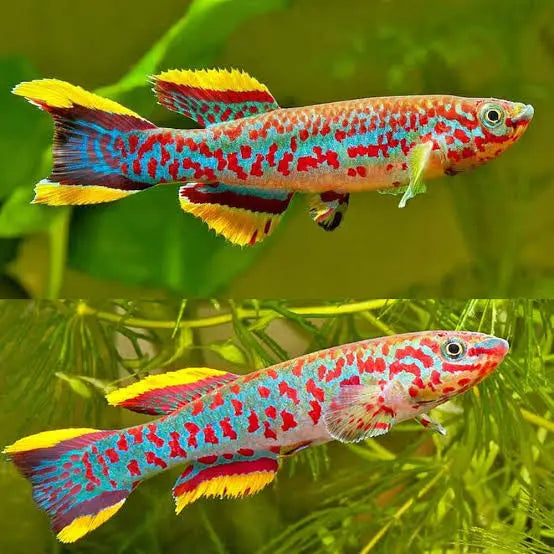
Mature males can develop brilliant steel-blue to blue-green coloration covered with vivid red spots and markings, along with colorful extended fins. Females are generally more subdued but remain attractive and active.
This species is relatively hardy for a killifish and is a good introduction to the group, but it is best maintained in a carefully planned aquarium rather than an unrestricted community setup.
Key Features
- Brilliant steel-blue coloration in mature males
- Striking red spots and markings
- Beautiful extended fins
- Popular African killifish species
- Relatively hardy compared with many killifish
- Can be maintained in pairs or small groups
- Excellent for planted aquariums
- Accepts prepared, frozen, and live foods
- Requires a tightly fitted aquarium lid
Fish Information
- Common Name: Steel-Blue Killifish
- Also Known As: Gardneri Killifish, Gardner's Killi, Blue Lyretail
- Scientific Name: Fundulopanchax gardneri
- Family: Nothobranchiidae
- Origin: West Africa
- Native Range: Nigeria and Cameroon
- Water Type: Freshwater
- Temperament: Generally peaceful toward many fish, but males may be territorial with one another
- Adult Size: Approximately 2–2.5 inches, with some individuals approaching 2.6 inches
- Swimming Level: Middle to upper levels
- Diet: Omnivore / micropredator
- Care Level: Easy to Moderate
Color and Appearance
Male Steel-Blue Killifish are exceptionally colorful. Depending on the strain or locality, males may display a metallic blue, turquoise, or blue-green body covered with bright red spots and streaks.
The fins may contain combinations of blue, yellow, red, and orange coloration.
Females are usually more subdued, with tan to gray-brown coloration and smaller fins.
Adult Size
Most Steel-Blue Killifish reach approximately 2–2.5 inches as adults.
FishBase reports a maximum total length of approximately 6.5 cm, or about 2.6 inches.
Recommended Aquarium Size
A 15-gallon aquarium or larger can work for a pair or small group, although a 20-gallon aquarium or larger provides more room for territories and planted cover.
When keeping multiple males, additional aquarium space and visual barriers are particularly important.
Recommended Water Parameters
- Temperature: Approximately 68–79°F
- pH: Approximately 6.0–7.5
- Water Hardness: Soft to moderately hard, approximately 1–10 dGH
- Ammonia: 0 ppm
- Nitrite: 0 ppm
- Nitrate: Kept low through routine maintenance
Stable water quality is more important than maintaining one exact pH value.
Aquarium Setup
Steel-Blue Killifish do especially well in planted aquariums with plenty of cover.
- Use a fully cycled freshwater aquarium
- Provide gentle filtration
- Use plants to create visual barriers
- Add floating plants for additional security
- Provide Java moss, spawning mops, or dense vegetation
- Use driftwood or other aquarium-safe décor
- Maintain gentle to moderate water movement
- Use a tightly fitting aquarium lid
Important Jumping Warning
Steel-Blue Killifish are excellent jumpers.
A securely fitted lid is essential. Even small gaps around filters, heaters, airline tubing, or cables may provide an escape route.
Feeding
In nature, Fundulopanchax gardneri feeds heavily on small aquatic invertebrates, insect larvae, worms, and zooplankton.
In the aquarium, offer a varied diet that may include:
- High-quality flakes
- Micro pellets
- Frozen brine shrimp
- Live or frozen daphnia
- Bloodworms
- Baby brine shrimp
- Small live foods
Live and frozen foods are especially useful for maintaining strong coloration and conditioning fish for breeding.
Temperament
Steel-Blue Killifish are relatively robust but should not automatically be treated as ideal general community fish.
Males can become territorial or aggressive toward one another, especially when competing for females.
Plenty of plants, hiding areas, and visual barriers can help reduce aggression.
Keeping Pairs and Groups
A pair can be maintained successfully, but when keeping mixed groups it is often better to provide approximately two to three females per male.
This helps distribute male attention and reduces pressure on a single female.
Multiple males require additional space and plenty of cover.
Potential Tankmates
Carefully selected tankmates may include:
- Peaceful small to medium rasboras
- Peaceful tetras
- Corydoras
- Small peaceful catfish
- Other calm fish that will not harass or outcompete them
Avoid aggressive fish, persistent fin nippers, or extremely fast and boisterous species.
Male vs. Female
Males are generally larger, much more colorful, and develop longer, more decorative fins.
Females are usually smaller and more subdued in coloration.
Breeding
Steel-Blue Killifish are considered relatively easy to breed compared with many killifish species.
Eggs may be deposited among:
- Java moss
- Fine-leaved plants
- Spawning mops
- Peat or similar spawning media
The eggs may develop while submerged or can tolerate a period of damp incubation depending on breeding method.
Adults may eat eggs, so breeders often remove eggs regularly or move spawning media to a separate incubation container.
Plants and Aquascaping
Dense planting works very well for Steel-Blue Killifish.
Good choices include:
- Java moss
- Water sprite
- Guppy grass
- Anubias
- Java fern
- Cryptocoryne
- Floating plants
Plants provide hiding areas, break up territories, and can also serve as spawning sites.
Expected Lifespan
Steel-Blue Killifish commonly live approximately 2–3 years in aquarium conditions, although lifespan can vary depending on genetics, water quality, temperature, diet, and overall care.
Important Care Notes
- Always use a tightly fitting lid.
- Provide plenty of plants and hiding places.
- Males may be territorial toward one another.
- Consider keeping two to three females per male.
- Feed a varied diet that includes frozen or live foods.
- Maintain ammonia and nitrite at 0 ppm.
- Avoid overly aggressive tankmates.
- Never release aquarium fish into local waterways.
Frequently Asked Questions
How large do Steel-Blue Killifish get?
Most adults reach around 2–2.5 inches, although individuals may approach approximately 2.6 inches.
Are Steel-Blue Killifish peaceful?
They are generally peaceful toward many other fish, but males can be territorial and aggressive toward other males.
Can Steel-Blue Killifish live in a community aquarium?
They can live with carefully selected peaceful tankmates, but they are not ideal for every general community setup. A species-focused or calm planted aquarium is often preferable.
Do they need a planted tank?
Plants are not absolutely required, but dense vegetation and floating plants provide valuable cover and help reduce stress and territorial behavior.
How long do Steel-Blue Killifish live?
A typical aquarium lifespan is approximately 2–3 years, although individual lifespan varies.
Do Steel-Blue Killifish jump?
Yes. They are excellent jumpers, so a tight-fitting aquarium lid is essential.
What should I feed them?
They accept quality prepared foods, but regular frozen or live foods such as brine shrimp, daphnia, and bloodworms are beneficial.
Are Steel-Blue Killifish easy to breed?
Yes. They are considered one of the easier killifish species to breed when maintained under suitable conditions.
Available at Tropical Treasures Wyo
Steel-Blue Killifish are available at Tropical Treasures Wyo in Cheyenne, Wyoming, when in stock.
Live fish are available for in-store purchase or local pickup only and are not available for shipping.
Explore More Aquarium Products:
Out of stock
Couldn't load pickup availability
Explore Related Aquarium Products: