
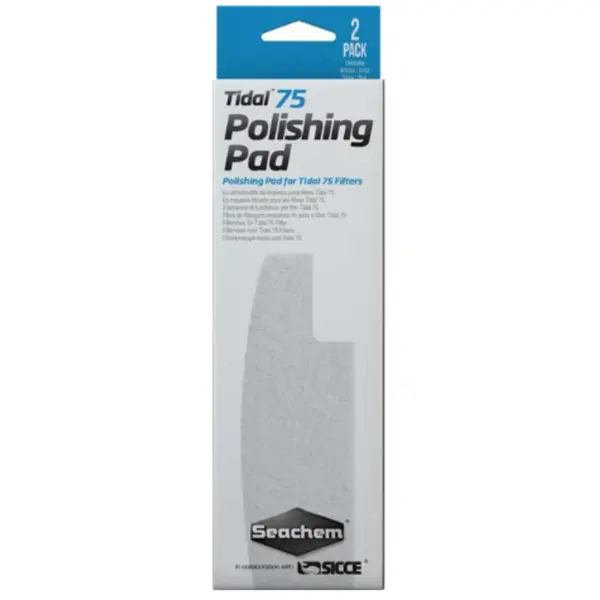
Seachem Tidal 75 Polishing Pad 2 Pack – Fine Mechanical Filter Media
The Seachem Tidal 75 Polishing Pad is a fine mechanical filtration pad designed to fit the media basket of the Seachem Tidal 75 Power Filter. It captures small suspended particles that may pass through the filter’s standard coarse foam, helping produce clearer, more polished aquarium water.
Polishing pads are particularly useful after aquarium maintenance, substrate cleaning, aquascaping, plant trimming, or other activities that release fine debris into the water. They may also be used as part of the filter’s regular mechanical filtration when additional water clarity is desired.
Each package contains two replacement polishing pads sized for the Tidal 75. The pads are suitable for freshwater, planted, brackish, marine, and reef aquariums.
Key Features
- Fine Mechanical Filtration: Captures small suspended particles and debris that may pass through coarse foam
- Improves Water Clarity: Helps polish aquarium water for a cleaner, clearer appearance
- Designed for the Tidal 75: Sized for convenient placement in the Seachem Tidal 75 media basket
- Two-Pad Package: Includes two replacement polishing pads
- Protects Other Filter Media: Helps prevent fine debris from coating biological and chemical filtration media
- Useful After Maintenance: Ideal after gravel cleaning, aquascaping, plant trimming, or disturbing the substrate
- Freshwater & Marine Use: Suitable for freshwater, planted, saltwater, and reef aquariums
- Easy to Install: Fits directly inside the Tidal 75 filter basket without cutting or trimming
Product Information
- Brand: Seachem
- Product: Tidal 75 Polishing Pad
- Pack Size: Two polishing pads
- Filtration Type: Fine mechanical filtration
- Primary Compatibility: Seachem Tidal 75 Power Filter
- Aquarium Type: Freshwater and saltwater aquariums
- Reusable: May be gently rinsed and reused while the pad remains intact and maintains proper water flow
Best Used For
- Removing fine suspended debris
- Improving aquarium water clarity
- Polishing water after substrate cleaning
- Capturing debris after aquascaping
- Removing fine plant fragments after trimming
- Protecting Matrix biological media from excess debris
- Protecting activated carbon, Purigen, and specialty media
- Freshwater community aquariums
- Planted aquariums
- Marine and reef aquariums
How the Polishing Pad Works
The standard reusable Tidal foam captures larger waste particles such as uneaten food, fish waste, plant fragments, and detritus. Smaller suspended particles may pass through this coarse mechanical stage.
The Tidal 75 Polishing Pad provides a finer layer of mechanical filtration that captures many of these smaller particles before they reach the biological or chemical media.
As debris accumulates, the pad gradually becomes more restrictive. It should be inspected, rinsed, or replaced before it significantly reduces filter flow.
Recommended Media Placement
The polishing pad should generally be installed after the coarse Tidal foam but before biological and chemical filtration media.
A practical Tidal 75 media arrangement is:
- Coarse Tidal Foam: Captures larger debris and solid waste
- Tidal 75 Polishing Pad: Captures finer suspended particles
- Seachem Matrix: Provides biological filtration
- Optional Chemical Media: Purigen, MatrixCarbon, PhosGuard, PhosBond, or another appropriate specialty media
The exact arrangement may vary depending on the media being used, but mechanical filtration should normally occur before biological and chemical filtration whenever possible.
Why Mechanical Media Goes First
Placing the polishing pad before Matrix, activated carbon, Purigen, or phosphate-removing media helps prevent fine debris from coating those products.
This can provide several benefits:
- Improved water flow through biological media
- Reduced debris accumulation inside Matrix pores
- Longer useful life for chemical filtration media
- Easier filter maintenance
- Cleaner media baskets
- More effective contact between aquarium water and specialty media
Installing the polishing pad as the final stage may still capture particles released by other media, but it will not provide the same protection for the biological and chemical stages.
Installation Directions
- Turn off and unplug the Seachem Tidal 75 filter.
- Remove the filter cover and lift out the media basket.
- Rinse the new polishing pad with clean water to remove any loose manufacturing debris.
- Place the pad above the reusable coarse foam and before the biological or chemical media.
- Make sure the pad lies flat and does not extend outside the media basket.
- Do not fold, compress, or stack excessive amounts of fine media.
- Return the media basket to the filter.
- Restart the filter and verify that normal water flow has resumed.
How Often Should the Pad Be Cleaned?
There is no single cleaning schedule that applies to every aquarium. Inspect the pad during regular filter maintenance and whenever the Tidal maintenance alert rises.
Cleaning may be needed more frequently in aquariums with:
- Heavy fish stocking
- Large or messy fish
- Frequent feeding
- Goldfish or large cichlids
- Substrate-digging fish
- Heavy plant debris
- Recent aquascaping or gravel cleaning
- Cloudy water containing suspended particles
Lightly stocked and well-maintained aquariums may allow longer periods between cleanings.
When to Replace the Polishing Pad
Replace the pad when it:
- Remains clogged after rinsing
- Restricts filter flow shortly after cleaning
- Becomes compressed or permanently flattened
- Begins tearing, fraying, or losing its shape
- Can no longer be cleaned adequately
- Has been exposed to a contaminant or medication that should not remain in the aquarium
Do not replace the pad automatically every two to four weeks if it remains clean, intact, and unrestricted. Likewise, do not continue using a clogged pad simply because it has not reached a scheduled replacement date.
Can the Pad Be Rinsed and Reused?
The polishing pad may be gently rinsed and reused while it remains structurally sound and can be cleaned without restricting water flow.
For routine aquarium maintenance, rinse it in water removed from the aquarium during a water change or in clean dechlorinated water.
Avoid aggressively twisting, scrubbing, or wringing the pad because this may damage the fibers and reduce its ability to lie flat inside the media basket.
Fine polishing pads generally require replacement more often than the reusable coarse Tidal foam because their tighter structure captures more debris and may become permanently clogged.
Using the Pad After Aquarium Maintenance
The polishing pad is especially useful after activities that disturb debris, including:
- Vacuuming gravel or sand
- Rearranging decorations
- Adding new substrate
- Trimming aquarium plants
- Cleaning algae from glass or decorations
- Moving live rock
- Cleaning a sump or filter chamber
Install a clean pad and operate the filter normally until the suspended debris has been captured. Inspect the pad soon afterward because it may clog more quickly during temporary water-polishing use.
Using the Pad in Planted Aquariums
The Tidal 75 Polishing Pad is suitable for planted aquariums and can help capture small leaf fragments, disturbed substrate particles, and debris released during plant trimming.
The pad does not remove dissolved fertilizer nutrients under normal use because it functions through mechanical filtration rather than chemical adsorption.
It does not replace regular plant maintenance, substrate cleaning, appropriate fertilization, suitable lighting, or carbon management.
Using the Pad in Marine and Reef Aquariums
The polishing pad may be used in saltwater and reef aquariums to capture suspended detritus, sand particles, food debris, and material released during maintenance.
Fine mechanical pads can accumulate organic waste quickly in reef systems. Rinse or replace the pad regularly so trapped waste does not remain in the filter and decompose.
Improved water clarity may increase light penetration. Monitor light-sensitive corals when heavily discolored or cloudy water becomes clear rapidly.
Is the Pad Safe for Shrimp and Sensitive Fish?
The polishing pad is placed inside the filter and does not release medication or chemical filtration ingredients into the aquarium.
It may be used in aquariums containing shrimp, snails, fry, and sensitive fish. However, the pad does not protect small animals from entering the Tidal filter intake.
Use a suitable intake guard or prefilter sponge when protecting juvenile shrimp, fry, or very small fish is necessary.
Does the Pad Remove Ammonia or Nitrate?
No. The polishing pad captures physical debris suspended in aquarium water. It does not directly remove dissolved ammonia, nitrite, nitrate, phosphate, chlorine, chloramine, medications, or heavy metals.
Biological filtration, chemical media, water conditioning, water changes, and appropriate aquarium maintenance are still required.
Polishing Pad vs. Tidal Foam
- Tidal Foam: Coarser, thicker, reusable mechanical filtration that captures larger debris
- Tidal Polishing Pad: Finer mechanical filtration that captures smaller suspended particles
The products are designed to complement each other. The coarse foam should normally remain the first mechanical stage, with the polishing pad positioned immediately afterward.
The polishing pad should not normally replace the reusable foam because fine media alone may clog too quickly.
Polishing Pad vs. Filter Floss
Both polishing pads and filter floss provide fine mechanical filtration.
- Tidal 75 Polishing Pad: Pre-cut to fit the Tidal 75 media basket
- Generic Filter Floss: May need to be cut, shaped, or layered manually
The pre-cut pad offers convenient sizing and a consistent fit, while bulk filter floss may provide more flexibility for customers who prefer custom media arrangements.
Maintenance Tips
- Place the pad after the coarse reusable foam
- Install it before biological and chemical media
- Rinse a new pad before installation
- Do not tightly compress the pad inside the basket
- Inspect it whenever the maintenance alert rises
- Rinse gently when debris begins to accumulate
- Replace it when damaged or permanently clogged
- Clean heavily soiled pads promptly
- Do not use soap, detergent, or household cleaners
- Continue routine water changes and aquarium testing
Important Aquarium Care Note
The Tidal 75 Polishing Pad improves mechanical filtration and water clarity but does not replace biological media, chemical filtration, water conditioning, water changes, or aquarium cycling.
A clogged polishing pad can significantly reduce filter flow. Fine filtration media should be inspected more frequently than coarse foam, particularly in heavily stocked aquariums.
Clear aquarium water is not necessarily chemically safe. Continue testing ammonia, nitrite, nitrate, pH, temperature, salinity, GH, KH, and other parameters appropriate for the aquarium.
Frequently Asked Questions
What is the Seachem Tidal 75 Polishing Pad used for?
It captures small suspended particles and fine debris to help improve aquarium water clarity.
How many pads are included?
Each package contains two Tidal 75 polishing pads.
Which filter does the pad fit?
It is designed specifically for the Seachem Tidal 75 Power Filter.
Where should the polishing pad be placed?
Place it after the coarse Tidal foam and before biological or chemical filter media.
Should it be used as the final filtration stage?
It is generally more effective before biological and chemical media because it protects those stages from fine debris.
Can the pad be rinsed and reused?
Yes. It may be gently rinsed and reused while it remains intact and does not restrict water flow.
How often should it be replaced?
Replace it when it remains clogged after rinsing, restricts flow, becomes damaged, or loses its shape. There is no universal fixed replacement interval.
Should it automatically be replaced every two to four weeks?
No. Actual lifespan depends on fish stocking, feeding, debris, maintenance, and aquarium conditions.
Can it be used in freshwater aquariums?
Yes. It is suitable for freshwater community, planted, cichlid, and other freshwater systems.
Can it be used in saltwater and reef aquariums?
Yes. It may be used in marine and reef systems and should be cleaned regularly as organic debris accumulates.
Is it safe for shrimp?
Yes. The pad itself is suitable for shrimp aquariums, but a separate intake guard may be needed to protect juvenile shrimp.
Does it remove medications?
No. It captures particles but does not adsorb dissolved medications like activated carbon or Purigen may.
Does it remove ammonia or nitrate?
No. It is mechanical filtration and does not directly remove dissolved nitrogen compounds.
Can it replace the standard Tidal foam?
No. The coarse foam captures larger debris and prevents the fine pad from clogging too quickly. The two products are best used together.
What should I do when the Tidal maintenance alert rises?
Inspect the polishing pad and coarse foam for debris and clean or replace them as necessary.
Does the polishing pad replace water changes?
No. It improves mechanical filtration but does not remove all dissolved waste or replace regular aquarium maintenance.
Available at Tropical Treasures Wyo
The Seachem Tidal 75 Polishing Pad 2 Pack provides fine mechanical filtration for capturing suspended debris and improving water clarity in freshwater, planted, marine, and reef aquariums.
Visit Tropical Treasures Wyo in Cheyenne, Wyoming, to shop Tidal 75 polishing pads, replacement foam, Matrix biological media, Purigen, MatrixCarbon, phosphate removers, and aquarium filtration supplies.
Explore More Aquarium Products:
Low stock: 1 left
Couldn't load pickup availability
Explore Related Aquarium Products: