
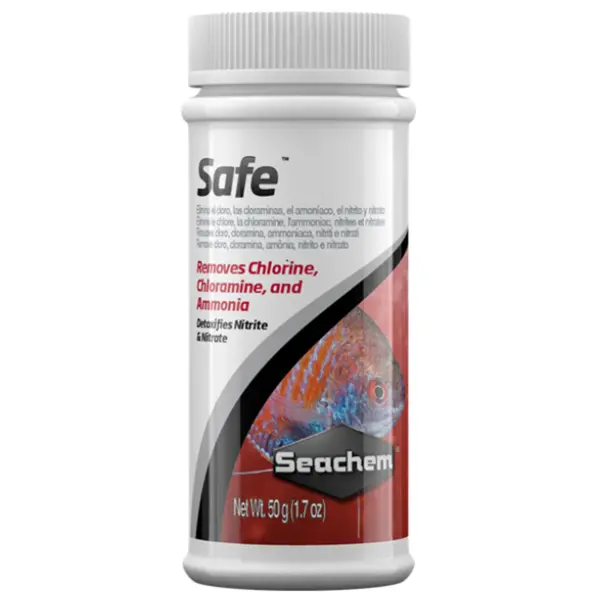
Seachem Safe 50 g – Ultra-Concentrated Dry Aquarium Water Conditioner
Seachem Safe 50 g is an ultra-concentrated dry water conditioner formulated for freshwater and saltwater aquariums. It removes chlorine and chloramine from tap water while temporarily detoxifying ammonia, nitrite, and nitrate so the aquarium’s biological filter can process these compounds more safely.
Safe provides many of the core water-conditioning functions associated with Seachem Prime in an extremely concentrated powder. Because there is no water added to the formula, a small amount treats a very large volume, making Safe particularly economical for large aquariums, fish rooms, breeders, retail systems, ponds, quarantine facilities, and frequent high-volume water changes.
The 50 g container can treat approximately 12,000 gallons of replacement water at Seachem’s routine chlorine-and-chloramine dosage. Precise measurement is essential because the amount needed for a typical home aquarium may be extremely small.
Key Features
- Removes Chlorine: Neutralizes chlorine found in municipal tap water
- Removes Chloramine: Breaks the chlorine-ammonia bond and conditions chloramine-treated water
- Detoxifies Ammonia: Temporarily binds toxic ammonia into a safer form that remains available to the biological filter
- Detoxifies Nitrite & Nitrate: Helps reduce toxicity while normal filtration and water changes address the underlying concentration
- Ultra-Concentrated Powder: Treats thousands of gallons with a compact 50 g container
- Freshwater & Marine Use: Suitable for freshwater, planted, brackish, marine, and reef aquariums
- Non-Acidic Formula: Does not intentionally alter aquarium pH when used as directed
- Reef-Compatible: Seachem states that Safe will not excessively activate protein skimmers
Product Information
- Brand: Seachem
- Product: Safe
- Size: 50 g
- Product Type: Ultra-concentrated dry aquarium water conditioner
- Form: Dry powder
- Aquarium Type: Freshwater and saltwater
- Removes: Chlorine and chloramine
- Detoxifies: Ammonia, nitrite, and nitrate
- Routine Chlorine/Chloramine Dose: 1.25 g per 300 US gallons
- Ammonia Dose: 1.25 g per 75 US gallons
- Effect on pH: Non-acidic and not intended to alter pH
Best Used For
- Conditioning municipal tap water
- Large freshwater aquariums
- Large saltwater and reef systems
- Fish rooms and breeding facilities
- Aquarium stores and centralized filtration systems
- Frequent or high-volume water changes
- Emergency ammonia or nitrite situations
- New aquarium cycling support
- Quarantine and hospital aquariums
- Transport and temporary holding systems
Routine Chlorine and Chloramine Directions
Use 1.25 g, approximately one-quarter teaspoon, for every 300 US gallons of water when removing normal chlorine and chloramine concentrations.
For replacement water, calculate the dose according to the amount of new tap water being added. Safe may be mixed into the replacement water before the water change or added directly to the aquarium immediately before untreated tap water enters the system.
When dosing directly into the aquarium, calculate the amount according to the aquarium’s total water volume unless all incoming tap water is treated separately before use.
Approximate Routine Water-Conditioning Dosage
Because Safe is extremely concentrated, small aquariums require only a tiny amount. A precision gram scale is strongly recommended.
- 10 Gallons: Approximately 0.042 g
- 20 Gallons: Approximately 0.083 g
- 29 Gallons: Approximately 0.12 g
- 40 Gallons: Approximately 0.17 g
- 55 Gallons: Approximately 0.23 g
- 75 Gallons: Approximately 0.31 g
- 100 Gallons: Approximately 0.42 g
- 125 Gallons: Approximately 0.52 g
- 150 Gallons: Approximately 0.63 g
- 200 Gallons: Approximately 0.83 g
- 300 Gallons: 1.25 g
These quantities are proportional calculations based on Seachem’s routine dose of 1.25 g per 300 gallons. Household teaspoons are not accurate enough for very small aquarium doses.
Ammonia Detoxification Directions
For ammonia, use 1.25 g, approximately one-quarter teaspoon, for every 75 US gallons.
This is four times the routine chlorine-and-chloramine concentration. Use the ammonia dose only when ammonia is present or when the source water contains enough chloramine-derived ammonia to require the stronger treatment level.
Safe does not permanently remove ammonia from an established aquarium. It temporarily converts ammonia into a less toxic form while beneficial bacteria, water changes, and corrective maintenance address the source.
Approximate Ammonia Dosage Guide
- 10 Gallons: Approximately 0.17 g
- 20 Gallons: Approximately 0.33 g
- 29 Gallons: Approximately 0.48 g
- 40 Gallons: Approximately 0.67 g
- 55 Gallons: Approximately 0.92 g
- 75 Gallons: 1.25 g
- 100 Gallons: Approximately 1.67 g
- 125 Gallons: Approximately 2.08 g
- 150 Gallons: 2.5 g
- 300 Gallons: 5 g
How Much Water Does the 50 g Container Treat?
At the routine chlorine-and-chloramine dosage:
50 g treats approximately 12,000 US gallons.
At the stronger ammonia-detoxification dosage:
50 g treats approximately 3,000 US gallons.
Actual product use may vary with source-water disinfectant levels, aquarium conditions, measurement accuracy, and the specific reason for treatment.
Does Safe Remove Ammonia, Nitrite, and Nitrate?
Safe removes chlorine and chloramine, but it does not physically remove ammonia, nitrite, or nitrate from the aquarium. Instead, it temporarily detoxifies these nitrogen compounds by binding them into less toxic forms.
The compounds may still be present and may continue to appear on aquarium test results. Biological filtration, water changes, reduced feeding, removal of decaying material, and correction of the underlying problem are still required.
Safe gives the biological filter additional time to process ammonia and nitrite. It should not be used as a permanent substitute for a properly cycled aquarium.
How Long Does Detoxification Last?
Seachem’s conditioner chemistry generally keeps ammonia and nitrite detoxified for approximately 24–48 hours. If the underlying problem remains after that period, additional treatment and corrective action may be required.
Do not repeatedly redose without testing and investigating the source of the ammonia or nitrite. Possible causes include:
- An uncycled or immature aquarium
- A sudden increase in livestock
- Overfeeding
- Dead fish, snails, or plant material
- A clogged or damaged filter
- Medication affecting biological filtration
- Power outages or loss of filter circulation
- Cleaning biological media with chlorinated water
Safe and Aquarium Test Results
Many aquarium test kits measure total ammonia rather than only toxic free ammonia. These kits may continue to show ammonia after Safe has temporarily detoxified it.
This does not necessarily mean the conditioner failed. The ammonia remains present in a bound form until it is processed by the biological filter or removed through water changes.
A free-ammonia monitor, such as Seachem Ammonia Alert, may be more useful for evaluating immediately toxic free ammonia after treatment.
Nitrite and nitrate tests will also continue to detect these compounds because Safe detoxifies rather than physically removes them.
Safe vs. Seachem Prime
Safe and Prime provide many of the same core water-conditioning functions:
- Both remove chlorine and chloramine
- Both detoxify ammonia, nitrite, and nitrate
- Both are suitable for freshwater and saltwater aquariums
- Both are non-acidic and are not intended to alter pH
The main practical difference is concentration and form:
- Safe: Ultra-concentrated dry powder offering exceptional value for large water volumes
- Prime: Concentrated liquid that is easier to measure accurately for small aquariums
Safe is often the more economical choice for fish rooms, breeders, stores, and large systems. Prime may be more convenient for nano tanks and customers who do not own a precision scale.
Measuring Safe Accurately
A digital gram scale capable of measuring to at least 0.01 g is the most reliable way to dose Safe for home aquariums.
The included or household teaspoon measurement is better suited for large volumes. Dividing one-quarter teaspoon visually into tiny aquarium doses can produce significant measurement error.
For very small aquariums, aquarists may prepare a carefully measured stock solution for immediate use. However, long-term storage of premixed conditioner solution is not recommended because the active reducing ingredients may gradually break down after being dissolved.
Should Safe Be Dissolved Before Use?
Safe may be added directly to the aquarium, but pre-dissolving the measured dose in replacement water is often easier and helps distribute the powder evenly.
When preparing replacement water:
- Measure the amount of new tap water.
- Calculate the Safe dose according to that water volume.
- Dissolve or disperse the powder in the replacement water.
- Mix thoroughly.
- Add the conditioned water to the aquarium.
When adding Safe directly to an aquarium, distribute it into an area with strong circulation and ensure adequate aeration.
Use During Water Changes
When replacement water is conditioned in a separate container, calculate the Safe dose based on the volume of new water.
When untreated tap water is added directly to the aquarium with a hose, dose Safe for the aquarium’s total water volume immediately before or as the refill begins. This helps ensure adequate conditioner is available throughout the system.
Do not estimate the dose based only on tank dimensions. Rock, substrate, decorations, sump water, and equipment affect actual system volume.
Use During Aquarium Cycling
Safe may be used during aquarium cycling to reduce the immediate toxicity of ammonia and nitrite. It does not replace beneficial bacteria or complete the nitrogen cycle by itself.
Continue testing ammonia and nitrite while the aquarium matures. Maintain strong aeration and avoid adding large numbers of fish before the biological filter is established.
A bacterial supplement such as Seachem Stability may be used alongside Safe to help establish and maintain biological filtration.
Use in Emergency Ammonia or Nitrite Situations
When ammonia or nitrite is detected:
- Confirm the result with a reliable test.
- Increase aeration and surface movement.
- Remove dead livestock, uneaten food, or decaying material.
- Perform an appropriate water change when safe to do so.
- Treat the replacement water with Safe.
- Use the correct ammonia-detoxification dose when required.
- Check filtration and restore biological-media flow.
- Retest the aquarium regularly.
Safe provides temporary protection but does not correct the cause of an ammonia or nitrite spike.
Use During Fish Transport
Safe may be used to condition transport water and help manage ammonia generated during holding or shipping. Because transport containers have limited water volume and oxygen, measurement must be extremely precise.
Seachem specifically recommends StressGuard for fish transport and quarantine support. Safe may be used for water conditioning, while StressGuard serves a different stress- and tissue-support role.
Do not substantially overdose reducing agents in sealed transport bags. Excess conditioner may increase oxygen demand in an already oxygen-limited environment.
Safe and Dissolved Oxygen
Safe is a reducing agent. At the proper dose, normal aquarium circulation and aeration are generally sufficient. However, substantial overdosing may consume dissolved oxygen, particularly when the water contains little chlorine, chloramine, ammonia, nitrite, or nitrate for the product to react with.
Risk may be greater in:
- Warm water
- Heavily stocked aquariums
- Transport bags and sealed containers
- Systems with poor surface movement
- Power outages
- Aquariums already experiencing bacterial blooms
- Systems receiving an unnecessarily large conditioner dose
Maintain strong aeration during emergency treatment and avoid guessing the amount.
Temperature Precaution
At temperatures above approximately 86°F, or 30°C, use extra caution because warm water holds less dissolved oxygen. Avoid unnecessary overdosing and increase aeration.
Fish experiencing heat stress, ammonia exposure, or poor oxygenation require immediate correction of the environmental problem in addition to water conditioning.
Protein Skimmer Use
Seachem states that Safe will not excessively activate protein skimmers when used as directed.
Any conditioner may interact differently with individual systems depending on organic waste, additives, and skimmer settings. Observe the collection cup after dosing and adjust the skimmer temporarily if needed.
Use in Planted Aquariums
Safe may be used in freshwater planted aquariums to condition tap water and detoxify nitrogen compounds during emergencies.
It does not supply plant nutrients, carbon, minerals, or fertilizer. Continue an appropriate planted-aquarium care routine based on lighting, plant species, substrate, and nutrient testing.
Use with Shrimp, Snails, and Other Invertebrates
Safe is suitable for freshwater and marine aquariums containing invertebrates when measured and used according to the directions.
Because shrimp and other invertebrates can be sensitive to sudden water-quality and oxygen changes, avoid overdosing and condition replacement water before use whenever possible.
Safe does not adjust GH, KH, salinity, or mineral balance. These parameters must be managed separately for species with specialized requirements.
Does Safe Affect pH?
Safe is non-acidic and is not intended to alter aquarium pH when used as directed.
It does not provide meaningful carbonate buffering. Aquariums with low KH may still experience pH instability and require a separate buffer suited to the livestock.
Does Safe Detoxify Heavy Metals?
Safe is primarily marketed for chlorine, chloramine, ammonia, nitrite, and nitrate treatment. Seachem’s liquid conditioner Prime also addresses heavy metals found in tap water at typical concentrations.
Safe should not be treated as a substitute for testing or specialized filtration when source water contains unusually high concentrations of copper, lead, or other contaminants.
Dosing Tips
- Use a precision gram scale for home aquarium doses
- Base routine dosing on the amount of untreated replacement water
- When adding untreated tap water directly, dose for the full aquarium volume
- Use 1.25 g per 300 gallons for routine chlorine and chloramine treatment
- Use 1.25 g per 75 gallons when treating ammonia
- Pre-dissolve or disperse the powder when practical
- Maintain strong aeration during emergency treatment
- Do not repeatedly redose without testing
- Do not use Safe as a replacement for biological filtration
- Store the powder tightly closed and protected from moisture
Storage Instructions
Keep the container tightly closed and store it in a cool, dry location. Prevent aquarium water, humidity, and wet measuring tools from entering the container.
Because Safe is a dry powder, it has excellent storage efficiency when protected from moisture. Replace the lid promptly after each use.
Keep out of reach of children and pets. Do not use household food-measuring tools for aquarium chemicals unless they are permanently dedicated to aquarium use.
Important Aquarium Care Note
Safe temporarily detoxifies ammonia, nitrite, and nitrate but does not physically remove them from aquarium water. Water changes and biological filtration remain necessary.
Clear water is not always safe water. Continue testing ammonia, nitrite, nitrate, pH, temperature, and other parameters appropriate for the aquarium.
Do not use repeated conditioner doses to compensate for overstocking, overfeeding, insufficient filtration, or an uncycled aquarium.
Because Safe is exceptionally concentrated, accurate measurement is essential. Excessive dosing may reduce dissolved oxygen, especially in warm, poorly aerated, or heavily stocked systems.
Frequently Asked Questions
What is Seachem Safe used for?
Safe removes chlorine and chloramine while temporarily detoxifying ammonia, nitrite, and nitrate in freshwater and saltwater aquariums.
How much Safe should I use for chlorine and chloramine?
Use 1.25 g, approximately one-quarter teaspoon, for every 300 US gallons.
Does 1 gram treat 300 gallons?
Not according to Seachem’s current directions. The official routine dose is 1.25 g per 300 gallons.
How much Safe should I use for ammonia?
Use 1.25 g for every 75 US gallons.
How many gallons does the 50 g container treat?
It treats approximately 12,000 gallons for routine chlorine and chloramine conditioning or about 3,000 gallons at the ammonia dose.
Does Safe permanently remove ammonia?
No. It temporarily detoxifies ammonia so the biological filter can process it more safely.
Will an ammonia test still show ammonia after dosing?
Many total-ammonia tests will continue to detect bound ammonia. A free-ammonia monitor may better indicate immediately toxic ammonia.
Does Safe remove nitrite and nitrate?
It detoxifies them temporarily but does not physically remove them. Water changes and biological filtration are still required.
How is Safe different from Prime?
Safe is an ultra-concentrated dry conditioner, while Prime is a concentrated liquid. Both perform many of the same primary conditioning functions.
Is Safe exactly the same as powdered Prime?
It is often described as the dry counterpart to Prime because their primary aquarium functions are similar, but customers should follow the specific Safe directions rather than converting Prime doses.
Is Safe safe for shrimp and snails?
Yes, when measured and used according to the directions. Avoid overdosing and maintain adequate aeration.
Can Safe be used in reef aquariums?
Yes. It is formulated for freshwater and marine systems, including reef aquariums.
Can Safe be added directly to the aquarium?
Yes. It may be added directly, although mixing it into replacement water is often easier and improves dosing control.
Should Safe be dissolved before use?
It is not mandatory, but dissolving or dispersing it in replacement water is recommended when practical.
Can Safe be overdosed?
Yes. Because it is extremely concentrated, excessive dosing may consume dissolved oxygen and should be avoided.
Does Safe remove oxygen from aquarium water?
The proper dose is generally compatible with normal aeration, but excessive amounts can reduce dissolved oxygen because Safe is a reducing agent.
Is Safe useful during aquarium cycling?
Yes. It can temporarily reduce ammonia and nitrite toxicity, but it does not replace beneficial bacteria or complete the nitrogen cycle.
Can Safe be used during fish transport?
It may condition transport water and help manage ammonia, but accurate dosing and adequate oxygen are critical. Seachem recommends StressGuard for additional transport support.
Does Safe affect pH?
Safe is non-acidic and is not intended to alter pH when used as directed.
Does Safe replace water changes?
No. It conditions water and temporarily detoxifies nitrogen compounds but does not remove accumulated waste from the aquarium.
Available at Tropical Treasures Wyo
Seachem Safe 50 g provides extremely economical water conditioning for large aquariums, fish rooms, breeders, retail systems, quarantine tanks, and routine freshwater or saltwater water changes.
Visit Tropical Treasures Wyo in Cheyenne, Wyoming, to shop Seachem Safe, Prime, Stability, Ammonia Alert, aquarium test kits, air pumps, biological filter media, and water-change supplies.
Explore More Aquarium Products:
Low stock: 2 left
Couldn't load pickup availability
Explore Related Aquarium Products: