
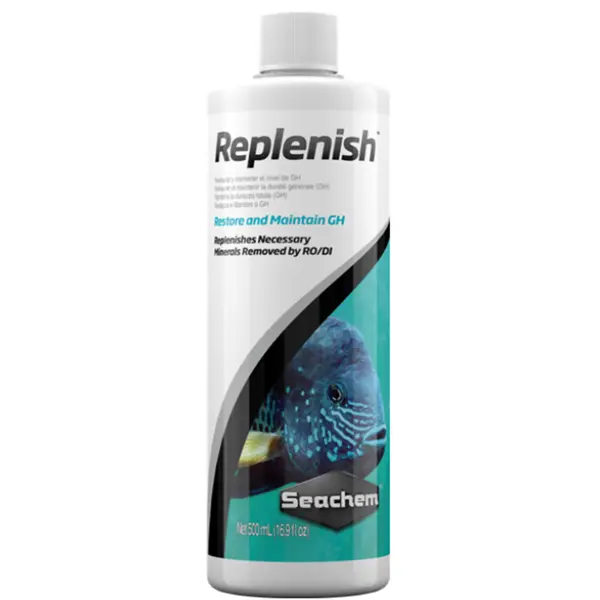
Seachem Replenish 500 mL – Freshwater RO/DI Remineralizer
Seachem Replenish 500 mL is a concentrated freshwater mineral supplement designed to restore physiologically important minerals removed by reverse-osmosis, deionization, and other water-purification methods. It raises general hardness, or GH, using a balanced blend of calcium, magnesium, potassium, and sodium salts.
Pure RO, DI, and distilled water contain very few dissolved minerals. Although this water can be useful for controlling aquarium chemistry, it should normally be remineralized before being used as the primary water source for freshwater fish. Replenish restores electrolytes that help fish maintain normal fluid and mineral balance.
Replenish is intended primarily for freshwater fish-only and community aquariums. Because it contains sodium and chloride, Seachem recommends using Equilibrium instead when remineralizing water for a planted aquarium.
Key Features
- Remineralizes Purified Water: Restores minerals removed by RO, DI, and distilled-water filtration
- Raises General Hardness: Increases GH using calcium, magnesium, potassium, and sodium salts
- Supports Fish Osmoregulation: Helps provide the mineralized environment required by many freshwater fish
- Helps Prevent Osmotic Stress: Reduces the risk associated with keeping mineral-dependent fish in inadequately mineralized water
- Does Not Directly Raise KH: Adds hardness minerals without functioning as a carbonate alkalinity buffer
- Liquid Formula: Easy to measure and mix into replacement water
- Freshwater Use: Formulated for freshwater fish and community aquariums
- 500 mL Bottle: Suitable for medium and large aquariums or regular RO-water preparation
Product Information
- Brand: Seachem
- Product: Replenish
- Size: 500 mL
- Equivalent Size: Approximately 17 fl oz
- Product Type: Freshwater remineralizing and GH supplement
- Primary Function: Restores minerals removed from purified water
- Minerals Supplied: Calcium, magnesium, potassium, and sodium salts
- Aquarium Type: Freshwater fish-only and community aquariums
- Standard Dose: 5 mL per 10 US gallons
- Effect per Standard Dose: Raises GH by 1 meq/L or approximately 2.8 dGH
Best Used For
- Freshwater aquariums using RO water
- Freshwater aquariums using DI water
- Distilled-water remineralization
- Fish-only freshwater aquariums
- Freshwater community tanks
- Hard-water and mineral-dependent fish species
- Preparing replacement water before a water change
- Blends of purified water and mineral-deficient tap water
- Correcting confirmed low general hardness
- Preventing osmotic stress caused by mineral-free water
Directions for Use
Add one capful, or 5 mL, of Seachem Replenish for every 10 US gallons of water. This raises general hardness by 1 meq/L, equivalent to approximately 2.8 dGH.
When restoring RO or DI water, Seachem recommends a general mineral level of approximately 1–2 meq/L. This normally requires 5 mL for every 5–10 gallons, depending on the desired hardness.
For the best control and stability, measure Replenish into the new replacement water before it is added to the aquarium. Mix thoroughly, test GH, and adjust until the water matches the aquarium’s intended parameters.
Approximate Dosage Guide to Raise GH by 2.8 dGH
- 5 Gallons: Approximately 2.5 mL
- 10 Gallons: 5 mL
- 20 Gallons: 10 mL
- 30 Gallons: 15 mL
- 40 Gallons: 20 mL
- 55 Gallons: Approximately 27.5 mL
- 75 Gallons: Approximately 37.5 mL
- 100 Gallons: 50 mL
- 125 Gallons: Approximately 62.5 mL
- 150 Gallons: 75 mL
These amounts raise GH by approximately 2.8 dGH. Larger increases require proportionally larger doses and should be made gradually.
Approximate Dosage Guide to Raise GH by 5.6 dGH
- 5 Gallons: 5 mL
- 10 Gallons: 10 mL
- 20 Gallons: 20 mL
- 30 Gallons: 30 mL
- 40 Gallons: 40 mL
- 55 Gallons: Approximately 55 mL
- 75 Gallons: Approximately 75 mL
- 100 Gallons: 100 mL
A 5.6 dGH increase equals approximately 2 meq/L and represents the upper end of Seachem’s general restoration recommendation for purified water. The correct hardness depends on the fish species being maintained.
How General Hardness Is Measured
General hardness represents the concentration of dissolved multivalent minerals, primarily calcium and magnesium. Aquarium test kits usually report GH in degrees of general hardness, written as dGH, while some manufacturers also use milliequivalents per liter, written as meq/L.
- 1 meq/L: Approximately 2.8 dGH
- 2 meq/L: Approximately 5.6 dGH
- 3 meq/L: Approximately 8.4 dGH
- 4 meq/L: Approximately 11.2 dGH
Replenish’s standard dose raises GH by 1 meq/L, which is approximately 2.8 dGH.
General Freshwater Hardness Guide
- 0–1 meq/L: Soft
- 1–2 meq/L: Moderately soft
- 2–3 meq/L: Slightly hard
- 3–4 meq/L: Moderately hard
- 4–6 meq/L: Hard
- Above 6 meq/L: Very hard
This guide describes mineral concentration only. The correct GH should be selected according to the natural requirements of the aquarium’s fish and invertebrates.
Why RO and DI Water Must Be Remineralized
Reverse-osmosis and deionization systems remove most dissolved minerals from source water. This provides a clean starting point but may leave the water unsuitable for fish when used without appropriate remineralization.
Fish regulate water and dissolved salts through their gills, kidneys, and body tissues. When the surrounding water contains too few minerals for the species, the difference between the fish’s internal fluids and the aquarium water may create excessive osmotic stress.
Severe mineral imbalance can contribute to osmotic shock, especially when fish are transferred suddenly between water with substantially different hardness levels.
Replenish and Osmoregulation
Osmoregulation is the biological process fish use to maintain the correct balance of water and dissolved salts inside their bodies.
Calcium, magnesium, potassium, sodium, and other electrolytes support normal physiological function. Replenish restores a balanced mixture of these minerals to purified freshwater.
Replenish is not a medication and does not treat illnesses caused by parasites, bacteria, toxins, ammonia, or poor water quality. Its role is to establish an appropriate mineral environment.
Does Replenish Raise KH?
No. Replenish primarily raises general hardness and does not provide a meaningful source of carbonate hardness.
GH and KH measure different parts of aquarium chemistry:
- GH: Primarily measures calcium and magnesium hardness
- KH: Measures carbonate and bicarbonate alkalinity that helps resist pH changes
An aquarium made entirely with RO or DI water may require both GH remineralization and a separate source of carbonate alkalinity. Choose an appropriate buffer according to the aquarium’s desired pH and KH.
Does Replenish Affect pH?
Replenish is not formulated as a pH-adjusting buffer. Its primary effect is increasing mineral content and GH.
However, adding dissolved salts can influence the overall chemistry and conductivity of extremely pure water. The final pH will also depend on KH, carbon dioxide, substrate, decorations, biological activity, and any buffers used.
Do not rely on Replenish alone to maintain pH stability in RO or DI water. Test GH, KH, and pH separately.
Replenish vs. Equilibrium
Replenish and Equilibrium both restore mineral content and raise GH, but they are intended for different aquarium types.
- Replenish: Designed primarily for fish-only and community aquariums; contains calcium, magnesium, potassium, sodium, and chloride salts
- Equilibrium: Designed for planted aquariums; contains calcium, magnesium, and potassium salts without sodium or chloride
Seachem recommends Equilibrium when increasing GH in a live-planted aquarium because elevated sodium and chloride may be undesirable for plants.
Is Replenish Recommended for Planted Aquariums?
Seachem does not recommend Replenish as its primary GH supplement for planted aquariums. Although the product contains calcium, magnesium, and potassium, it also contains sodium and chloride.
For planted systems, use Seachem Equilibrium, which is formulated specifically to provide plant-relevant minerals without sodium or chloride.
A small amount of Replenish will not necessarily cause immediate plant damage, but it should not be marketed as Seachem’s preferred planted-aquarium remineralizer.
Replenish and Freshwater Shrimp
Replenish raises GH and supplies minerals, but it is not specifically formulated to create the precise calcium-to-magnesium ratios required by every freshwater shrimp species.
Neocaridina, Caridina, Sulawesi shrimp, and other invertebrates may require substantially different GH, KH, pH, conductivity, and mineral compositions.
Use a remineralizer formulated for the specific shrimp species when precise mineral control is required. Always test the prepared water before adding it to a shrimp aquarium.
Do not market Replenish as universally suitable for all shrimp tanks.
Can Replenish Be Used with Tap Water?
Yes, but only when testing confirms that the tap water or tap-and-RO mixture does not contain enough general hardness for the aquarium’s livestock.
Test the source water before dosing. Adding Replenish to already hard tap water may push GH above the desired range.
When mixing tap water with RO water, prepare the blend first, then test GH and add only the amount of Replenish needed to reach the target.
Preparing Water for a Water Change
- Measure the required amount of RO, DI, distilled, or blended source water.
- Add an appropriate water conditioner if any untreated tap water is present.
- Measure Replenish according to the volume and desired GH increase.
- Mix the replacement water thoroughly.
- Test GH, KH, pH, and temperature.
- Adjust parameters gradually when necessary.
- Add the prepared water slowly to the aquarium.
Whenever possible, match the new water to the aquarium before beginning the water change. This reduces parameter swings and osmotic stress.
Should Replenish Be Added for Evaporation?
No. Minerals do not evaporate with water. When aquarium water evaporates, the dissolved minerals remain behind and become more concentrated.
Replace ordinary evaporation with plain freshwater that matches the aquarium’s source-water requirements. Add Replenish only when replacing water that has actually been removed during a water change or when testing confirms a GH correction is required.
Continually adding minerals to evaporation top-off water can cause GH and total dissolved solids to rise over time.
Using Replenish During Aquarium Setup
When setting up an aquarium with RO or DI water, calculate the total dose required for the intended hardness and mix it thoroughly before adding fish.
Allow the aquarium to circulate, then test GH, KH, and pH. Make any additional adjustments gradually.
Replenish does not cycle an aquarium or establish biological filtration. A new aquarium still requires proper cycling before fish are introduced.
Testing and Adjusting the Dose
Use a reliable freshwater GH test kit before and after dosing. Test the source water separately from the aquarium whenever possible.
If GH is already at the intended level, do not add more Replenish. If GH is too low, calculate the required increase and add the product gradually.
For repeat water changes, prepare the same mineral concentration each time. Consistency helps prevent hardness and conductivity swings.
Dosing Tips
- Shake the bottle before use
- Test source-water GH before dosing
- Measure using the actual replacement-water volume
- Add Replenish to new water before the water change
- Mix thoroughly before testing
- Adjust GH gradually
- Test KH and pH separately
- Do not add Replenish automatically to evaporation top-off water
- Use Equilibrium instead for planted aquariums
- Keep a written record of water-change recipes and test results
Important Freshwater Aquarium Note
Replenish raises general hardness but does not condition chlorine or chloramine, establish carbonate hardness, cycle an aquarium, remove ammonia, or replace water changes.
Mineral requirements vary substantially among freshwater species. Soft-water fish, livebearers, African cichlids, goldfish, shrimp, and snails should not all be maintained at the same GH.
Avoid changing hardness rapidly in an established aquarium. Large GH or conductivity changes may cause osmotic stress even when the final value is technically suitable for the species.
Test first, prepare replacement water consistently, and prioritize stable parameters.
Frequently Asked Questions
What is Seachem Replenish used for?
Replenish restores calcium, magnesium, potassium, sodium, and other physiologically relevant minerals removed from freshwater by RO or DI filtration.
How much Replenish should I use?
Use 5 mL for every 10 US gallons to raise GH by 1 meq/L, equivalent to approximately 2.8 dGH.
Does 5 mL per 10 gallons raise GH by 1 dGH?
No. The official dose raises GH by approximately 2.8 dGH.
What GH does Seachem recommend for RO or DI water?
Seachem provides a general restoration recommendation of approximately 1–2 meq/L, equivalent to about 2.8–5.6 dGH. The correct target depends on the fish species.
Does Replenish raise KH?
No. It raises general hardness and is not a carbonate alkalinity buffer.
Does Replenish raise pH?
It is not designed as a pH-adjusting product. Test and manage pH and KH separately.
Can Replenish be used with RO water?
Yes. Restoring minerals removed by RO and DI filtration is its primary purpose.
Can it be used with distilled water?
Yes. Distilled water should be remineralized appropriately before being used as the primary water source for freshwater fish.
Can Replenish be used with tap water?
Yes, when testing confirms that the tap water or tap-and-RO blend requires additional GH.
Is Replenish recommended for planted aquariums?
No. Seachem recommends Equilibrium for planted aquariums because Replenish contains sodium and chloride.
Does Replenish contain calcium and magnesium?
Yes. It contains calcium and magnesium along with potassium and sodium salts.
Is Replenish safe for shrimp?
It can raise GH in freshwater systems, but it is not specifically formulated for every shrimp species. Use a species-appropriate remineralizer when precise mineral ratios are required.
Should Replenish be added during every water change?
Add it whenever purified replacement water needs remineralization. Dose according to the volume and hardness of the new water, not automatically according to the full aquarium volume.
Should Replenish be used for evaporation top-off?
Generally no. Minerals remain in the aquarium when water evaporates, so routine top-off should not continually add more minerals.
Does Replenish condition chlorine or chloramine?
No. Use a separate water conditioner when untreated tap water is present.
Does Replenish replace a GH test kit?
No. Testing is recommended so the correct amount can be added and hardness remains stable.
Does Replenish replace water changes?
No. It restores minerals but does not remove waste, nitrate, dissolved organics, or other accumulated substances.
Available at Tropical Treasures Wyo
Seachem Replenish 500 mL restores essential minerals and general hardness in freshwater fish aquariums using RO, DI, distilled, or mineral-deficient water. For live-planted aquariums, Seachem recommends Equilibrium instead.
Visit Tropical Treasures Wyo in Cheyenne, Wyoming, to shop Seachem water conditioners, freshwater remineralizers, GH and KH test kits, aquarium buffers, filtration products, and water-change supplies.
Explore More Aquarium Products:
Low stock: 2 left
Couldn't load pickup availability
Explore Related Aquarium Products: