
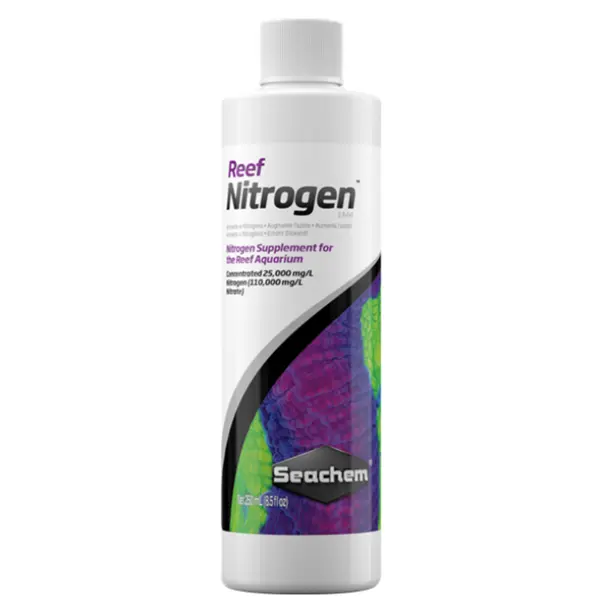
Seachem Reef Nitrogen 250 mL – Reef Aquarium Nitrogen Supplement
Seachem Reef Nitrogen 250 mL is a concentrated nitrogen supplement formulated for saltwater reef aquariums with low or undetectable nitrogen levels. It provides a controlled source of inorganic nitrogen that can be measured with a standard aquarium nitrate test.
Nitrogen is required for coral and macroalgae metabolism, protein synthesis, tissue development, and growth. In aquariums with aggressive nutrient export, light fish stocking, heavy coral growth, or very efficient filtration, available nitrogen may become depleted faster than it is naturally replenished.
Reef Nitrogen allows aquarists to increase nitrogen without intentionally adding phosphate, food particles, or dissolved organic waste. This makes it useful for carefully managing nutrient-limited SPS, LPS, mixed reef, and macroalgae systems.
Key Features
- Concentrated Nitrogen Supplement: Contains 25,000 mg/L total nitrogen
- Fully Testable Nitrogen: Added nitrogen can be detected with a typical aquarium nitrate test
- Supports Coral Metabolism: Provides nitrogen required for protein synthesis, tissue development, and growth
- Useful in Low-Nutrient Systems: Helps replenish nitrogen when nitrate remains consistently low or undetectable
- No Added Phosphate: Allows nitrogen to be adjusted independently from phosphorus
- No Added Organic Waste: Raises nitrogen without relying on overfeeding or increased fish waste
- Manual or Automated Dosing: Suitable for careful hand dosing or a properly configured aquarium dosing pump
- 250 mL Bottle: Convenient for nano, small, and medium reef aquariums
Product Information
- Brand: Seachem
- Product: Reef Nitrogen
- Size: 250 mL
- Equivalent Size: Approximately 8.5 fl oz
- Product Type: Reef aquarium nitrogen supplement
- Total Nitrogen Concentration: 25,000 mg/L
- Nitrate Equivalent: 110,750 mg/L
- Total Nitrogen: 2.5%
- Nitrate Nitrogen: 2.3%
- Ammoniacal Nitrogen: 0.2%
- Aquarium Type: Saltwater and reef aquariums
- Beginner Dosage: 5 mL per 40 US gallons twice weekly
Ingredients
- Calcium nitrate
- Magnesium nitrate
- Ammonium nitrate
The product contains multiple inorganic nitrogen sources. A standard aquarium nitrate test will show the nitrogen added by Reef Nitrogen, allowing dosing to be managed through regular testing.
Best Used For
- Reef aquariums with low or undetectable nitrate
- Ultra-low nutrient reef systems
- SPS-dominant aquariums
- LPS and mixed reef systems
- Coral-dominant aquariums with light fish stocking
- Systems using strong protein skimming
- Aquariums using refugiums, algae scrubbers, or aggressive nutrient export
- Macroalgae aquariums
- Balancing nitrogen and phosphorus availability
- Controlled dosing through a reef aquarium dosing pump
Beginner Directions
Use one capful, or 5 mL, of Seachem Reef Nitrogen for every 40 US gallons of aquarium water twice per week or as needed to maintain the desired nitrate level.
For new aquariums or systems with a low coral population, begin with one-quarter to one-half of the recommended dose. Gradually increase the amount only when testing confirms that additional nitrogen is needed.
Add the measured dose to an area with strong water movement so it disperses quickly throughout the aquarium. Avoid pouring concentrated product directly onto corals or other livestock.
Approximate Beginner Dosage Guide
- 5-Gallon Aquarium: Approximately 0.6 mL twice weekly
- 10-Gallon Aquarium: Approximately 1.25 mL twice weekly
- 20-Gallon Aquarium: Approximately 2.5 mL twice weekly
- 30-Gallon Aquarium: Approximately 3.75 mL twice weekly
- 40-Gallon Aquarium: 5 mL twice weekly
- 55-Gallon Aquarium: Approximately 6.9 mL twice weekly
- 75-Gallon Aquarium: Approximately 9.4 mL twice weekly
- 100-Gallon Aquarium: Approximately 12.5 mL twice weekly
- 125-Gallon Aquarium: Approximately 15.6 mL twice weekly
- 150-Gallon Aquarium: Approximately 18.75 mL twice weekly
These amounts are proportional calculations based on Seachem’s beginner dosage. Calculate dosing from the aquarium’s estimated actual water volume after accounting for live rock, sand, sump equipment, and other displacement.
How Much Does the Standard Dose Add?
The beginner dose of 5 mL per 40 gallons raises total nitrogen by approximately 0.78 mg/L.
This is equivalent to approximately 3.5 mg/L, or 3.5 ppm, when expressed as nitrate.
One milliliter per 20 gallons does not raise nitrate by 0.5 ppm. Based on Seachem’s concentration, that amount would raise nitrate by approximately 1.4 ppm.
Recommended Nitrogen and Nitrate Levels
Ideal nutrient levels vary according to the aquarium’s livestock, coral species, lighting, feeding, filtration, and nutrient-export methods.
Seachem generally recommends maintaining:
- Nitrogen: Approximately 1–2 mg/L
- Nitrate Equivalent: Approximately 4.4–8.9 mg/L
These values are general guidelines rather than mandatory targets for every reef aquarium. Some established systems may perform well at different levels.
Avoid increasing nitrate simply to match a universal number. Evaluate coral condition, phosphate availability, algae growth, livestock load, nutrient trends, and the aquarium’s existing maintenance routine.
Advanced Dosing Formula
To calculate the amount needed for a specific nitrate increase, use Seachem’s formula:
0.009 × v × n = m
- v: Aquarium water volume in liters
- n: Desired nitrate increase in mg/L
- m: Reef Nitrogen dose in milliliters
For example, raising 160 liters of aquarium water by 3.5 mg/L nitrate requires approximately 5 mL:
0.009 × 160 × 3.5 = 5.04 mL
Calculated corrections should be divided into smaller doses when nitrate is extremely low or when the aquarium’s nutrient consumption is unknown.
Why Add Nitrogen to a Reef Aquarium?
Corals and their symbiotic organisms require nitrogen for normal metabolic activity, protein production, tissue development, and growth. Macroalgae and other photosynthetic organisms also require nitrogen.
In a balanced reef aquarium, fish waste, feeding, bacterial activity, and natural nutrient cycling may supply enough nitrogen. Supplementation becomes useful when nutrient export consistently removes nitrogen faster than the aquarium produces it.
Potential causes of chronically low nitrate include:
- Light fish stocking
- Low feeding levels
- Heavy coral biomass
- Strong protein skimming
- Large refugiums or algae scrubbers
- Frequent large water changes
- Nitrate-removing filter media
- Carbon dosing or bacterial nutrient-control methods
- Efficient denitrification
Possible Signs of Nitrogen Limitation
- Repeatedly undetectable nitrate test results
- Pale coral tissue
- Reduced coral growth
- Reduced macroalgae growth
- Poor tissue development despite suitable lighting and alkalinity
- Phosphate remaining measurable while nitrate stays at zero
These observations do not prove nitrogen deficiency by themselves. Pale coloration, poor growth, and reduced polyp extension may also result from excessive lighting, inadequate feeding, unstable alkalinity, pests, disease, salinity changes, or other water-quality problems.
Reef Nitrogen vs. Feeding More
Increasing fish or coral food can raise nitrogen, but it also introduces phosphorus, dissolved organics, fats, proteins, and particulate waste. The amount of nitrate produced is difficult to predict.
Reef Nitrogen provides a measurable inorganic nitrogen source without intentionally adding phosphate or food waste. This allows nitrate to be adjusted more precisely.
It does not replace proper feeding. Corals, fish, and invertebrates still require species-appropriate nutrition.
Reef Nitrogen and Phosphate Balance
Nitrogen and phosphorus are both essential nutrients. Increasing nitrogen while phosphate remains undetectable may not improve coral or macroalgae performance because phosphorus can become the limiting nutrient.
Test both nitrate and phosphate before establishing a nutrient-dosing routine. Seachem Reef Phosphorus may be used when phosphate also requires controlled supplementation.
Seachem generally identifies approximately 0.02–0.05 mg/L phosphate as a useful range for Reef Phosphorus dosing, although the best level depends on the individual aquarium.
Should Reef Nitrogen and Reef Phosphorus Be Dosed Together?
Not automatically. Dose each nutrient according to separate nitrate and phosphate test results.
An aquarium may require nitrogen while phosphate is already within range. Another system may require phosphorus but no additional nitrogen. Adding both products without testing may create excess nutrients or an unsuitable imbalance.
Establish each dose independently and monitor how quickly the aquarium consumes each nutrient.
Reef Nitrogen and Algae
Nitrogen is also used by nuisance algae and cyanobacteria. Excessive dosing can contribute to unwanted growth, particularly when lighting, phosphate, organic waste, or maintenance conditions are already favorable for algae.
Raise nitrate slowly and stop increasing the dose when the selected target is reached. Do not continue dosing simply because the bottle directions list a standard schedule.
If algae increases after dosing, review nitrate, phosphate, lighting duration, feeding, water flow, mechanical filtration, and accumulated organic waste.
Using Reef Nitrogen with a Dosing Pump
Reef Nitrogen may be dispensed with a properly configured aquarium dosing pump. Use a clean, dedicated reservoir, dosing channel, tube, and outlet.
Determine the aquarium’s nitrogen consumption before programming a permanent schedule. Test nitrate at approximately the same time each day for several days and observe how quickly the measured level declines.
Divide the required amount into smaller additions when possible. This can help reduce nutrient swings and maintain a more consistent concentration.
Do not place Reef Nitrogen in the same reservoir as other concentrated reef supplements unless Seachem specifically confirms that the products are chemically compatible.
Testing and Adjusting the Dose
Test nitrate before the first dose and regularly while establishing the aquarium’s nutrient demand.
If nitrate remains very low, consumption by corals, macroalgae, bacteria, and other organisms may remove the added nitrogen quickly. It may take several gradual additions before nitrate remains detectable.
Once a stable concentration has been achieved, reduce testing frequency while continuing to monitor trends. Recalculate the dose whenever coral biomass, fish stocking, feeding, filtration, or nutrient export changes.
Dosing Tips
- Test nitrate and phosphate before dosing
- Begin with one-quarter to one-half dose in new or lightly stocked reef systems
- Use a dosing syringe for accurate small measurements
- Calculate dosage from actual aquarium water volume
- Add the product to an area with strong water movement
- Raise nitrate gradually over several days
- Do not automatically dose Reef Phosphorus at the same time
- Monitor algae and cyanobacteria growth
- Recalculate demand after changing filtration or livestock
- Keep a written record of doses and test results
Important Reef Aquarium Note
Reef Nitrogen is intended for aquariums with a confirmed need for additional nitrogen. It should not be routinely added to a system that already has adequate or elevated nitrate.
The product contains nitrate nitrogen and a smaller amount of ammoniacal nitrogen. Dose conservatively, especially in new, unstable, or lightly populated aquariums.
Do not use Reef Nitrogen as an emergency treatment for pale corals, tissue loss, poor polyp extension, or slow growth without first testing nitrate and reviewing the complete aquarium environment.
Healthy coral growth depends on balanced nutrients, alkalinity, calcium, magnesium, salinity, temperature, lighting, water flow, feeding, and overall aquarium stability.
Reef Nitrogen does not replace water changes, protein skimmer maintenance, mechanical filtration, appropriate feeding, water testing, or complete reef aquarium husbandry.
Frequently Asked Questions
What is Seachem Reef Nitrogen used for?
Reef Nitrogen supplies measurable inorganic nitrogen to reef aquariums with low or undetectable nitrate.
How concentrated is Reef Nitrogen?
It contains 25,000 mg/L total nitrogen, equivalent to approximately 110,750 mg/L nitrate.
What forms of nitrogen does it contain?
It contains nitrate nitrogen and a smaller amount of ammoniacal nitrogen derived from calcium nitrate, magnesium nitrate, and ammonium nitrate.
How much Reef Nitrogen should I use?
The beginner dose is 5 mL per 40 US gallons twice weekly or as needed to maintain the desired nitrate level.
How much does the standard dose raise nitrate?
A 5 mL dose per 40 gallons raises nitrate by approximately 3.5 mg/L, or 3.5 ppm.
Does 1 mL per 20 gallons raise nitrate by 0.5 ppm?
No. Based on the official concentration, that amount raises nitrate by approximately 1.4 ppm.
What nitrate level does Seachem recommend?
Seachem generally recommends approximately 4.4–8.9 mg/L nitrate, equivalent to 1–2 mg/L nitrogen.
Why would I add nitrogen to a reef aquarium?
Corals and macroalgae require nitrogen for metabolism, protein synthesis, tissue development, and growth. Some highly efficient reef systems can become nitrogen limited.
Is Reef Nitrogen the same as feeding more?
No. Feeding adds organic matter, phosphorus, fats, proteins, and other compounds. Reef Nitrogen provides a more measurable inorganic nitrogen source.
Can Reef Nitrogen cause algae?
Yes. Excess nitrogen can contribute to nuisance algae or cyanobacteria. Test regularly and avoid exceeding the aquarium’s demand.
Is Reef Nitrogen suitable for SPS aquariums?
Yes, when testing confirms that nitrate is too low and the product is dosed gradually.
Can it be used in mixed reef aquariums?
Yes. It may be used in SPS, LPS, soft-coral, mixed reef, and macroalgae systems with a confirmed nitrogen requirement.
Should Reef Nitrogen be used with Reef Phosphorus?
The products may be used together when both nutrients are deficient, but each should be dosed according to separate nitrate and phosphate test results.
Can Reef Nitrogen be used with a dosing pump?
Yes. Use a dedicated reservoir and determine the aquarium’s nutrient consumption before programming the schedule.
Why does nitrate remain low after dosing?
Corals, bacteria, macroalgae, and other organisms may consume the added nitrogen quickly. Raise the level gradually and test consistently.
Should I dose Reef Nitrogen when nitrate is already measurable?
Only when the measured level is below the aquarium’s selected target and testing confirms that supplementation is appropriate.
Does Reef Nitrogen replace coral food?
No. It provides nitrogen but does not replace proteins, amino acids, lipids, plankton, or other nutritional components supplied through appropriate feeding.
Does Reef Nitrogen replace water changes?
No. It supplements nitrogen but does not replace water changes, filtration, testing, feeding, or complete reef aquarium maintenance.
Available at Tropical Treasures Wyo
Seachem Reef Nitrogen 250 mL provides concentrated, fully testable nitrogen for reef aquariums with low or undetectable nitrate. It allows reef keepers to increase nitrogen without intentionally adding phosphate or excess organic waste.
Visit Tropical Treasures Wyo in Cheyenne, Wyoming, to shop Seachem reef supplements, nitrate and phosphate test kits, dosing equipment, coral foods, marine filtration, and saltwater aquarium care essentials.
Explore More Aquarium Products:
Low stock: 1 left
Couldn't load pickup availability
Explore Related Aquarium Products: