
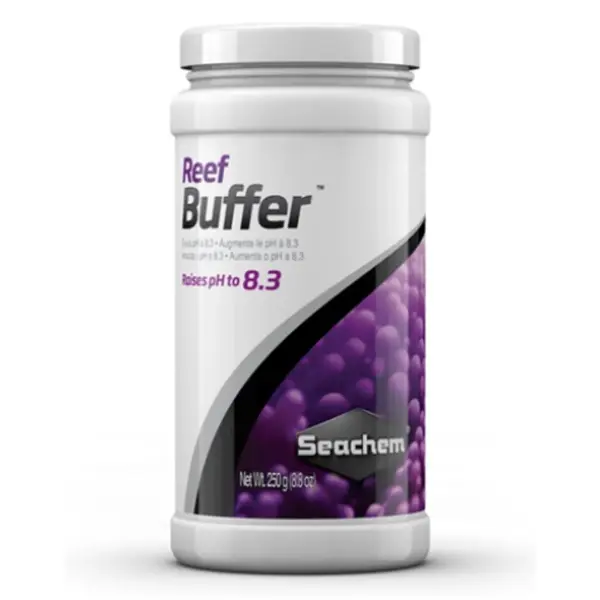
Seachem Reef Buffer 250 g – Reef Aquarium pH & Alkalinity Buffer
Seachem Reef Buffer 250 g is a concentrated marine aquarium buffer formulated to raise and stabilize pH in reef systems where biological activity and organic acids continually push pH downward. It is designed to bring reef aquarium pH toward approximately 8.3 while also increasing carbonate alkalinity.
Reef Buffer uses a carefully balanced blend of carbonate and bicarbonate salts rather than relying only on sodium bicarbonate. This produces a pK of approximately 8.6 in saltwater, helping the product overcome the heavier acid load commonly found in coral reef aquariums.
The 250 g container provides an economical supply for nano, medium, and regularly maintained reef systems. It may be used for gradual pH correction and ongoing stabilization when testing confirms that both pH and alkalinity need to be increased.
Key Features
- Raises Reef Aquarium pH: Formulated to bring saltwater reef systems toward approximately 8.3
- Raises Carbonate Alkalinity: Increases alkalinity while correcting low pH
- Reef-Specific Buffer: Designed for aquariums with corals and other reef organisms that produce a heavier organic acid load
- High Buffering Capacity: Features a pK of approximately 8.6 for improved pH stability in reef systems
- Carbonate & Bicarbonate Blend: Provides stronger reef-focused buffering than products based only on sodium bicarbonate
- Freshwater Mixing: Dissolves in freshwater before being added to the aquarium
- Concentrated Dry Formula: Provides long-lasting value for routine reef aquarium maintenance
- 250 g Container: Suitable for nano, small, and medium reef aquariums
Product Information
- Brand: Seachem
- Product: Reef Buffer
- Size: 250 g
- Product Type: Marine and reef aquarium pH and alkalinity buffer
- Form: Concentrated dry powder
- Aquarium Type: Saltwater reef aquariums
- Target pH: Approximately 8.3
- Buffer pK: Approximately 8.6 in saltwater
- Standard Dose: 5 g per 40 US gallons
- Approximate Effect: Raises pH by about 0.1 and alkalinity by about 0.5 meq/L
Best Used For
- Reef aquariums with persistently low pH
- Mixed reef aquariums
- SPS and LPS coral systems
- Reef aquariums with high biological activity
- Systems where pH and alkalinity both need to be increased
- Nano and medium reef aquariums
- Correcting gradual pH decline between water changes
- Maintaining a stable marine buffer system
- Reef aquariums with an appropriate calcium and magnesium supplementation routine
Directions for Use
Test aquarium pH and alkalinity before using Seachem Reef Buffer.
Use 5 g, or one level teaspoon, for every 40 US gallons of aquarium water. This dose raises pH by approximately 0.1 pH units and also raises alkalinity by approximately 0.5 meq/L.
Dissolve the measured powder in at least 250 mL, or one cup, of freshwater. Once dissolved, slowly add the solution to an area with strong aquarium water movement.
Retest pH and alkalinity before repeating the dose. Aquarium chemistry should be adjusted gradually rather than attempting to reach the desired level with one large addition.
Approximate Dosage Guide
- 5-Gallon Aquarium: Approximately 0.63 g
- 10-Gallon Aquarium: Approximately 1.25 g
- 20-Gallon Aquarium: Approximately 2.5 g
- 30-Gallon Aquarium: Approximately 3.75 g
- 40-Gallon Aquarium: 5 g
- 55-Gallon Aquarium: Approximately 6.9 g
- 75-Gallon Aquarium: Approximately 9.4 g
- 100-Gallon Aquarium: Approximately 12.5 g
- 125-Gallon Aquarium: Approximately 15.6 g
- 150-Gallon Aquarium: Approximately 18.75 g
These amounts are proportional calculations based on Seachem’s standard dosage. Use the aquarium’s estimated actual water volume after accounting for rock, sand, decorations, sump equipment, and other displacement.
How Much Does One Dose Raise Alkalinity?
One standard dose of 5 g per 40 gallons raises alkalinity by approximately 0.5 meq/L.
This is equivalent to approximately 1.4 dKH. Actual results may vary slightly depending on the aquarium’s starting chemistry, salinity, organic acid load, and total water volume.
Because Reef Buffer affects both pH and alkalinity, always test both parameters before and after dosing.
Recommended Reef Alkalinity
Seachem recommends maintaining reef aquarium alkalinity between approximately 3 and 6 meq/L, equivalent to about 8–17 dKH.
The most important goal is stability within a suitable range. Rapid daily swings can be more harmful to corals than a stable value that is not at the extreme upper end of the recommended range.
Choose a target appropriate for the aquarium’s livestock, salt mix, nutrient level, and dosing system, then avoid frequent large adjustments.
How Reef Buffer Works
Aquarium livestock, bacterial activity, respiration, and decomposing organic matter produce acids that gradually push pH downward. Reef systems often produce more acids than fish-only marine aquariums because of their higher biological activity.
Reef Buffer contains carbonate and bicarbonate salts with a pK of approximately 8.6. This higher pK allows it to resist the stronger downward pressure on pH and bring the aquarium closer to approximately 8.3.
The product also increases carbonate alkalinity, which helps the water resist future pH changes.
Reef Buffer vs. Reef Builder
Reef Buffer and Reef Builder both affect reef aquarium alkalinity, but they are intended for different primary purposes.
- Reef Buffer: Primarily used when both pH and carbonate alkalinity need to be increased
- Reef Builder: Primarily used to raise carbonate alkalinity without significantly increasing pH
Use Reef Buffer when pH is difficult to maintain near 8.3 and alkalinity also has room to increase. Use Reef Builder or Reef Carbonate when pH is already satisfactory but alkalinity is low.
Reef Buffer vs. Marine Buffer
Seachem Marine Buffer is formulated primarily for fish-only marine aquariums and has a pK of approximately 8.3.
Reef Buffer has a higher pK of approximately 8.6. This makes it better suited for overcoming the greater amount of organic acids produced in a biologically active reef aquarium.
Reef Buffer should therefore be selected for coral reef systems, while Marine Buffer is generally more appropriate for marine fish-only aquariums.
Using Reef Buffer with Calcium Supplements
Do not directly mix Reef Buffer with calcium supplements. Concentrated carbonate and calcium solutions can react and form insoluble calcium carbonate.
Add calcium and carbonate products on alternate days whenever practical, or separate their dosing by at least 30 minutes. Dose each product into an area with strong water movement.
Use separate measuring tools and separate dosing containers for calcium and buffer products.
Using Reef Buffer with Magnesium or Strontium
Do not directly mix Reef Buffer with magnesium or strontium supplements. Add them on alternate days or separate dosing by at least 30 minutes.
Excessive alkalinity may encourage the precipitation and loss of calcium, magnesium, and strontium from aquarium water. This is another reason to test before every major adjustment.
Why Low pH Happens in Reef Aquariums
Low reef aquarium pH may result from several conditions, including:
- Elevated indoor carbon dioxide
- Limited aquarium surface movement
- Insufficient aeration
- High biological activity
- Accumulated organic waste
- Overstocking or overfeeding
- Low carbonate alkalinity
- Poor gas exchange in a covered aquarium
- Improperly calibrated pH testing equipment
Reef Buffer can correct low pH when alkalinity also needs to rise, but it does not remove excess carbon dioxide or correct every underlying cause of depressed pH.
Carbon Dioxide & Indoor Air
High indoor carbon dioxide is a common cause of persistently low reef aquarium pH. In this situation, adding buffer may temporarily raise pH while also causing alkalinity to climb higher than desired.
Improve surface agitation, increase ventilation, open nearby windows when safe, or route a protein skimmer’s air intake toward fresher outside air when practical.
Do not continue adding Reef Buffer solely to chase pH when alkalinity is already high.
When Not to Use Reef Buffer
Do not use Reef Buffer when pH is already acceptable and only alkalinity needs to be raised. Reef Builder or Reef Carbonate is a better choice for that situation.
Do not use it when alkalinity is already above the desired range. Investigate carbon dioxide, aeration, equipment calibration, and other causes of low pH before adding more buffer.
Do not add it without testing. pH alone does not provide enough information to determine whether additional carbonate alkalinity is safe.
Dosing Tips
- Test pH and alkalinity before every correction
- Use a digital gram scale for precise measurement
- Dissolve each dose in at least one cup of freshwater
- Add the solution slowly to an area with strong water movement
- Make gradual corrections rather than one large adjustment
- Retest before repeating the dose
- Separate dosing from calcium, magnesium, and strontium supplements
- Do not chase pH when alkalinity is already elevated
- Calibrate electronic pH probes regularly
- Keep a written record of test results and dosing amounts
Important Reef Aquarium Note
Reef Buffer raises both pH and carbonate alkalinity. It should not be marketed or used as a product that changes pH without affecting alkalinity.
Excess alkalinity may increase the precipitation and loss of calcium, magnesium, and strontium. Overdosing may also produce cloudy water, deposits on heaters or pumps, and unstable reef chemistry.
Healthy coral growth depends on stable alkalinity, calcium, magnesium, salinity, temperature, nutrients, lighting, water flow, and overall aquarium maturity.
Reef Buffer does not replace regular water changes, accurate testing, aeration, protein skimmer maintenance, or correction of elevated indoor carbon dioxide.
Frequently Asked Questions
What is Seachem Reef Buffer used for?
Reef Buffer raises reef aquarium pH toward approximately 8.3 while also increasing carbonate alkalinity.
How much Reef Buffer should I use?
Use 5 g, or one level teaspoon, for every 40 US gallons.
How much does the standard dose raise pH?
It raises pH by approximately 0.1 pH units.
How much does the standard dose raise alkalinity?
It raises alkalinity by approximately 0.5 meq/L, equivalent to about 1.4 dKH.
Should Reef Buffer be dissolved before use?
Yes. Dissolve the measured dose in at least 250 mL, or one cup, of freshwater before adding it to the aquarium.
Does Reef Buffer maintain pH at 8.3?
It is formulated to raise reef aquarium pH toward 8.3 and provide buffering stability when used according to testing and aquarium demand.
Will Reef Buffer raise alkalinity?
Yes. Reef Buffer raises both pH and carbonate alkalinity.
What is the difference between Reef Buffer and Reef Builder?
Reef Buffer is primarily used to raise pH and alkalinity together. Reef Builder is primarily used when alkalinity needs to be raised without significantly increasing pH.
What is the difference between Reef Buffer and Marine Buffer?
Reef Buffer has a higher pK and is designed for biologically active reef systems. Marine Buffer is primarily intended for fish-only saltwater aquariums.
Can Reef Buffer be used in freshwater aquariums?
No. It is formulated specifically for saltwater reef systems.
Is Reef Buffer safe for SPS corals?
Yes, when used according to accurate pH and alkalinity testing. Stability and gradual adjustment are essential for SPS aquariums.
Can Reef Buffer be used with calcium supplements?
Yes, but do not mix the concentrated products directly. Dose them on alternate days or at least 30 minutes apart.
Can it be used with magnesium or strontium?
Yes, but separate dosing by at least 30 minutes and never mix the concentrated products directly.
Why is my pH still low after adding buffer?
Elevated indoor carbon dioxide, poor aeration, high biological activity, accumulated organic waste, or inaccurate testing may continue pushing pH downward.
Should I continue dosing if alkalinity is already high?
No. Investigate carbon dioxide and gas exchange instead of repeatedly increasing alkalinity.
Can Reef Buffer be overdosed?
Yes. Excessive use can raise alkalinity too high and promote the loss or precipitation of calcium, magnesium, and strontium.
Does Reef Buffer replace water changes?
No. It supplements reef chemistry but does not replace water changes, testing, nutrient management, or complete aquarium maintenance.
Available at Tropical Treasures Wyo
Seachem Reef Buffer 250 g raises reef aquarium pH toward 8.3 while increasing carbonate alkalinity for improved marine buffering stability. Visit Tropical Treasures Wyo in Cheyenne, Wyoming, to shop Seachem reef supplements, marine test kits, calcium and alkalinity products, dosing supplies, reef salt, and saltwater aquarium care essentials.
Explore More Aquarium Products:
Low stock: 2 left
Couldn't load pickup availability
Explore Related Aquarium Products: