
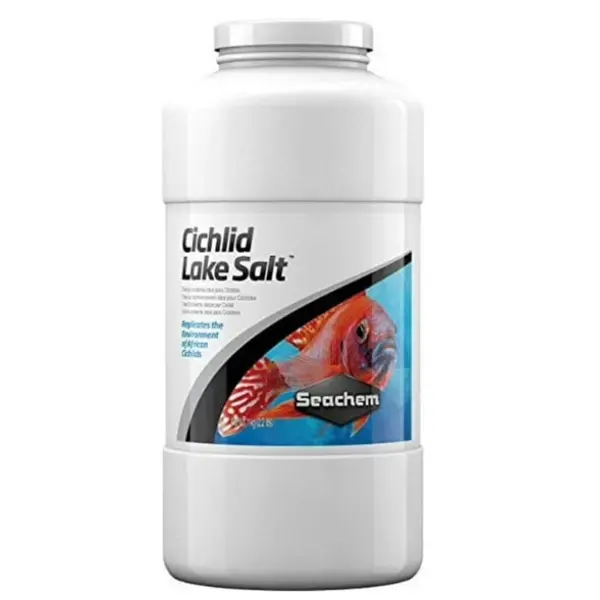
Seachem Cichlid Lake Salt 500 g – African Rift Lake Mineral Supplement
Seachem Cichlid Lake Salt 500 g is a concentrated freshwater mineral supplement formulated to recreate the mineral-rich conditions associated with the African Rift Lakes. It provides calcium, magnesium, potassium, sodium, and trace elements in lake-specific concentrations for Lake Tanganyika, Lake Malawi, and Lake Victoria cichlid aquariums.
Unlike ordinary aquarium salt, Cichlid Lake Salt is not simply sodium chloride. It is a balanced mixture of mineral salts designed to increase general hardness and provide physiologically important ions used by African cichlids for normal osmoregulation and mineral balance.
Cichlid Lake Salt affects mineral hardness, or GH, but does not significantly increase carbonate hardness, alkalinity, or pH. When pH and KH also need to be adjusted, Seachem recommends pairing it with Tanganyika Buffer or Malawi/Victoria Buffer according to the fish species being maintained.
Key Features
- Formulated for African Rift Lake Cichlids: Provides lake-specific dosing for Tanganyika, Malawi, and Victoria aquariums
- Raises General Hardness: Supplies calcium, magnesium, potassium, sodium, and other mineral salts
- Supports Osmoregulation: Helps create an appropriate mineral environment for hard-water African cichlids
- More Complete Than Basic Aquarium Salt: Contains several physiologically important minerals rather than relying only on sodium chloride
- Does Not Raise KH: Allows mineral hardness and carbonate hardness to be adjusted separately
- Does Not Directly Buffer pH: May be paired with an appropriate Seachem cichlid buffer when pH adjustment is needed
- RO/DI Water Compatible: Ideal for controlled remineralization of purified source water
- Freshwater Use: Designed specifically for African cichlid aquariums
Product Information
- Brand: Seachem
- Product: Cichlid Lake Salt
- Size: 500 g
- Equivalent Weight: Approximately 1.1 lb
- Product Type: African Rift Lake mineral and GH supplement
- Aquarium Type: Freshwater African cichlid aquariums
- Raises: General hardness and dissolved mineral content
- Does Not Directly Raise: KH, alkalinity, or pH
- Recommended Use: New aquarium setup and replacement water during water changes
Best Used For
- Lake Tanganyika cichlid aquariums
- Lake Malawi cichlid aquariums
- Lake Victoria cichlid aquariums
- Frontosa aquariums
- Tropheus aquariums
- Mbuna aquariums
- Peacock cichlid aquariums
- Haplochromine cichlid aquariums
- Shell-dwelling cichlid systems
- Remineralizing RO or DI water
- Correcting confirmed low GH in African cichlid systems
- Preparing consistent replacement water for water changes
Official Dosing by Rift Lake
All official doses are based on 10 US gallons of RO or DI water.
- Lake Tanganyika: 11 g, approximately 1½ teaspoons, per 10 gallons
- Lake Malawi: 5.5 g, approximately ¾ teaspoon, per 10 gallons
- Lake Victoria: 3.6 g, approximately ½ teaspoon, per 10 gallons
These doses are designed for purified water with little or no existing hardness. Tap water, mineral substrates, limestone, crushed coral, and other sources of calcium or magnesium may reduce the amount required.
Lake Tanganyika Dosage Guide
Use 11 g per 10 gallons. This raises GH by approximately 8.8 dGH.
- 5 Gallons: Approximately 5.5 g
- 10 Gallons: 11 g
- 20 Gallons: 22 g
- 30 Gallons: 33 g
- 40 Gallons: 44 g
- 55 Gallons: Approximately 60.5 g
- 75 Gallons: Approximately 82.5 g
- 100 Gallons: 110 g
- 125 Gallons: Approximately 137.5 g
- 150 Gallons: 165 g
Lake Malawi Dosage Guide
Use 5.5 g per 10 gallons. This raises GH by approximately 4.4 dGH.
- 5 Gallons: Approximately 2.75 g
- 10 Gallons: 5.5 g
- 20 Gallons: 11 g
- 30 Gallons: 16.5 g
- 40 Gallons: 22 g
- 55 Gallons: Approximately 30.25 g
- 75 Gallons: Approximately 41.25 g
- 100 Gallons: 55 g
- 125 Gallons: Approximately 68.75 g
- 150 Gallons: 82.5 g
Lake Victoria Dosage Guide
Use 3.6 g per 10 gallons. This raises GH by approximately 3 dGH.
- 5 Gallons: Approximately 1.8 g
- 10 Gallons: 3.6 g
- 20 Gallons: 7.2 g
- 30 Gallons: 10.8 g
- 40 Gallons: 14.4 g
- 55 Gallons: Approximately 19.8 g
- 75 Gallons: 27 g
- 100 Gallons: 36 g
- 125 Gallons: 45 g
- 150 Gallons: 54 g
Recommended GH Ranges
Seachem recommends the following general-hardness ranges:
- Lake Tanganyika: 3–5.5 meq/L, approximately 8–14 dGH
- Lake Malawi: 1.5–3 meq/L, approximately 4–8 dGH
- Lake Victoria: 1–2 meq/L, approximately 3–6 dGH
These are general lake-specific guidelines. Individual species, captive-bred populations, and existing source-water chemistry should also be considered.
How Much Water Does the 500 g Container Treat?
Approximate treatment capacity at the full official dose:
- Tanganyika Dose: Approximately 455 gallons
- Malawi Dose: Approximately 909 gallons
- Victoria Dose: Approximately 1,389 gallons
Actual capacity may be greater when tap water already contains part of the required hardness and testing shows that a reduced dose is appropriate.
Directions for Use
- Measure the volume of water being prepared.
- Test the source water’s existing GH.
- Calculate the required dose according to the lake and desired GH.
- Dissolve Cichlid Lake Salt thoroughly in freshwater before use.
- Add the prepared mineral solution to the replacement water.
- Circulate and aerate the water.
- Test GH, KH, pH, and temperature.
- Adjust gradually if additional mineral hardness is required.
- Add the prepared replacement water slowly to the aquarium.
For an established aquarium, calculate the dose according to the amount of water being replaced—not the aquarium’s total volume—unless the entire system is being remineralized for the first time.
Using Cichlid Lake Salt with RO or DI Water
RO and DI water contain very little calcium, magnesium, potassium, sodium, carbonate hardness, or alkalinity. This makes purified water useful for creating controlled aquarium chemistry, but the required minerals and buffering must be restored before the water is suitable for Rift Lake cichlids.
A complete preparation routine may include:
- Add Cichlid Lake Salt to establish GH and mineral content.
- Dissolve the product thoroughly.
- Add the appropriate cichlid buffer to establish KH and pH.
- Circulate and aerate the water.
- Test GH, KH, pH, and temperature before use.
Do not use untreated pure RO or DI water as the primary water source for African cichlids.
Using Cichlid Lake Salt with Tap Water
Cichlid Lake Salt may be used with tap water, but the starting GH must be tested first. Seachem’s full doses are based on purified water and may be excessive when added to naturally hard tap water.
Cheyenne and other regional water sources may already contain significant calcium and magnesium. Customers should not assume that the full label dose is needed without testing their specific source water.
When tap water already provides part of the desired GH, add only enough Cichlid Lake Salt to reach the intended range.
Does Cichlid Lake Salt Raise GH?
Yes. Increasing general hardness is one of the product’s main functions.
GH primarily reflects dissolved calcium and magnesium, although Cichlid Lake Salt also provides potassium, sodium, and trace elements.
The approximate GH increases at the official doses are:
- Tanganyika Dose: Approximately 8.8 dGH
- Malawi Dose: Approximately 4.4 dGH
- Victoria Dose: Approximately 3 dGH
Does Cichlid Lake Salt Raise KH?
No. Seachem states that Cichlid Lake Salt affects hardness but not alkalinity.
GH and KH measure different aspects of aquarium chemistry:
- GH: Primarily measures calcium and magnesium hardness
- KH: Measures carbonate and bicarbonate alkalinity that helps stabilize pH
Use an appropriate cichlid buffer when carbonate hardness needs to be increased.
Does Cichlid Lake Salt Raise pH?
It is not formulated as a pH buffer and does not directly establish the high pH required by Rift Lake cichlids.
Adding dissolved minerals may slightly influence the overall chemistry or conductivity of very pure water, but reliable pH control requires sufficient carbonate alkalinity.
Use Tanganyika Buffer or Malawi/Victoria Buffer when pH and KH adjustment is required.
Cichlid Lake Salt with Tanganyika Buffer
For Lake Tanganyika aquariums:
- Cichlid Lake Salt: Establishes GH and supplies mineral salts
- Tanganyika Buffer: Raises KH and maintains approximately pH 9.0–9.4
Seachem recommends adding Cichlid Lake Salt before Tanganyika Buffer when preparing new water.
Cichlid Lake Salt with Malawi/Victoria Buffer
For Lake Malawi and Lake Victoria aquariums:
- Cichlid Lake Salt: Establishes lake-specific mineral hardness
- Malawi/Victoria Buffer: Raises KH and maintains approximately pH 7.8–8.4
Add Cichlid Lake Salt first, dissolve it thoroughly, and then add the buffer according to test results.
Ingredients
Seachem lists the following ingredients:
- Magnesium chloride
- Calcium chloride
- Potassium sulfate
- Sodium chloride
- Aluminum sulfate
- Iron sulfate
- Potassium iodide
Cichlid Lake Salt therefore contains sodium chloride, but it is not simply ordinary aquarium salt. Its formula provides a broader selection of major and trace minerals.
Guaranteed Mineral Analysis
Seachem provides the following guaranteed analysis per gram:
- Calcium: 3.24% minimum, 3.50% maximum
- Magnesium: 11.83% minimum
- Potassium: 10.08% minimum
- Sodium: 3.53% minimum, 3.75% maximum
- Aluminum: 0.90 mg minimum
- Iodine: 0.02 mg minimum
- Iron: 0.20 mg minimum
- Selenium: 0.00002 mg minimum
- Zinc: 0.007 mg minimum
Cichlid Lake Salt vs. Aquarium Salt
- Cichlid Lake Salt: A multi-mineral blend formulated to increase GH and replicate Rift Lake mineral concentrations
- Basic Aquarium Salt: Usually primarily sodium chloride
Ordinary aquarium salt does not provide the same calcium, magnesium, potassium, and trace-mineral balance as Cichlid Lake Salt.
The two products should not be treated as interchangeable or dosed using the same directions.
Cichlid Lake Salt vs. Cichlid Trace
- Cichlid Lake Salt: Used during aquarium setup and water changes to establish major mineral concentrations and GH
- Cichlid Trace: Supplies smaller trace-element amounts between water changes
Cichlid Trace does not replace the larger mineral contribution provided by Cichlid Lake Salt.
Should It Be Added During Every Water Change?
Use Cichlid Lake Salt when new replacement water requires additional mineral hardness.
Calculate the dose according to:
- The volume of replacement water
- The source water’s existing GH
- The lake-specific target range
- The amount of mineral hardness already present in the aquarium
Do not automatically add a full-tank dose during every partial water change.
Should It Be Added for Evaporation Top-Off?
No. Minerals do not evaporate with aquarium water. When water evaporates, calcium, magnesium, sodium, potassium, and other dissolved substances remain behind.
Replacing evaporation with mineralized water can cause GH and total dissolved solids to rise gradually.
Top off ordinary evaporation with plain conditioned freshwater or appropriately prepared RO water. Add Cichlid Lake Salt only when actual water has been removed or testing confirms that GH needs correction.
Use in Established Aquariums
When correcting low mineral hardness in an occupied aquarium, make adjustments gradually. Sudden changes in GH and conductivity can create osmotic stress.
Whenever possible, prepare and test replacement water outside the aquarium. Small controlled changes are safer than adding a large amount of dry mineral salt directly to the tank.
Do not add undissolved powder directly onto fish, plants, substrate, or decorations.
Use with Mineral Substrates and Rock
Crushed coral, aragonite, limestone, coral sand, and some decorative rocks may already add calcium, magnesium, KH, or alkalinity to aquarium water.
These materials can increase the final hardness beyond what is expected from the product dose alone. Test source and aquarium water regularly when mineral-rich substrates or rock are present.
Is It Suitable for All African Cichlids?
Cichlid Lake Salt is formulated for Rift Lake African cichlids, but the required concentration varies considerably by lake.
Lake Tanganyika fish generally require a higher mineral concentration than Lake Malawi or Victoria fish. Always select the dose that matches the fish’s origin.
West African river cichlids and soft-water species should not automatically receive Rift Lake mineral concentrations.
Is It Suitable for Community Aquariums?
It should be used only when the aquarium’s inhabitants require hard, mineral-rich water.
It is generally not appropriate for soft-water community species such as:
- Discus
- Many South American dwarf cichlids
- Wild-type tetras
- Many rasboras
- Soft-water catfish
- Blackwater fish
Mixed-species aquariums should be maintained at parameters that are appropriate for every inhabitant.
Is It Suitable for Planted Aquariums?
Cichlid Lake Salt may be used in aquariums containing plants that tolerate hard, alkaline conditions, but it is not a planted-aquarium fertilizer.
Many common aquarium plants can adapt to moderate hardness, while some soft-water plants may perform poorly at the higher mineral concentrations associated with Rift Lake systems.
Plant compatibility depends on species, GH, KH, pH, substrate, lighting, and overall aquarium conditions.
Does It Improve Fish Color or Breeding?
Providing appropriate mineral conditions can support normal health, osmoregulation, and reproductive function, but the product should not be marketed as guaranteeing brighter coloration or breeding.
Color and breeding behavior also depend on:
- Genetics
- Species and maturity
- Diet
- Water quality
- Social structure
- Tank size and territory
- Temperature
- Stress and aggression
Testing Recommendations
Use a reliable freshwater GH test kit before and after dosing. Also test KH and pH because Cichlid Lake Salt does not control those parameters.
For greater consistency, aquarists may also monitor conductivity or total dissolved solids. A standard saltwater hydrometer is generally not sensitive enough to measure the relatively low mineral concentrations used in freshwater cichlid aquariums.
Dosing Tips
- Test source-water GH before adding the product
- Use lake-specific dosing rather than one universal dose
- Base water-change dosing on the amount of replacement water
- Dissolve the mineral salt in freshwater before use
- Add Cichlid Lake Salt before cichlid buffer products
- Adjust GH gradually in occupied aquariums
- Do not add it automatically to evaporation top-off water
- Use a digital gram scale for accurate measurement
- Keep a written water-preparation recipe
- Test GH, KH, and pH separately
Storage Instructions
Keep the container tightly closed and store it in a cool, dry location. Protect the powder from humidity and prevent wet measuring tools from entering the container.
Use a clean, dry spoon or digital scale. Keep aquarium products away from children, pets, food, and household cooking utensils.
Important Aquarium Care Note
Cichlid Lake Salt raises mineral hardness but does not remove chlorine, chloramine, ammonia, nitrite, nitrate, or dissolved waste.
It does not cycle an aquarium, replace water changes, or provide carbonate buffering. A complete African cichlid setup may require:
- A suitable water conditioner
- Cichlid Lake Salt for GH
- An appropriate cichlid buffer for KH and pH
- Established biological filtration
- Regular water testing
- Species-appropriate diet and aquarium space
Rapid changes in GH, KH, pH, or conductivity can stress fish. Prepare replacement water consistently and make corrections gradually.
Frequently Asked Questions
What is Seachem Cichlid Lake Salt used for?
It increases GH and supplies calcium, magnesium, potassium, sodium, and trace minerals for African Rift Lake cichlid aquariums.
Is it the same as ordinary aquarium salt?
No. Ordinary aquarium salt is primarily sodium chloride. Cichlid Lake Salt is a multi-mineral blend formulated for Rift Lake water.
Does Cichlid Lake Salt contain sodium chloride?
Yes. Sodium chloride is one ingredient, but the product also contains substantial magnesium, calcium, potassium, and trace-mineral compounds.
Is sodium chloride the only ingredient?
No. The formula includes magnesium chloride, calcium chloride, potassium sulfate, sodium chloride, and several trace-mineral salts.
Does it raise GH?
Yes. It is specifically designed to increase general hardness and mineral content.
Does it raise KH?
No. Use Tanganyika Buffer or Malawi/Victoria Buffer when KH and alkalinity need to be raised.
Does it raise pH?
It is not a pH buffer and does not directly establish the desired Rift Lake pH.
How much should I use for Lake Tanganyika?
Use 11 g, approximately 1½ teaspoons, per 10 gallons of RO or DI water.
How much should I use for Lake Malawi?
Use 5.5 g, approximately ¾ teaspoon, per 10 gallons of RO or DI water.
How much should I use for Lake Victoria?
Use 3.6 g, approximately ½ teaspoon, per 10 gallons of RO or DI water.
Are those doses appropriate for tap water?
They are based on RO or DI water. Test tap-water GH and reduce the dose when minerals are already present.
How much does the 500 g container treat?
Approximately 455 gallons at the Tanganyika dose, 909 gallons at the Malawi dose, or 1,389 gallons at the Victoria dose.
Should it be dissolved before use?
Yes. Dissolve it in freshwater before adding it to the aquarium or replacement-water container.
Should it be added during water changes?
Add it to replacement water when testing shows that additional GH is required.
Should it be added when replacing evaporated water?
No. Minerals remain behind during evaporation, so automatic mineral dosing during top-off can cause GH to accumulate.
Can it be used with Tanganyika Buffer?
Yes. Add Cichlid Lake Salt first to establish GH, then use Tanganyika Buffer to adjust KH and pH.
Can it be used with Malawi/Victoria Buffer?
Yes. The salt establishes mineral hardness, while the buffer adjusts carbonate hardness and pH.
Is it suitable for community fish?
Only when every species in the aquarium requires hard, mineral-rich water. It is not appropriate for most soft-water community species.
Is it safe for plants?
It may be used with plants that tolerate hard alkaline water, but some soft-water plants may not thrive under Rift Lake conditions.
Can Cichlid Lake Salt be overdosed?
Yes. Excessive dosing may raise GH and conductivity beyond the appropriate range. Test before and after use.
Does it replace aquarium water changes?
No. It adjusts mineral content but does not remove waste or accumulated contaminants.
Available at Tropical Treasures Wyo
Seachem Cichlid Lake Salt 500 g supplies calcium, magnesium, potassium, sodium, and trace minerals for establishing lake-specific GH in Tanganyika, Malawi, and Victoria cichlid aquariums.
Visit Tropical Treasures Wyo in Cheyenne, Wyoming, to shop Cichlid Lake Salt, Tanganyika Buffer, Malawi/Victoria Buffer, Cichlid Trace, African cichlid foods, GH and KH test kits, and Rift Lake aquarium supplies.
Explore More Aquarium Products:
Out of stock
Couldn't load pickup availability
Explore Related Aquarium Products: