
Rainbow Goby
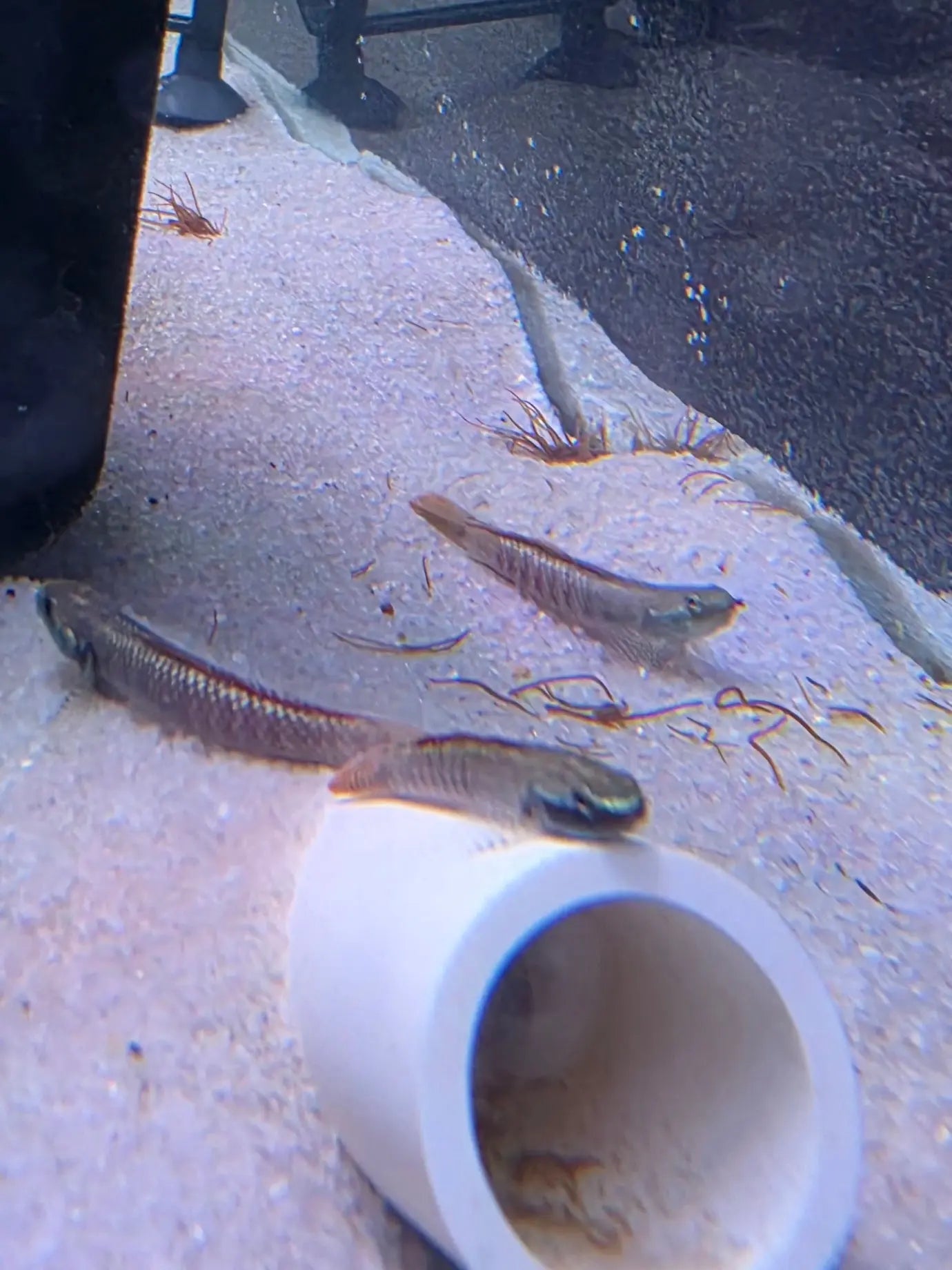
The Rainbow Goby (Stiphodon ornatus) is a small, peaceful freshwater goby prized for its colorful appearance, unusual bottom-dwelling behavior, and constant grazing on algae and biofilm.
Males can develop beautiful iridescent blue, green, red, and orange tones, while females are usually more subdued with mottled or banded coloration. These fish are especially attractive in mature stream-style aquariums with smooth stones, flowing water, and plenty of natural algae growth.
Key Features
- Small, peaceful freshwater goby
- Beautiful iridescent coloration, especially in males
- Excellent algae and biofilm grazer
- Clings to rocks and hard surfaces with fused pelvic fins
- Best suited to mature, established aquariums
- Prefers clean, highly oxygenated water
- Appreciates moderate to strong water movement
- Excellent choice for peaceful stream-style community tanks
- Does not grow large
Fish Information
- Common Name: Rainbow Goby
- Scientific Name: Stiphodon ornatus
- Also Known As: Rainbow Stiphodon Goby, Ornate Rainbow Goby
- Fish Type: Freshwater goby
- Origin: Southeast Asian island streams
- Water Type: Freshwater
- Temperament: Peaceful
- Adult Size: Approximately 2–2.5 inches
- Swimming Level: Bottom
- Diet: Primarily algae, biofilm, and aufwuchs grazer
- Care Level: Intermediate
- Recommended Tank Size: Approximately 20 gallons or larger
Appearance
Rainbow Gobies have long, streamlined bodies adapted to life in flowing streams.
Males are typically the most colorful and may develop:
- Iridescent blue
- Green
- Red
- Orange
- Metallic markings
Females are generally more subdued and may have gray, brown, cream, or striped patterns.
Coloration can vary with age, sex, mood, diet, lighting, and dominance.
Adult Size
Rainbow Gobies remain relatively small.
Most adults stay around 2–2.5 inches, making them suitable for smaller community aquariums provided their specialized feeding and water-quality needs are met.
Their small size should not be mistaken for beginner-level care, however. A mature aquarium with natural grazing surfaces is extremely important.
Recommended Aquarium Size
A 20-gallon aquarium or larger is a good practical starting point.
A longer aquarium is preferred because it provides:
- More bottom area
- More rocks for grazing
- Better current distribution
- More territory for multiple gobies
- More surface area for algae and biofilm growth
Recommended Water Parameters
A practical range is:
- Temperature: Approximately 68–79°F
- pH: Approximately 6.5–7.5
- Water Hardness: Soft to moderately hard
- Ammonia: 0 ppm
- Nitrite: 0 ppm
- Nitrate: Kept low through routine maintenance
Stable, clean, highly oxygenated water is especially important for this species.
Aquarium Setup
Rainbow Gobies come from flowing stream environments.
A suitable aquarium should include:
- Smooth river stones
- Rounded rocks
- Driftwood
- Sand or fine gravel
- Strong filtration
- Good surface agitation
- Moderate to strong current
- Plenty of open grazing surfaces
- Mature algae and biofilm
Bright enough lighting to encourage natural algae growth can be beneficial.
Importance of a Mature Aquarium
This is one of the most important care requirements.
Rainbow Gobies spend much of the day grazing on:
- Soft algae
- Diatoms
- Biofilm
- Aufwuchs
- Microscopic organisms growing on rocks
They should not be placed into a brand-new, sterile aquarium.
A mature tank with established grazing surfaces greatly improves the chances of long-term success.
Feeding
Rainbow Gobies are specialized grazers.
Natural algae and biofilm should form a major part of their diet.
Supplemental foods may include:
- Spirulina-based foods
- Algae wafers
- Fine sinking herbivore pellets
- Powdered algae foods
- Gel foods formulated for herbivorous fish
- Small amounts of blanched vegetables
- Occasional small frozen foods
Protein-rich foods should be supplemental rather than the main diet.
Does a Rainbow Goby Eat Algae?
Yes.
Rainbow Gobies naturally scrape algae and biofilm from rocks and aquarium surfaces.
However, they should not be purchased solely as an algae-control fish.
Their feeding needs are specialized, and they require a consistent source of natural grazing material.
Water Movement and Oxygenation
Rainbow Gobies are adapted to flowing streams.
Provide:
- Strong surface agitation
- Good dissolved oxygen
- Moderate to strong current
- Clean filter media
- Regular water changes
A powerhead or circulation pump may be useful in larger aquariums.
Avoid stagnant areas and chronically warm, poorly oxygenated water.
Temperament
Rainbow Gobies are generally very peaceful.
Males may display toward each other or defend preferred grazing areas, but serious aggression is uncommon when enough space and rockwork are provided.
They are well suited to peaceful community aquariums.
Compatible Tankmates
Good tankmates may include:
- Small rasboras
- Danios
- Peaceful tetras
- Hillstream loaches
- Small peaceful barbs
- Small rainbowfish
- Corydoras
- Peaceful shrimp
- Snails
- Other small non-aggressive stream fish
Avoid tankmates that are aggressive, excessively large, or extremely competitive at feeding time.
Keeping Multiple Rainbow Gobies
Multiple Rainbow Gobies may be kept together when the aquarium provides enough space and grazing surfaces.
Provide:
- Multiple rocks
- Visual barriers
- Plenty of biofilm
- Enough open bottom area
- Strong filtration
Males may display to each other, which can make their coloration even more vivid.
Plants
Rainbow Gobies are generally plant-safe.
Suitable plants include:
- Anubias
- Java fern
- Bucephalandra
- Cryptocoryne
- Mosses
- Other plants that tolerate current
Plants attached to rocks or driftwood work especially well in stream-style layouts.
Acclimation
- Turn aquarium lights off before introducing the fish.
- Float the unopened transport bag for approximately 15–20 minutes to equalize temperature.
- Gradually add small amounts of aquarium water to the bag or acclimation container.
- Carefully transfer the fish into the aquarium.
- Avoid adding transport water to the display aquarium when practical.
- Leave the lights off for several hours while the fish settles.
Quarantine new fish when a suitable quarantine system is available.
Important Care Notes
- Do not add to a new or sterile aquarium.
- Provide established algae and biofilm.
- Maintain excellent oxygenation.
- Provide moderate to strong water movement.
- Keep ammonia and nitrite at 0 ppm.
- Do not rely only on commercial fish food.
- Avoid aggressive or overly competitive tankmates.
- Use smooth rocks and grazing surfaces.
- Never release aquarium fish into local waterways.
Frequently Asked Questions
How large does a Rainbow Goby get?
Most adults remain around 2–2.5 inches.
Is the Rainbow Goby peaceful?
Yes. It is generally a peaceful species, although males may display or defend small grazing areas.
Does it need strong current?
Moderate to strong water movement and high oxygen levels are highly beneficial because the species naturally inhabits flowing streams.
Will it eat aquarium algae?
Yes, but it also relies on biofilm and microscopic organisms growing on aquarium surfaces.
Can I put one in a brand-new aquarium?
It is not recommended. A mature aquarium with established algae and biofilm is much better.
Can Rainbow Gobies live with shrimp?
They are generally peaceful with adult freshwater shrimp, although extremely small shrimplets may always carry some risk with fish.
Do males and females look different?
Yes. Males are usually much more colorful, while females tend to have more subdued gray, brown, or striped patterns.
Are they difficult to breed?
Yes. Stiphodon breeding is considered challenging because their natural reproductive cycle involves larval development connected to marine or estuarine environments.
Available at Tropical Treasures Wyo
Rainbow Gobies are available at Tropical Treasures Wyo in Cheyenne, Wyoming, when in stock.
Live fish are available for in-store purchase or local pickup only and are not available for shipping.
Explore More Aquarium Products:
Low stock: 8 left
Couldn't load pickup availability
Explore Related Aquarium Products: