
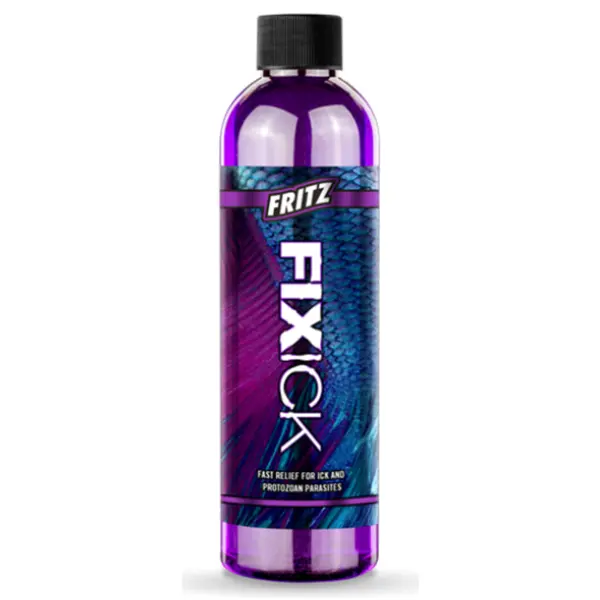
Fritz FixIck 8 oz – Ich and External Protozoan Treatment
Fritz FixIck 8 oz is a fast-acting aquarium medication formulated to treat ich and several other common external protozoan infections in ornamental freshwater and marine fish. Its formaldehyde-free and malachite-green-free formula offers an alternative to traditional ich treatments that may be harsh on sensitive fish tissues.
FixIck contains gentian violet, which gives the medication its recognizable purple color. In addition to targeting external protozoan parasites, the formula provides antibacterial and antifungal activity that may help address certain secondary infections associated with damaged skin and fins.
The convenient six-day treatment schedule makes FixIck suitable for home aquariums, fish rooms, quarantine systems, hospital tanks, aquarium stores, and other ornamental-fish applications. For best results, Fritz recommends treating affected fish in a separate quarantine aquarium.
Key Features
- Treats Ich: Formulated to control Ichthyophthirius multifiliis, commonly called ich or white spot disease
- Targets External Protozoans: Also treats Chilodonella, Trichodina, and Tetrahymena
- Formaldehyde-Free: Does not contain formaldehyde or formalin
- Malachite-Green-Free: Uses gentian violet rather than malachite green
- Antibacterial and Antifungal Activity: May help with certain secondary infections associated with damaged tissue
- Freshwater and Marine Use: Suitable for ornamental freshwater and saltwater fish
- Safe at Full Strength for Scaleless Fish: Fritz states it may be used at the normal dose with scaleless species
- Six-Day Treatment Course: Uses four medication doses and two scheduled water changes
- Concentrated Formula: The 8 oz bottle treats approximately 480 gallons
Product Information
- Brand: Fritz Aquatics
- Product: FixIck
- Size: 8 fl oz / 236 mL
- Item Number: 03976
- Product Type: External parasite, protozoan, antibacterial, and antifungal aquarium treatment
- One Active Ingredient: Gentian violet
- Contains Formaldehyde: No
- Contains Malachite Green: No
- Aquarium Type: Freshwater and marine ornamental-fish systems
- Standard Dose: 5 mL per 10 US gallons
- Approximate Treatment Capacity: 480 gallons
Helps Treat
- Ichthyophthirius multifiliis, commonly called freshwater ich
- External protozoan parasites
- Chilodonella
- Trichodina
- Tetrahymena
- Certain secondary bacterial problems
- Certain secondary fungal problems
FixIck should not be treated as a universal medication for every fish disease. Accurate diagnosis remains important because bacterial infections, fungal infections, flukes, internal parasites, velvet, and water-quality problems may require different treatments.
Common Signs of Ich
- Small white spots resembling grains of salt
- Rubbing or flashing against rocks and decorations
- Clamped fins
- Rapid breathing
- Reduced appetite
- Lethargy or hiding
- Remaining near the water surface or filter outlet
- Increased mucus production
- Irritated skin or gills
Visible white spots are only one stage of the parasite’s life cycle. Fish may appear improved before all parasites in the aquarium have reached a stage vulnerable to medication. Complete the full treatment schedule unless severe stress requires treatment to be stopped.
Before Treatment
- Confirm the aquarium’s actual water volume.
- Test ammonia, nitrite, nitrate, pH, and temperature.
- Remove activated carbon and ion-exchange resins.
- Turn off ultraviolet sterilizers.
- Turn off protein skimmers in marine treatment systems.
- Remove all freshwater and saltwater invertebrates and corals.
- Increase aeration and surface movement.
- Shake the bottle well before every dose.
Fritz recommends gradually adjusting the aquarium temperature to approximately 82–85°F before dosing. The higher temperature accelerates the parasite life cycle and may increase exposure to the medication.
Not every fish species safely tolerates 82–85°F. Research the temperature limits of all fish being treated and increase temperature gradually. Do not raise temperature when the species, oxygen level, disease condition, or treatment protocol makes warmer water unsafe.
Official Six-Day Treatment Schedule
Shake well before every dose.
- Day 1: Add 5 mL, or 1 teaspoon, per 10 US gallons
- Day 2: Add 5 mL, or 1 teaspoon, per 10 US gallons
- Day 3: Perform a 25–30% water change
- Day 4: Add 5 mL, or 1 teaspoon, per 10 US gallons
- Day 5: Add 5 mL, or 1 teaspoon, per 10 US gallons
- Day 6: Perform a 25–30% water change
If symptoms remain, a second complete six-day treatment course may be performed.
When no further symptoms are observed, restore chemical filtration, restart the protein skimmer, resume normal feeding, and gradually return the aquarium to its normal temperature.
Approximate Dose by Aquarium Size
- 5 Gallons: 2.5 mL
- 10 Gallons: 5 mL
- 20 Gallons: 10 mL
- 29 Gallons: Approximately 14.5 mL
- 40 Gallons: 20 mL
- 55 Gallons: Approximately 27.5 mL
- 75 Gallons: Approximately 37.5 mL
- 100 Gallons: 50 mL
These amounts represent one dose. A complete six-day course includes four separate medication doses.
How Much Water Does the 8 oz Bottle Treat?
The 8 oz bottle treats approximately 480 gallons based on the standard dose of 5 mL per 10 gallons.
This figure represents the total volume treated by individual doses. Because one complete course requires four medication doses, the approximate full-course capacity is lower.
For example, one complete six-day course for a 20-gallon aquarium uses approximately 40 mL of medication.
Water Changes During Treatment
Follow the scheduled 25–30% water changes on Days 3 and 6. Fritz advises avoiding additional water changes during treatment when possible.
When an unscheduled water change is necessary because of ammonia, nitrite, contamination, or fish distress, treat the replacement water with enough FixIck to maintain the intended medication concentration.
Water quality emergencies take priority over preserving the treatment dose. Never leave fish in toxic ammonia or nitrite simply to avoid a water change.
Filtration and Equipment During Treatment
- Remove activated carbon
- Remove ion-exchange resins
- Turn off ultraviolet sterilizers
- Turn off protein skimmers
- Keep mechanical and biological filtration operating
- Maintain strong aeration and water circulation
Activated carbon, resins, ultraviolet sterilization, and protein skimming may remove or interfere with the medication. Biological filtration should normally remain operating to help control ammonia and nitrite.
Feeding During Treatment
If the fish continue eating, feed lightly during treatment. Remove uneaten food promptly.
Reduced feeding can help limit ammonia production while fish are stressed and while chemical filtration is unavailable. Do not overfeed in an attempt to encourage a sick fish to eat.
Use with Scaleless Fish
Fritz states that FixIck may be used at full strength with scaleless fish.
Scaleless and sensitive fish should still be monitored closely. Loaches, catfish, eels, rays, and other species may respond differently to medications depending on their condition, water chemistry, oxygen level, and previous exposure.
If severe distress develops, increase aeration and perform a partial water change as appropriate.
Freshwater Aquarium Use
FixIck may be used for ornamental freshwater fish affected by ich and the listed external protozoan parasites.
For best results, move affected fish to a simple quarantine aquarium without substrate, porous decorations, snails, shrimp, or other invertebrates.
A hospital tank makes observation, accurate dosing, cleaning, and water-quality management easier while avoiding unnecessary exposure of the display aquarium.
Marine Aquarium Use
FixIck may be used with ornamental marine fish in a dedicated fish-only quarantine or hospital system.
It is not reef safe and must not be used in an aquarium containing corals, shrimp, crabs, snails, clams, or other marine invertebrates.
Marine white spot disease is caused by Cryptocaryon irritans, not freshwater Ichthyophthirius multifiliis. Diagnosis and treatment protocols may differ. Follow an appropriate marine quarantine protocol and do not assume every white spot is the same disease.
Invertebrate and Coral Warning
FixIck is not safe for use with invertebrates.
Remove the following before treatment:
- Freshwater shrimp
- Marine shrimp
- Snails
- Crayfish
- Crabs
- Clams
- Corals
- Other crustaceans
- Other mollusks
Moving only the invertebrates may not prevent exposure if contaminated water, décor, substrate, or equipment is transferred. A separate hospital aquarium for the fish is generally the safest approach.
Can FixIck Be Combined with Other Medications?
Fritz states that FixIck has no contraindications with its other products and medications.
That does not mean every medication combination is automatically necessary or appropriate. Combining treatments can make it harder to identify the disease, evaluate side effects, maintain oxygen, and determine which medication is helping.
Follow the directions for every product used and avoid mixing treatments from different manufacturers unless compatibility has been confirmed.
Possible Staining
Gentian violet gives FixIck its purple color and may stain aquarium silicone, tubing, porous decorations, ornaments, clothing, counters, or other surfaces.
Use the medication carefully and remove decorative items before treatment when staining is a concern.
A dedicated quarantine aquarium is especially helpful because it reduces the risk of discoloring the main display tank.
What to Do After an Overdose
Observe the fish closely for unusual breathing, loss of balance, severe lethargy, frantic swimming, or other signs of distress.
Increase aeration and perform small partial water changes when needed. Chemical filtration may also be restored when medication removal becomes necessary.
Do not add another dose until the actual water volume and previous amount have been reviewed.
Quarantine Tank Recommendations
- Use a bare-bottom aquarium when possible
- Provide a cycled sponge filter or established biological media
- Add an air stone for additional oxygenation
- Use inert hiding places such as aquarium-safe PVC
- Monitor ammonia and nitrite daily
- Use a separate thermometer
- Keep quarantine tools separate from display-aquarium tools
- Disinfect nets, siphons, and equipment after treatment
Important Treatment Notes
- Shake well before every dose
- Calculate the dose using actual aquarium water volume
- Complete the entire six-day course
- Maintain strong aeration
- Feed lightly when fish are eating
- Remove chemical filtration before treatment
- Turn off UV sterilizers and protein skimmers
- Do not use with invertebrates or coral
- Monitor ammonia, nitrite, temperature, and fish behavior
- Use a quarantine aquarium whenever possible
Frequently Asked Questions
What does Fritz FixIck treat?
It treats ich and external protozoans including Chilodonella, Trichodina, and Tetrahymena. It also provides some antibacterial and antifungal activity.
Does FixIck contain formaldehyde?
No. Fritz FixIck is formaldehyde-free.
Does FixIck contain malachite green?
No. It is malachite-green-free and uses gentian violet as one of its active ingredients.
Why is FixIck purple?
Gentian violet gives the medication its recognizable purple color.
How much FixIck should I use?
Use 5 mL, or 1 teaspoon, per 10 US gallons on Days 1, 2, 4, and 5.
How long is one treatment course?
One complete treatment course lasts six days and includes medication doses on four days plus water changes on Days 3 and 6.
Should I continue dosing every day?
No. Follow the official six-day schedule rather than dosing continuously each day.
Can the treatment be repeated?
Yes. Fritz states that a second six-day course may be performed when necessary.
Does the 8 oz bottle treat 480 gallons?
Yes, it provides approximately 480 gallons of individual-dose treatment capacity. A complete six-day course requires four doses.
Should the aquarium temperature be increased?
Fritz recommends approximately 82–85°F before treatment, but only when that range is safe for the fish being treated.
Should activated carbon be removed?
Yes. Remove activated carbon and ion-exchange resins because they may remove medication from the water.
Should the UV sterilizer be turned off?
Yes. Discontinue ultraviolet sterilization during treatment.
Should the protein skimmer be turned off?
Yes. Turn off the skimmer during treatment and resume use after the course is complete.
Is FixIck safe for scaleless fish?
Fritz states that it may be used at full strength with scaleless fish. Continue monitoring all fish closely.
Is FixIck safe for shrimp and snails?
No. It is not safe for freshwater or marine invertebrates.
Is FixIck reef safe?
No. Do not use it in an aquarium containing coral or other invertebrates.
Can FixIck be used in saltwater?
Yes, with ornamental marine fish in a fish-only quarantine or hospital aquarium.
Can FixIck be combined with other Fritz medications?
Fritz lists no contraindications with its other products and medications. Use combinations only when appropriate and follow every product label.
Can it stain the aquarium?
Yes. The purple medication may stain silicone or certain ornaments and porous materials.
Should fish be fed during treatment?
Feed lightly when the fish are eating and remove uneaten food.
What should I do after an overdose?
Observe the fish for distress, increase aeration, and perform partial water changes as needed.
Is FixIck intended for food fish?
No. It is intended only for ornamental aquarium fish and not for fish used for human consumption.
Available at Tropical Treasures Wyo
Fritz FixIck 8 oz provides a formaldehyde-free and malachite-green-free six-day treatment for ich and several other external protozoan infections in ornamental freshwater and marine fish.
Visit Tropical Treasures Wyo in Cheyenne, Wyoming, to shop Fritz aquarium medications, quarantine supplies, sponge filters, air pumps, test kits, activated carbon, and fish-health products.
Explore More Aquarium Products:
Out of stock
Couldn't load pickup availability
Explore Related Aquarium Products: