
Calico Oranda Goldfish
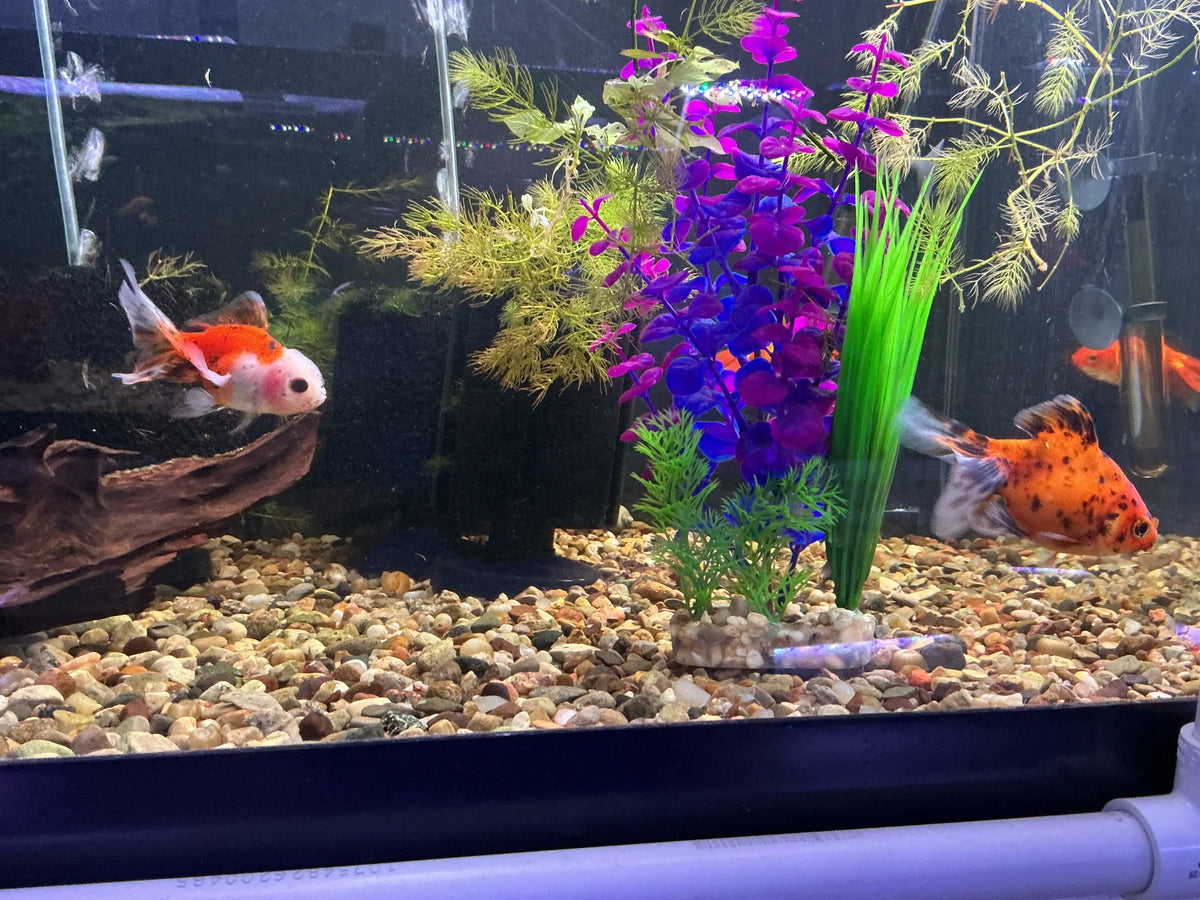
The Calico Oranda Goldfish is a beautiful fancy goldfish known for its rounded body, flowing double tail, distinctive head growth, and colorful mottled pattern. Calico Orandas may display combinations of white, orange, red, black, gray, and blue-toned markings, making every fish unique.
Orandas are slower swimmers than common and comet goldfish and are best kept with other peaceful fancy goldfish that have similar body shapes and swimming abilities. They require a spacious, fully cycled aquarium with strong filtration and regular maintenance.
Key Features
- Colorful calico pattern with individually unique markings
- Rounded fancy-goldfish body shape
- Distinctive head growth known as a wen
- Flowing paired tail fin
- Peaceful and social when kept with compatible goldfish
- Best suited to spacious, well-filtered aquariums
- Not suitable for bowls or very small tanks
Fish Information
- Common Name: Calico Oranda Goldfish
- Scientific Name: Carassius auratus
- Fish Type: Fancy goldfish
- Water Type: Freshwater
- Temperament: Peaceful and social
- Adult Size: Commonly 6–8 inches, with larger growth possible under excellent care
- Recommended Minimum Tank Size: Approximately 30 gallons for one adult, with additional space for each added goldfish
- Swimming Level: All levels
- Diet: Omnivore
- Care Level: Intermediate
Color and Appearance
Calico Orandas have a nacreous or partially translucent scale type that creates a mottled pattern. Individual fish may show combinations of orange, red, white, black, gray, and blue-toned areas.
The pattern and intensity can change somewhat as the fish matures. Lighting, diet, genetics, health, and environment may all affect how the colors appear.
The Oranda Wen
The fleshy growth on the head is called the wen. It develops gradually as the fish matures and may become more pronounced with age.
The wen should appear clean and free of sores, redness, fuzzy growth, trapped debris, or tissue damage. In rare cases, excessive growth can interfere with vision or feeding and may require attention from a veterinarian experienced with fish.
Recommended Water Parameters
- Temperature: Approximately 65–75°F
- pH: Approximately 7.0–8.0
- Water Hardness: Moderate hardness is generally suitable
- Ammonia: 0 ppm
- Nitrite: 0 ppm
- Nitrate: Kept as low as practical through routine water changes
Orandas tolerate cool water, but they do not handle sudden temperature changes well. Stable water quality is more important than reaching one exact temperature or pH value.
Aquarium Setup
Calico Orandas need a spacious aquarium with strong biological and mechanical filtration. Goldfish produce a substantial amount of waste, so the filter should be appropriately sized and maintained without disrupting the aquarium’s beneficial bacteria.
- Use a fully cycled aquarium
- Provide strong filtration with gentle to moderate current
- Leave open swimming space
- Use smooth décor without sharp edges
- Choose sand, larger smooth substrate, or a bare-bottom setup
- Avoid small gravel that may become lodged in the mouth
- Provide good surface agitation and oxygenation
- Perform regular partial water changes
- Use a secure aquarium lid when practical
Tank Size
A young Oranda may appear small when purchased, but it requires room for adult growth and produces considerably more waste than many tropical fish of a similar length.
A tank of approximately 30 gallons for one adult Oranda is a practical starting point. Add approximately 10–20 gallons of additional capacity for each additional fancy goldfish, depending on filtration, maintenance, and the aquarium’s dimensions.
Longer aquariums generally provide more useful swimming room and gas exchange than tall, narrow tanks.
Compatible Tankmates
The best companions are other peaceful fancy goldfish with similar swimming ability and feeding speed.
- Other Oranda goldfish
- Fantail goldfish
- Ryukin goldfish
- Ranchu and Lionhead goldfish
- Black Moor goldfish
- Other compatible double-tail fancy goldfish
Avoid keeping Orandas with fast single-tail goldfish such as commons, comets, and shubunkins in most typical aquariums. Faster fish may outcompete them for food or bump into their slower-moving tankmates.
Avoid tropical species requiring consistently high temperatures, aggressive fish, fin nippers, and any animal small enough to be swallowed.
Feeding
Feed a varied goldfish-specific diet that provides both plant and animal-based nutrition.
- High-quality sinking goldfish pellets
- Soft gel foods formulated for goldfish
- Blanched or softened vegetables such as shelled peas, zucchini, or leafy greens
- Frozen brine shrimp
- Frozen daphnia
- Bloodworms as an occasional food
Sinking foods are often preferred because they reduce the amount of air swallowed at the surface. Feed small portions once or twice daily and offer only what the fish can consume within a few minutes.
Avoid overfeeding. Excess food can quickly reduce water quality and may contribute to digestive problems.
Wen Care and Health Monitoring
Check the head growth regularly for injuries, discoloration, trapped debris, or fungal-looking patches. Maintain clean water and avoid sharp décor that could damage the wen.
Observe the fish daily for:
- Normal swimming and balance
- Steady breathing
- Healthy appetite
- Fins held open rather than tightly clamped
- No sores, fuzzy growth, red streaking, or raised scales
- No persistent floating, sinking, or rolling
Persistent buoyancy problems should not automatically be treated as a swim-bladder infection. Check water quality, diet, constipation, body shape, and other possible causes before medicating.
Routine Maintenance
- Test ammonia, nitrite, nitrate, and pH regularly
- Perform weekly partial water changes based on stocking and nitrate levels
- Vacuum waste from the substrate
- Rinse filter media in removed aquarium water when needed
- Do not replace all filter media at the same time
- Use water conditioner whenever adding tap water
- Maintain stable temperature and avoid sudden changes
Acclimation
- Turn off the aquarium lights.
- Float the unopened transport bag for approximately 15–20 minutes to equalize temperature.
- Gradually add small amounts of aquarium water to the bag or acclimation container.
- Carefully net the fish into the aquarium.
- Avoid pouring transport water into the display tank when practical.
- Leave the lights off for several hours while the fish settles.
Quarantine new goldfish before introducing them to an established aquarium whenever a suitable quarantine system is available.
Important Care Notes
- Do not keep in a bowl.
- Do not add to an uncycled aquarium.
- Provide strong filtration and regular water changes.
- Use smooth décor to protect the body, fins, eyes, and wen.
- Choose tankmates with similar swimming and feeding abilities.
- Avoid sudden temperature or water-chemistry changes.
- Never release goldfish into ponds, lakes, rivers, or local waterways.
Frequently Asked Questions
How large do Calico Oranda Goldfish grow?
They commonly reach approximately 6–8 inches, although larger sizes are possible with excellent care, genetics, and sufficient space.
Can an Oranda live in a bowl?
No. Orandas grow large, produce substantial waste, and require filtration, oxygenation, swimming room, and stable water quality.
Do Orandas need a heater?
A heater may not be necessary in a climate-controlled room if the temperature remains stable within a suitable range. A heater can be useful when the room experiences large or rapid temperature fluctuations.
Can Orandas live with common or comet goldfish?
It is generally better to keep them with other fancy goldfish. Common and comet goldfish are faster swimmers and may outcompete Orandas for food.
Can different fancy-goldfish varieties live together?
Yes, provided they have similar swimming ability, body type, feeding speed, and water requirements.
Will the calico pattern stay the same?
The general calico appearance usually remains, but individual colors and markings can change as the fish matures.
What is the growth on the head?
The head growth is called a wen. It is a normal characteristic of the Oranda variety and becomes more pronounced as many fish mature.
Available at Tropical Treasures Wyo
Calico Oranda Goldfish are available at Tropical Treasures Wyo in Cheyenne, Wyoming, when in stock. Live fish are available for in-store purchase or local pickup only and are not available for shipping.
Explore More Aquarium Products:
Out of stock
Couldn't load pickup availability
Explore Related Aquarium Products: