
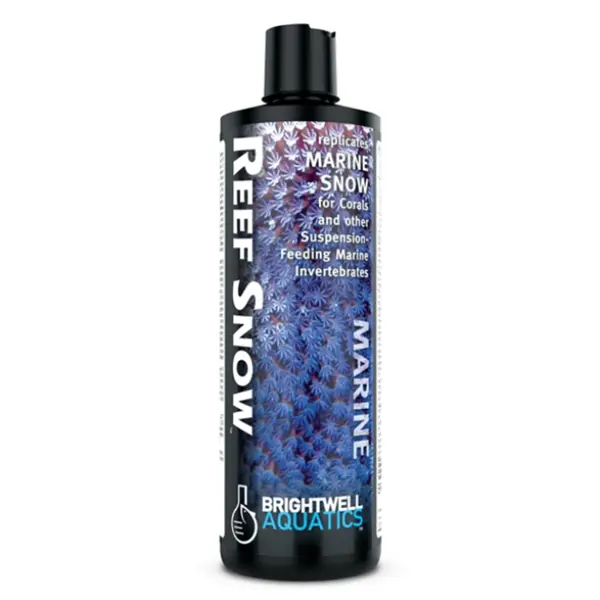
Brightwell Aquatics Reef Snow 250 mL – Marine Snow Coral Food
Brightwell Aquatics Reef Snow 250 mL is a concentrated particulate food formulated for corals, clams, sponges, tube worms, gorgonians, tunicates, and other suspension-feeding marine invertebrates.
Reef Snow replicates the nutritional concept of naturally occurring marine snow by combining carbonate-bound major, minor, and trace elements in aragonite ratios with marine-derived proteins and lipids in ratios associated with coral tissue.
This combination provides organic nutrition for soft-tissue development along with inorganic elements used by calcifying reef organisms. Reef Snow may be broadcast throughout the aquarium or target fed near individual corals and filter feeders.
Key Features
- Marine Snow Substitute: Replicates the nutritional concept of naturally occurring suspended marine particles
- Particulate Reef Food: Formulated for corals and other suspension-feeding marine invertebrates
- Organic & Inorganic Nutrition: Supplies marine-derived proteins, lipids, carbonates, and reef-building elements
- Aragonite-Based Mineral Ratios: Contains calcium, strontium, magnesium, potassium, and carbonate-bound trace elements
- Broad Reef Compatibility: Suitable for stony corals, soft corals, gorgonians, clams, sponges, tube worms, and tunicates
- Target or Broadcast Feeding: May be directed toward individual organisms or dispersed throughout the aquarium
- Nighttime Feeding Option: Ideally offered after aquarium lights have been off and coral feeding tentacles are extended
- No Refrigeration Required: Store in a cool, shaded area for improved shelf life
Product Information
- Brand: Brightwell Aquatics
- Product: Reef Snow
- Size: 250 mL
- Equivalent Size: Approximately 8.45 fl oz
- Product Type: Liquid particulate food suspension
- Aquarium Type: Marine and reef aquariums
- Broadcast Dose: Up to 2.5 mL per 50 US gallons every other day
- Feeding Schedule: Begin conservatively for the first four weeks
- Storage: Refrigeration not required
Recommended For
- SPS and LPS corals
- Zooxanthellate soft corals
- Azooxanthellate soft corals
- Gorgonians and sea fans
- Tridacnid clams and other bivalves
- Tube worms and feather dusters
- Sponges
- Tunicates
- Other suspension-feeding marine invertebrates
- Deep-water and non-photosynthetic reef displays
How Reef Snow Works
In natural marine environments, the term “marine snow” describes small organic and inorganic particles that drift through the water column. These particles may contain biological material, minerals, microorganisms, and other nutrients consumed by suspension-feeding organisms.
Reef Snow recreates this feeding concept using a suspended mixture of:
- Carbonate-bound calcium
- Strontium
- Magnesium
- Potassium
- Major, minor, and trace elements
- Marine-derived proteins
- Marine-derived lipids
The suspended particles deliver nutrition directly into the water column where they may be captured by coral polyps and other filter-feeding organisms.
Broadcast Feeding Directions
Shake the bottle thoroughly before each use.
For the first four weeks, add up to:
2.5 mL per 50 US gallons every other day.
Add Reef Snow to an area of rapid water movement so the suspension disperses throughout the aquarium.
After the first four weeks, the dosage may be gradually increased when necessary according to livestock density, feeding response, nutrient levels, and filtration capacity.
Broadcast Dosage Guide
- 10 Gallons: Approximately 0.5 mL every other day
- 20 Gallons: Approximately 1 mL every other day
- 25 Gallons: Approximately 1.25 mL every other day
- 40 Gallons: Approximately 2 mL every other day
- 50 Gallons: Up to 2.5 mL every other day
- 55 Gallons: Approximately 2.75 mL every other day
- 75 Gallons: Approximately 3.75 mL every other day
- 100 Gallons: Up to 5 mL every other day
- 125 Gallons: Approximately 6.25 mL every other day
- 150 Gallons: Approximately 7.5 mL every other day
- 200 Gallons: Up to 10 mL every other day
Calculate the dose using the aquarium’s approximate actual water volume after accounting for rock, substrate, and equipment displacement.
Target Feeding Directions
Target feeding is Brightwell’s recommended feeding method for directing Reef Snow toward specific corals or filter-feeding organisms.
- Shake the bottle thoroughly.
- Draw a small amount into a clean syringe, pipette, dropper, or length of rigid air tubing.
- Position the feeding device approximately 2–4 inches upstream from the target organism.
- Slowly release the suspension so normal water movement carries the particles toward the feeding tentacles.
- Repeat only as needed according to the number and size of organisms being fed.
Avoid blasting coral tissue with a strong concentrated stream because this may cause the coral to retract rather than feed.
Best Time to Feed
Brightwell recommends feeding Reef Snow at night, preferably after the aquarium lights have been off for one to two hours and the room is dark.
Many corals extend their feeding tentacles more fully after dark, making suspended food more likely to be captured.
Use a dim flashlight when locating and feeding individual colonies. Avoid shining an intense light directly onto corals because they may retract their polyps.
Filtration Instructions
Turn off protein skimming and mechanical filtration before adding Reef Snow.
Wait approximately:
10–15 minutes after feeding before restarting filtration.
This brief pause allows corals and other suspension feeders time to capture the food before it is removed by filter socks, fine pads, or protein skimming.
Keep circulation pumps running unless the flow is so strong that food is immediately carried away from the target organisms. Adequate water movement helps keep the particles suspended and available for feeding.
Use with UV Sterilization and Ozone
Brightwell’s official directions specifically instruct users to pause protein skimming and mechanical filtration for 10–15 minutes. They do not require UV sterilization or ozone to be turned off for extended periods.
Follow the equipment manufacturer’s directions and monitor water quality when feeding heavily.
Maximum Total Liquid Food Guidance
Reef Snow should be treated as food rather than as a water conditioner or filtration additive.
During the first four weeks, Brightwell recommends adding no more than:
5 mL total of all liquid food suspensions per 50 gallons daily.
This total includes Reef Snow and any other liquid plankton, coral food, or suspended feeding product used in the same aquarium.
Adding several foods together without considering the combined amount can increase nitrate, phosphate, bacterial growth, and oxygen demand.
Guaranteed Analysis
- Carbonate: 93,600 ppm
- Calcium: 55,000 ppm
- Strontium: 1,100 ppm
- Magnesium: 150 ppm
- Potassium: 10 ppm
- Protein: Minimum 0.5%
- Lipids: Minimum 0.15%
- Fiber: Minimum 0%
- Moisture: Maximum 70%
Ingredients
Purified water, carbonates of calcium, strontium, magnesium, potassium, and marine-derived proteins and lipids.
Brightwell states that Reef Snow does not contain sugars or sugar derivatives.
Does Reef Snow Improve Water Clarity?
Reef Snow is not primarily a water clarifier and should not be advertised as a product that binds debris for removal.
It is a particulate nutritional suspension. A slight temporary haze may appear after dosing as the inorganic components disperse and begin entering solution.
This temporary cloudiness should dissipate rapidly under normal aquarium conditions.
Will Reef Snow Remove Nitrate or Phosphate?
No. Reef Snow is food and does not directly remove nitrate or phosphate.
Because it contains proteins, lipids, and other nutrients, excessive feeding may increase nitrate or phosphate if more food is added than the aquarium’s organisms can consume and filtration can process.
Monitor aquarium nutrient levels and adjust feeding accordingly.
Can Reef Snow Be Mixed with Other Coral Foods?
Reef Snow may be used in a varied coral-feeding program, but Brightwell recommends limiting the total amount of liquid food suspensions during the first four weeks.
Rather than combining several products at full dosage, consider rotating foods to provide different particle sizes and nutrient profiles.
Always count Reef Snow toward the maximum combined liquid-food amount.
Can Reef Snow Be Used with Amino Acids?
It may be used as part of a reef feeding program that includes amino-acid supplements, but the products should be dosed according to their separate directions.
Reef Snow already contains marine-derived proteins. Additional amino acids should not be added automatically or used as a substitute for water testing and nutrient management.
Does Reef Snow Contain Living Plankton?
No. Reef Snow is a non-living particulate food suspension. It does not contain live phytoplankton, zooplankton, or bacteria.
Aquarists seeking plankton-based foods should select a product designed specifically for the desired particle size and feeding organism.
Does Reef Snow Supply Calcium and Trace Elements?
Reef Snow contains calcium, carbonate, strontium, magnesium, potassium, and trace elements in its particulate nutritional complex.
However, it is primarily a feeding product and should not replace a tested calcium, alkalinity, magnesium, or trace-element supplementation program.
Continue testing major reef parameters and use dedicated supplements when required.
Temporary Cloudiness
Slight cloudiness immediately after feeding is normal and should clear quickly.
If the water remains heavily cloudy, develops a bacterial haze, or produces an unusual odor:
- Reduce or temporarily stop feeding
- Restart protein skimming and mechanical filtration
- Increase aeration and surface movement
- Test ammonia, nitrate, and phosphate
- Perform an appropriate water change when necessary
How Much Does the 250 mL Bottle Treat?
At the introductory broadcast dose of 2.5 mL per 50 gallons:
The 250 mL bottle provides approximately 100 standard doses and treats up to 5,000 cumulative gallons.
Examples include:
- Approximately 100 feedings for a 50-gallon aquarium
- Approximately 50 feedings for a 100-gallon aquarium
- Approximately 200 feedings for a 25-gallon aquarium
Actual product life depends on whether Reef Snow is target fed or broadcast, aquarium size, livestock density, and feeding frequency.
Storage Instructions
Reef Snow does not require refrigeration.
Store the bottle tightly closed in a cool, shaded location away from direct sunlight and excessive heat. Refrigeration may maximize shelf life but is not required.
Shake thoroughly before every use because suspended ingredients may settle during storage.
Avoid Contaminating the Bottle
Do not return a syringe, pipette, dropper, or feeding tube to the bottle after it has contacted aquarium water unless it has first been thoroughly rinsed inside and outside with clean fresh water.
Introducing aquarium water into the container can contaminate the product and encourage decomposition.
Important Feeding Note
Reef Snow is a concentrated food. More food does not automatically produce faster coral growth.
Overfeeding may contribute to:
- Elevated nitrate and phosphate
- Algae growth
- Cyanobacterial growth
- Bacterial cloudiness
- Reduced dissolved oxygen
- Heavy protein-skimmer production
- Accumulated detritus
Begin conservatively, observe feeding response, and increase only when the aquarium can process the additional nutrition.
Frequently Asked Questions
What is Brightwell Reef Snow?
It is a suspended particulate food that replicates the nutritional concept of marine snow for corals and other filter-feeding marine invertebrates.
Is Reef Snow a water clarifier?
No. It is primarily a coral and suspension-feeder food, not a debris-binding clarifier.
What organisms can eat Reef Snow?
It is suitable for many stony corals, soft corals, gorgonians, clams, tube worms, sponges, tunicates, and other suspension feeders.
What is the broadcast dose?
Add up to 2.5 mL per 50 gallons every other day for the first four weeks.
Can Reef Snow be target fed?
Yes. Slowly release it approximately 2–4 inches upstream from the target organism.
When is the best time to feed?
Brightwell recommends feeding after the aquarium lights have been off for one to two hours, when many corals have extended their feeding tentacles.
Should the protein skimmer be turned off?
Yes. Turn it off before feeding and restart it approximately 10–15 minutes later.
Should mechanical filtration be turned off?
Yes. Pause filter socks and other mechanical filtration for approximately 10–15 minutes so the food is not immediately removed.
Should circulation pumps remain on?
Generally, yes. Water movement helps carry suspended food toward corals, although excessively strong flow may be reduced during target feeding.
Will Reef Snow cloud the water?
Slight temporary cloudiness may occur and should dissipate rapidly.
Does Reef Snow remove nitrate or phosphate?
No. It is food and may increase nutrients if overdosed.
Does it contain living plankton?
No. It is a non-living particulate suspension.
Can it be mixed with other coral foods?
It may be used in a varied feeding program, but total liquid food should remain within Brightwell’s recommended limit.
Does Reef Snow replace calcium or alkalinity supplements?
No. It contains mineral components but should not replace test-based reef chemistry supplementation.
Does it require refrigeration?
No. Refrigeration is optional and may extend shelf life.
Is Reef Snow safe for reef aquariums?
Yes, when used as directed and not overfed.
Can Reef Snow be used in freshwater aquariums?
No. It is formulated for marine and reef aquariums.
Available at Tropical Treasures Wyo
Brightwell Aquatics Reef Snow 250 mL provides a suspended blend of marine-derived proteins, lipids, and carbonate-bound reef elements for corals, clams, sponges, tube worms, and other suspension-feeding marine invertebrates.
Visit Tropical Treasures Wyo in Cheyenne, Wyoming, to shop Brightwell Reef Snow, coral foods, reef supplements, feeding syringes, marine test kits, protein-skimmer supplies, and saltwater aquarium products.
Explore More Aquarium Products:
Low stock: 1 left
Couldn't load pickup availability
Explore Related Aquarium Products: