
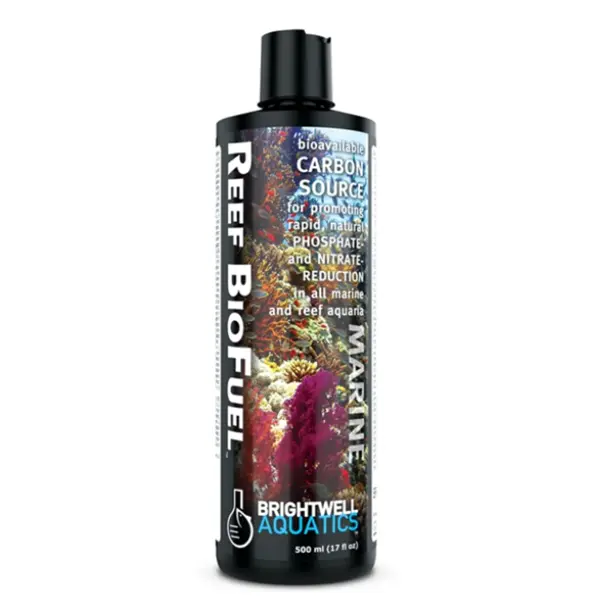
Brightwell Aquatics Reef BioFuel 500 mL – Organic Carbon Source for Marine Aquariums
Brightwell Aquatics Reef BioFuel 500 mL is a concentrated organic-carbon supplement formulated to support biological nutrient control in marine and reef aquariums. It provides a proprietary blend of high-purity carbon sources that encourages the growth and activity of microorganisms involved in the assimilation of nitrate, phosphate, and dissolved organic waste.
As these microorganisms consume available nutrients, their biomass may be exported through protein skimming, mechanical filtration, and normal aquarium maintenance. When used carefully, Reef BioFuel can help maintain lower nitrate and phosphate concentrations, improve water clarity, and reduce conditions that contribute to nuisance algae growth.
Reef BioFuel is not a bacterial culture. It provides food for microorganisms already present in the aquarium or introduced with a compatible bacterial supplement such as Brightwell Aquatics MicroBacter7.
Key Features
- Organic Carbon Source: Supplies a proprietary blend of high-purity carbon compounds for marine microbial communities
- Supports Nutrient Assimilation: Encourages microorganisms that consume available nitrate and phosphate
- Helps Manage Dissolved Organics: Supports microbial processing of organic material in established aquariums
- Promotes Nutrient Export: Bacterial biomass may be removed through protein skimming and mechanical filtration
- Supports Water Clarity: May help reduce dissolved organic material that contributes to yellowing or haziness
- Compatible with MicroBacter7: May be paired with a beneficial microbial supplement for a more controlled nutrient-management approach
- Daily Dosing Formula: Designed for consistent, measured carbon supplementation
- Marine & Reef Use: Formulated for marine fish-only and reef aquariums
- 500 mL Bottle: Suitable for larger systems and ongoing nutrient-control programs
Product Information
- Brand: Brightwell Aquatics
- Product: Reef BioFuel
- Size: 500 mL
- Equivalent Size: Approximately 16.9 fl oz
- Product Type: Organic-carbon supplement
- Aquarium Type: Marine fish-only and reef aquariums
- Primary Function: Supports microbial assimilation of nitrate, phosphate, and organic nutrients
- Ingredients: Purified water and a proprietary blend of ACS reagent-grade organic carbon sources
- Medium- to High-Nutrient Dose: 5 mL per 50 US gallons daily
- Low-Nutrient Maintenance Dose: 5 mL per 100 US gallons daily
Best Used For
- Marine aquariums with measurable nitrate and phosphate
- SPS, LPS, soft-coral, and mixed reef systems
- Heavily stocked or heavily fed marine aquariums
- Supporting controlled biological nutrient reduction
- Maintaining established low-nutrient reef systems
- Reducing conditions that favor nuisance algae
- Supporting clearer aquarium water
- Use alongside MicroBacter7
- Systems equipped with effective protein skimming
- Manual or carefully calibrated automated dosing
How Reef BioFuel Works
Microorganisms require carbon, nitrogen, and phosphorus for growth. In many marine aquariums, nitrate and phosphate are present in excess while biologically available organic carbon is limited.
Reef BioFuel supplies a controlled carbon source that encourages heterotrophic and other nutrient-assimilating microorganisms to consume available nitrogen and phosphorus as they reproduce.
The nutrient-containing microbial biomass can then be removed through:
- Protein skimming
- Filter socks
- Fine mechanical filter pads
- Filter floss
- Substrate and detritus removal
- Routine aquarium maintenance
This process is commonly called organic-carbon dosing or biological nutrient assimilation.
Medium- to High-Nutrient Systems
For aquariums with medium to high nitrate, phosphate, dissolved organic material, or visible nutrient-related issues:
Add 5 mL, or one capful, per 50 US gallons daily.
This is approximately two drops per gallon.
Test nitrate and phosphate regularly. When the aquarium reaches the desired nutrient range and concentrations remain stable, switch to the lower maintenance dosage.
Medium- to High-Nutrient Dosage Guide
- 10 Gallons: Approximately 1 mL daily
- 20 Gallons: Approximately 2 mL daily
- 25 Gallons: Approximately 2.5 mL daily
- 40 Gallons: Approximately 4 mL daily
- 50 Gallons: 5 mL daily
- 55 Gallons: Approximately 5.5 mL daily
- 75 Gallons: Approximately 7.5 mL daily
- 100 Gallons: 10 mL daily
- 125 Gallons: Approximately 12.5 mL daily
- 150 Gallons: 15 mL daily
- 200 Gallons: 20 mL daily
Stable Low-Nutrient Systems
For established aquariums that have already reached a low and stable nutrient condition:
Add 5 mL, or one capful, per 100 US gallons daily.
This is approximately one drop per gallon.
With continued testing, some aquariums may maintain suitable conditions with the dosage or frequency reduced by as much as 50%.
Low-Nutrient Maintenance Dosage Guide
- 10 Gallons: Approximately 0.5 mL daily
- 20 Gallons: Approximately 1 mL daily
- 25 Gallons: Approximately 1.25 mL daily
- 40 Gallons: Approximately 2 mL daily
- 50 Gallons: Approximately 2.5 mL daily
- 55 Gallons: Approximately 2.75 mL daily
- 75 Gallons: Approximately 3.75 mL daily
- 100 Gallons: 5 mL daily
- 125 Gallons: Approximately 6.25 mL daily
- 150 Gallons: Approximately 7.5 mL daily
- 200 Gallons: 10 mL daily
After Increasing Bioload or Changing Filtration
During a significant change in biological filtration or after increasing the aquarium’s livestock load, Brightwell recommends:
One drop per 50 US gallons daily for one week.
After the one-week support period, return to the normal low-nutrient maintenance dosage.
This temporary dosing approach may be useful after:
- Adding new fish
- Increasing feeding
- Replacing or cleaning biological filter media
- Moving the aquarium
- Restarting a system after an extended power interruption
How Much Does the 500 mL Bottle Treat?
The 500 mL bottle contains approximately 100 standard 5 mL capfuls.
- Medium- to High-Nutrient Dose: Approximately 5,000 cumulative gallon-doses
- Low-Nutrient Maintenance Dose: Approximately 10,000 cumulative gallon-doses
For example, the bottle provides approximately:
- 100 daily high-nutrient doses for a 50-gallon aquarium
- 50 daily high-nutrient doses for a 100-gallon aquarium
- 100 daily maintenance doses for a 100-gallon aquarium
Directions for Use
- Test nitrate and phosphate before beginning carbon dosing.
- Estimate the aquarium’s actual water volume after accounting for rock, sand, and equipment displacement.
- Shake the bottle well before use.
- Measure the appropriate dose for the aquarium’s nutrient condition.
- Add the dose to a high-flow area of the aquarium or sump.
- Maintain strong circulation and aeration.
- Monitor nitrate, phosphate, water clarity, livestock behavior, and protein-skimmer performance.
- Reduce the dose when the aquarium reaches the desired nutrient range.
Protein Skimmer Use
An efficient protein skimmer is strongly recommended when carbon dosing because it helps export bacterial biomass and processed organic material.
Brightwell recommends that users may turn off protein skimming for approximately two to six hours after adding Reef BioFuel. This can allow microorganisms additional time to assimilate the added carbon and available nutrients before being exported.
The product may also be used without turning the skimmer off. Keeping the skimmer operating continuously may be preferable in aquariums with limited oxygenation, heavy livestock loads, or a history of bacterial blooms.
When temporarily pausing the skimmer:
- Keep normal water circulation running
- Maintain strong surface agitation
- Use a timer to ensure the skimmer restarts
- Do not leave the skimmer off indefinitely
- Monitor fish for rapid breathing or oxygen stress
Use with MicroBacter7
Reef BioFuel may be used with Brightwell Aquatics MicroBacter7 as part of a controlled microbial nutrient-management program.
- MicroBacter7: Introduces beneficial non-pathogenic microorganisms and natural enzymes
- Reef BioFuel: Supplies organic carbon that supports microbial growth and nutrient assimilation
Begin conservatively when using both products. Combining bacterial inoculation with carbon dosing may increase microbial activity more rapidly than using either product alone.
Maintain strong aeration and test nitrate and phosphate frequently.
Does Reef BioFuel Contain Bacteria?
No. Reef BioFuel is an organic-carbon supplement and does not contain the bacterial culture supplied by MicroBacter7.
It feeds microorganisms already present in the aquarium or added through a separate bacterial supplement.
Does Reef BioFuel Reduce Nitrate?
Reef BioFuel supports microorganisms that assimilate nitrogen as they grow. This can gradually reduce measurable nitrate when:
- A suitable microbial community is present
- Phosphate is also available
- Carbon is the limiting nutrient
- Bacterial biomass is effectively exported
- Nutrient input does not exceed removal
It does not chemically bind or instantly detoxify nitrate. Results develop through biological activity and vary among aquariums.
Does Reef BioFuel Reduce Phosphate?
Microorganisms require phosphorus as well as carbon and nitrogen. Reef BioFuel can therefore support phosphate assimilation as bacterial biomass increases.
Phosphate reduction may slow or stop when nitrate becomes too low, and nitrate reduction may slow when phosphate becomes deficient.
Carbon dosing works best when both nutrients remain available in balanced, measurable amounts.
Avoid Driving Nutrients to Zero
Do not intentionally maintain a reef aquarium completely free of measurable nitrate and phosphate. Corals, zooxanthellae, microorganisms, and other reef organisms require nitrogen and phosphorus.
Excessive nutrient reduction may contribute to:
- Pale or bleached corals
- Reduced polyp extension
- Tissue recession
- Dinoflagellate outbreaks
- Cyanobacterial imbalance
- Slowed coral growth
- Reduced macroalgae health
Use reliable tests and reduce or pause dosing before nitrate or phosphate becomes undesirably low.
Can Reef BioFuel Cause Cloudy Water?
Yes. Excess carbon dosing may cause rapid bacterial reproduction that appears as white or milky water.
A bacterial bloom may also create slippery films on aquarium surfaces or unusually heavy protein-skimmer production.
If cloudiness develops:
- Stop dosing Reef BioFuel.
- Increase aeration and surface movement.
- Keep the protein skimmer operating.
- Install clean mechanical filtration.
- Monitor fish for rapid breathing.
- Perform an appropriate water change if oxygen stress or severe cloudiness occurs.
- Resume only at a substantially reduced dose after the system stabilizes.
Carbon Dosing and Dissolved Oxygen
Bacterial growth and respiration consume oxygen. The risk of low dissolved oxygen increases when carbon is added faster than the aquarium can process it.
Use additional caution in:
- Heavily stocked aquariums
- Warm water
- Systems with weak surface agitation
- Aquariums without a protein skimmer
- Systems with bacterial cloudiness
- Aquariums receiving other carbon sources
- Systems with nighttime oxygen limitations
Strong aeration and dependable skimmer operation are essential safeguards during organic-carbon dosing.
Can Reef BioFuel Be Used Without a Protein Skimmer?
Reef BioFuel can biologically support nutrient assimilation without a skimmer, but nutrient export and oxygen management become more difficult.
Without a protein skimmer, bacterial biomass must be removed through mechanical filtration, water changes, detritus removal, and other export methods.
Use a lower dose, maintain strong aeration, and watch carefully for cloudy water or bacterial films.
Use with Mechanical Filtration
Filter socks, polishing pads, and filter floss can capture microbial aggregates and suspended organic material produced during carbon dosing.
Clean or replace mechanical filtration regularly. Leaving trapped bacterial biomass in the filter allows it to decompose and release nutrients back into the aquarium.
Use with UV Sterilization
Brightwell’s Reef BioFuel directions focus primarily on protein-skimmer management and do not require UV sterilization to be turned off.
UV may reduce some free-floating microorganisms, but most aquarium bacteria live on rock, substrate, filter media, and other surfaces.
Customers using Reef BioFuel with MicroBacter7 should follow the separate UV instructions for MicroBacter7 when the bacterial supplement is dosed.
Use with Ozone
Ozone can influence dissolved organics and suspended microbial populations. Carbon dosing may still be used in ozonated systems, but the aquarium’s response should be monitored carefully.
Follow the ozone equipment manufacturer’s safety instructions and monitor oxidation-reduction potential when applicable.
Use with Automated Dosing Pumps
Reef BioFuel may be added with a properly calibrated dosing pump when daily supplementation is required.
Before automated use:
- Confirm the daily dose manually
- Calibrate the dosing pump accurately
- Use tubing compatible with organic solutions
- Prevent siphoning or accidental continuous dosing
- Inspect the dosing container and tubing regularly
- Recheck nitrate and phosphate frequently
Automatic dosing should not continue unchanged when nutrients decline or livestock responses change.
Use with Other Carbon Sources
Do not combine Reef BioFuel casually with vodka, vinegar, sugar, biopellets, or another commercial carbon source.
Multiple carbon inputs can make the total dose difficult to calculate and increase the risk of bacterial blooms, oxygen depletion, and excessive nutrient reduction.
When changing from another carbon source, reduce or discontinue the previous method and transition gradually.
Does Reef BioFuel Control Nuisance Algae?
Lowering excessive nitrate and phosphate may make aquarium conditions less favorable for nuisance algae.
Reef BioFuel is not an algaecide and does not directly kill existing algae. Effective algae control may also require:
- Manual removal
- Reduced overfeeding
- Improved mechanical filtration
- Regular detritus removal
- Purified source water
- Appropriate herbivores
- Lighting adjustments
- Correction of phosphate stored in rock or substrate
Does Reef BioFuel Improve Coral Color?
Maintaining suitable nutrient levels may support normal coral coloration and growth, but Reef BioFuel does not directly color corals or guarantee improved appearance.
Coral coloration is also influenced by:
- Lighting intensity and spectrum
- Nitrate and phosphate balance
- Alkalinity stability
- Calcium and magnesium
- Trace nutrients
- Feeding
- Water flow
- Temperature and salinity
- Pests and disease
Overly aggressive nutrient reduction can make coral coloration worse rather than better.
Use in New Aquariums
Reef BioFuel should not be treated as a product that instantly cycles a new aquarium. It supplies carbon but does not provide the complete nitrifying bacterial population needed to establish biological filtration.
New systems should be cycled with an appropriate bacterial culture and ammonia source before beginning aggressive nutrient reduction.
Carbon dosing is generally more useful after the aquarium has developed an established microbial community and measurable nutrient input.
Storage and Handling
Keep the bottle tightly closed and store it in a cool location away from direct sunlight and excessive heat.
Prevent aquarium water, food, dirty syringes, or contaminated dosing tubing from entering the bottle.
Keep out of reach of children. Reef BioFuel is not intended for human consumption.
Dosing Tips
- Test nitrate and phosphate before beginning
- Shake well before use
- Calculate dosage from actual system water volume
- Begin conservatively in mature reef aquariums
- Maintain strong aeration and circulation
- Use an efficient protein skimmer whenever possible
- Do not combine multiple carbon sources without a controlled plan
- Reduce the dose as nitrate and phosphate decline
- Stop dosing if a bacterial bloom develops
- Do not attempt to force nutrients to zero
Important Aquarium Care Note
Reef BioFuel is a concentrated organic-carbon source. It is not a water conditioner, bacterial starter, nitrate-binding resin, phosphate remover, medication, or coral food.
Gross overdosing will not improve results and may reduce water quality, cause bacterial cloudiness, and lower dissolved oxygen.
Carbon dosing does not replace water changes, protein skimming, mechanical-filter cleaning, detritus removal, appropriate feeding, or regular aquarium testing.
Nitrate and phosphate should remain balanced and available at suitable concentrations for the aquarium’s corals and other photosynthetic organisms.
Frequently Asked Questions
What is Brightwell Reef BioFuel?
It is a concentrated organic-carbon supplement that supports microbial assimilation of nitrate, phosphate, and organic nutrients in marine aquariums.
Does Reef BioFuel contain bacteria?
No. It supplies carbon to microorganisms already in the aquarium or added with a separate bacterial product.
How much should I use in a high-nutrient aquarium?
Use 5 mL per 50 gallons daily while monitoring nitrate and phosphate.
What is the low-nutrient maintenance dose?
Use 5 mL per 100 gallons daily. The dose or frequency may later be reduced by up to 50% when testing shows that less is sufficient.
Should Reef BioFuel be shaken before use?
Yes. Shake the bottle well before dosing.
Does Reef BioFuel reduce nitrate?
It supports microorganisms that assimilate nitrogen, which may gradually lower nitrate when aquarium conditions are suitable.
Does Reef BioFuel reduce phosphate?
It supports microbial uptake of phosphorus as bacterial biomass grows. Phosphate reduction depends on nutrient balance and effective export.
Is Reef BioFuel reef safe?
Yes, when used as directed and adjusted according to nitrate, phosphate, oxygenation, and livestock response.
Do I need a protein skimmer?
A skimmer is strongly recommended because it exports bacterial biomass and helps maintain oxygenation.
Should the protein skimmer be turned off?
Brightwell states that it may be turned off for two to six hours after dosing, but the product can also be used with the skimmer operating continuously.
Can Reef BioFuel cause cloudy water?
Yes. Excessive dosing may cause a bacterial bloom and cloudy or milky water.
What should I do if the water becomes cloudy?
Stop dosing, increase aeration, keep the skimmer operating, use clean mechanical filtration, and monitor livestock closely.
Can Reef BioFuel lower dissolved oxygen?
Excess microbial growth can increase oxygen consumption. Strong aeration and careful dosing are important.
Can it be used with MicroBacter7?
Yes. MicroBacter7 supplies microorganisms, while Reef BioFuel supplies an organic carbon source. Begin conservatively when combining them.
Should UV be turned off?
Reef BioFuel’s directions do not require UV to be turned off. Follow MicroBacter7’s separate instructions when dosing that bacterial product.
Can Reef BioFuel be used with an automatic dosing pump?
Yes, provided the pump is accurately calibrated and dosing is adjusted according to regular nutrient testing.
Can it be combined with vodka, vinegar, or biopellets?
Combining carbon sources can increase overdose risk and is not recommended without careful calculation and monitoring.
Does Reef BioFuel kill algae?
No. It may help reduce nutrients that contribute to algae growth, but it does not directly kill algae.
Will it improve coral coloration?
Balanced nutrient control may support normal coral appearance, but coloration is affected by many factors and is not guaranteed.
Should nitrate and phosphate be reduced to zero?
No. Corals and other photosynthetic organisms require measurable nitrogen and phosphorus.
Is Reef BioFuel suitable for freshwater aquariums?
No. It is formulated for marine and reef aquarium nutrient management.
Does Reef BioFuel replace water changes?
No. It supports biological nutrient processing but does not replace routine water changes and physical maintenance.
Available at Tropical Treasures Wyo
Brightwell Aquatics Reef BioFuel 500 mL provides a concentrated organic-carbon source for supporting microbial nitrate, phosphate, and organic-waste assimilation in marine and reef aquariums.
Visit Tropical Treasures Wyo in Cheyenne, Wyoming, to shop Brightwell Aquatics Reef BioFuel, MicroBacter7, marine nitrate and phosphate tests, protein-skimmer supplies, filter socks, mechanical filter media, and reef aquarium products.
Explore More Aquarium Products:
Low stock: 2 left
Couldn't load pickup availability
Explore Related Aquarium Products: